Sunday, February 25, 2007

Rudolph the Long-Nosed Antelope

A few weeks ago, Greg1 suggested some animals about which I could possibly write. I thank you profusely for your suggestions, and urge other people to send their ideas. I would never have thought to look at some endangered antelope to see if it was ugly.

Image from CITES
Image from CITES

Yes, this is the Saiga Antelope2 (Saiga tatarica), which I mentioned in the footnote of the last post; it’s the one that looks like that informant from Star Wars3. They are more than just their big nose, but it’s big and ugly enough to make one ask: Why the nose?

It took a bit of searching to find an answer. ARKive states that the gigantic schnoz is used for warming the cold air of the winter, and for keeping the dust out in the dry summers. I don’t just have to take their word for it, since this article (which also has some rockin’-cool skull images) also mentions it (I think):

The enlarged nasal vestibule, lateral vestibular recess, repositioned basal fold, and septal cavernous mass are regarded as a coordinated adaptation to dusty habitats, such that nasal air flow can be dynamically regulated allowing for collection of inspired particulates in the vestibule and thus cleansing of air destined for the lungs.
Moving away from the nose (seriously, stop staring), the Saiga lives in Eastern Europe and Western Asia, wintering in the deserts and summering in the dry steppes, moving up to 70 miles per day during their migration north in April and south in November. Rutting happens at their wintering sites, where males gather up harems of females and fight fiercely for them. I’m sure many of you have heard that most animal fights are ritualistic and don’t end in death—most. The male mortality rate of the Saiga can reach 90%, much of that due to exhaustion. Those who survive start the trek back north to the steppes.

CITES has banned trade of Saiga parts, and hunting is banned in their range, but overgrazing, as domestic ungulates are introduced, is thought to be a major threat to the Saiga. The horns are considered aphrodisiacs, so poaching is rife. Under the Soviet Union, major controls were put in place that boosted its numbers, but since the collapse, poaching has come back into play. Sine only the males have horns, and have their own problems, this leads to a very female-heavy population, who don’t have enough males to inseminate them. The males are already dying from exhaustion; we shouldn’t add sexual exhaustion to the mix.

1See, if you suggest an animal, I'll link to you.
2The name is almost a misnomer. Taxonomists have argued whether these are antelopes or sheep. Current thought says that they’re an intermediate, halfway between the two.
3The first one, IV (not to be confused with the fourth one, I)

Sunday, February 18, 2007

Does Whatever A Spider Can

After the post on most of the arachnids on the US List, I couldn’t help but look at the non-cave spider. I will get to your suggestions1, but I’m still trying to spread the love to all the taxa2.
Image from Animal Diversity Web

The Spruce-fir Moss Spider (Microhexura montivaga) is a small (3-5 mm) member of the tarantula group. They live above 5,400 feet in the Appalachian Mountains in North Carolina and Tennessee, where it can get colder and snowier than many spiders mind to handle. The prominent vegetation of these areas (surprise, surprise) is Frasier fir and red spruce, and the spiders inhabit the mosses found in association with those trees.

Like most tarantulas, the moss spider is an ambush predator, feeding on arthropods smaller than itself. This does not mean they don’t make webs; they weave tunnel-shaped nests between the rock and the moss. After mating, the males make a run for it, since many female spiders find the male to be a readily available protein. Females stay with the egg sac until it hatches, and will carry it around if she’s disturbed. When the spiderlings3 hatch, they disperse to other areas by a process called ballooning4, where the babies extend a strand of silk to be caught by the wind.

They’re not terribly sure why the spruce-fir moss spider is endangered, though there are some good ideas. The primary suspect: the balsam wooly adelgid, an invasive insect that attacks fir trees, which mess up the spider’s habitat. There’s a possibility of throwing out the baby with the bathwater, as it’s possible that the insecticide used to kill these tree-borers could also be killing the spiders.

The Louisville Zoo is working on a breeding program, though there are no cute little spiderlings yet. I’m finding enough information that I know someone is worried about the species. Heck, someone even named a debugging program after it.

1I’m really looking forward to learning more about the antelope that looks like something out of Star Wars.
2There are two lichens that I might have to write something about to spread the love even further.
3This is the actual term for a baby spider. Another Cute Endangered Ugly Thing design?
4Popularized by the animated version of Charlotte’s Web.

Sunday, February 11, 2007

Heroes in a Soft Shell

I want to thank people for beginning to send in suggestions. I will get to them soon enough, but I want to step away from mammals for a bit. I had thought of the Ohio soft-shelled turtles, and encountered the matamata online, but neither was endangered. Every time I see a perfectly ugly animal that is not endangered, I get a little disappointed, and then feel bad for wishing this animal was endangered just so I could write about it.

Image from Reptiles and Amphibians of Europe

The Nile Soft-shelled turtle (Trionyx triunguis), also known as the African Softshell turtle, lives up to its name well. It lives in slow-moving freshwater rivers in northern Africa and along the Mediterranean, one such being the Nile, though the populations in Turkey are the largest. The shell on these turtles, and others like it, is in fact, soft. They rely more on stealth for protection and hunting than their hard-shelled brethren. They will lie, covered in sand with just their snout sticking out of the substrate, as both a protective and ambush method.

Not that the Nile softshell is picky about what it eats. They hunt fish and snails, mostly, and some aquatic arthropods, amphibians and reptiles. That’s only what they’ll hunt. They’ll eat palm nuts and dates, and there’s apparently a report of four of them feeding on a goat carcass. Unlike many of the soft-shelled turtles, the Nile softshell will live in the brackish water found at mouths of the rivers it inhabits. Nests are dug in banks along the river, or, for the ones closer to sea, on the sandy beaches.

Much like the solenodon, these took quite some time after being described in the 1800s to be rediscovered in the 1970’s. Their population is terribly fragmented, so there is little genetic interchange between sub-populations. Major threats to the Nile soft-shelled turtle include habitat destruction, as tourists develop where the turtles nest; issues with fisheries, since they are both caught in the nets, and will actively attack the nets to get at the fish; and human disturbance, such as boat traffic, affects their breeding habits.

There are certainly people worried about the Nile soft-shelled turtle, as I found conservation reports, and many scientific papers on their habits and phylogenies. The issue is finding them on broad enough topics for me to give you a picture of their lifestyle.

Sunday, February 04, 2007

Solenodon is Gonna Get You

An anonymous contributor from a previous blog suggested I take a look at the Cuban Solenodon. I did, and what I found was not pretty. Perfect. While I did just write about a mammal, I have to keep the viewers happy. That, and I don’t know where to look for my next post. Dear readers, please follow the example held by this nameless person, and give me suggestions for ugly things for me to relate to the world.


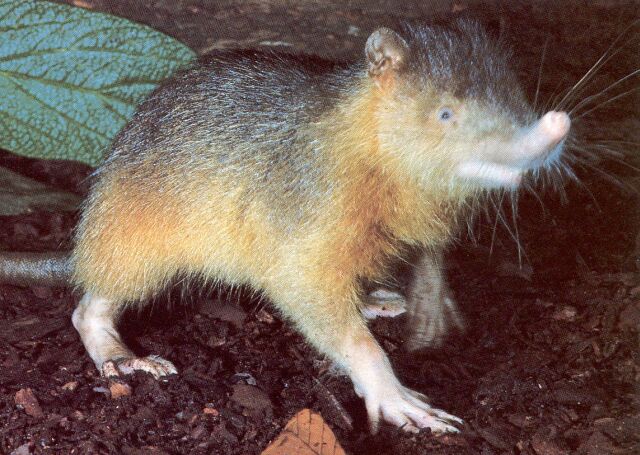
Image from Encyclopaedia Britannica
The Cuban Solenodon (Solenodon cubanus) is a shrew-like insectivore whose look reminds me most of a scaled down (to 6 or 7 inches) Rodent Of Unusual Size from The Princess Bride. They hail from the southeastern end of Cuba1, where they inhabit the dense, moist forests. They are nocturnal, relying on their sense of touch and their long snout to hunt.

They use toxic saliva to kill. Yes, the solenodon is a venomous mammal2, and its bite is used to subdue their prey—various arthropods. It is also used as defense against potential predators like snakes and birds of prey. Their name means “channel tooth,” which is likely the way to channel the venom, though I can’t find a source for that. Solenodons have an obviously positive impact on people, since their insectivorous habits help remove pests, and they are unlikely to hurt anyone unless you try to get bitten.

The solenodon is another island species that has been destroyed by the introduction of various carnivorous mammals. While rats, cats, and dogs have shown up in past posts, mongooses (mongeese?) have been introduced to Cuba, and destroyed the population. Enough that they were thought to be extinct, since none were found between 1890 and 1975.

Conservation is minimal, mostly relying on the fact that much of their habitat is within two Cuban National Parks.

1There also exists the Hispanolan solenodon, which is very similar to the Cuban variety, only on a different Caribbean Island. And cuter.
2I swore I had heard that the platypus, with a small spur, was the only venomous mammal. I was wrong.

Sunday, January 28, 2007

Davey and Goliath

A while ago, I mentioned that frogs tend to be too cute to be mentioned here. I was mostly driven to this comment by the existence of the Golden Mantella, a tiny, big-eyed yellow frog, which happens to be critically endangered. My parents suggested that there might be, in fact, an ugly frog out there. I looked on the U.S. Endangered List and found something called a Goliath frog.

Goliath frog and watch--Image from Enyclopaedia Britannica
Image from Enyclopaedia Britannica

At 13 inches and 7 pounds, Conraua goliath lives up to its name. It is found in Equatorial Guinea and Cameroon. They tend to eat arthropods and fish, though they will eat anything smaller than their head that can be easily caught. ARKive has a picture of a Goliath frog eating... a Goliath frog. I didn’t find any indication of the frequency of cannibalism, though this article mentions it. It also talks about a 10-foot leap, but “it can only make three or four such bounds before giving in to exhaustion.” That is to say, they’ll be 30 feet away from you before they get tired.

The Goliath frogs, despite their large size, are difficult to find. The Cameroon Government allows the export of 300 individuals, though good hunters can find only a few dozen a year1. This does hint at the first cause of their endangerment: there’s a lot of meat on a 7 pound frog; they have been hunted for bush meat. They are exported for pet trade as well, but since they breed poorly in captivity, this collection does not help their numbers.

Scientists are trying to find more about their habits, and there was an extensive PIT-tagging project in 2004. However, legal aspects will have to come into play, since the Goliath frog is still unprotected.

1Though, for proper multiplication, it would be nice to have the number of good hunters around Cameroon.

Sunday, January 21, 2007

AYE Aye aye aye! (begin Crazy Train)

I’ve been mulling over this Endangered Ugly Thing since the inception of this blog. Is it cute or hideous1? Well, it was originally classified as a rodent, and the native Malagasy consider it a portent of death, so we welcome the world’s largest nocturnal lemur to Endangered Ugly Things.

Image from BBC


The aye-aye (Daubentonia madagascariensis) has massive eyes and ears for better managing its nightlife. Like all lemurs2, they live in the dense jungles of Madagascar. Unlike the rest of the lemurs, their hands are long and spindly, with a skinny, elongated middle finger (I can’t find the average length, though). Aye-ayes tap the wood with this finger and listen for the correct echo with their huge ears, and gnaw a hole in the wood with their rat-like teeth before they begin rummaging for the grubs with their twiggy middle finger, filling much the same role as our woodpeckers. They will also eat fruit or vegetable material (or eggs), extracting the pulp using this finger3.

These raccoon-sized lemurs are usually solitary, moving along the treetops. Males’ home ranges are large (100-200 hectares) and encompass many females’ ranges. They tend to be curious and unafraid of people. Territories are marked by scents. When breeding season comes around, the females scream out to advertise their availability. The babies are weaned for about 7 months, and the females mate every three years.

Habitat destruction is the major threat to the aye-ayes, along with just about everything living in Madagascar. When agriculture invades their usual haunts, they will feed on the fruits, such as coconuts, becoming pests. Also, as mentioned in the beginning of the post, many Malagasy natives believe them to be omens of death, or other like portent, so they get killed on sight.

Many of the places aye-ayes live are protected, helping to save their habitat, and they are being introduced into other areas. There is a law against killing them, but it is not well enforced. Breeding programs exist at various zoos and the Duke University Lemur Center. But be warned, the little aye-ayes are even uglier.

1I get the feeling that the guys at Ugly Overload get this issue all the time.
2Which, appropriately enough, comes from the Latin “spirits of the night,” at least according to Wikipedia.
3ARKive has tons of wonderful pictures and videos, and it looks so much creepier when it’s moving.

Monday, January 15, 2007

Condor of Happiness

The following post was written by my girlfriend. She volunteered to write an ugly bird post, and I was more than glad to let her.
--Garfman

For the most part, birds are not considered to be terribly ugly. After all, they tend to be the object of many an extended metaphor involving ethereal instances such as flight and dazzling color elements. However, these correlations only extend to the surface of the animal. Humans mostly attracted to avian organisms with distinctions such as “songbird”, birds noted for their song or “parrots/parakeets,” which are noted for their plumage and ability to cross the border of “human speech.”

Never mind the sanitation officers of the avian world.

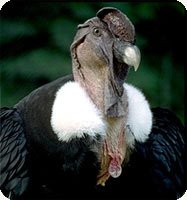
Image from National Zoo

Condors serve the biological niche required of them by being scavengers. The Andean Condor (Vultur gryphus1) is perhaps the most perfect example because they are known for being traditional scavengers. Their feet have blunt claws, unlike their cousin, the California condor (which has sharper claws and is known to hunt). In fact, the only time they hunt is in extreme cases, where they stalk, at a minimum, newborn or sickly creatures. On the menu for the average condor are assorted ungulates, sea bird eggs, and various rodents.

With a hideous head-crest and a fleshy comb on the males that rivals the common rooster, they can be considered rather “ugly.” However, these magnificent birds have the unique distinction of being one of the largest flying birds with an 11-foot wingspan and a body length of 43-51 inches. It is the only New World vulture/condor that is sexually dimorphic; the female is smaller at 17-24 pounds, sport garnet colored eyes, and lack a comb, while the male is 24-33 pounds with brown eyes. Both birds have rather “boring” plumage—black with white patches on the wings and neck.

They mate for life (huzzah) and lay a single egg per term directly on rock ledges or the cave. The incubation period lasts 54-58 days and the chick is raised for 1 ½ to 2 years. Due to the fact that they are sexually viable at six years, breeding and repopulation efforts face the issue of time.

Andean Condors inhabit South America (the Andes Mountains of South America from Venezuela to the islands of Tierra del Fuego in the Strait of Magellan), and due to hunting and poisoning, less than 3,000 exist in the wild. They used to frequent the northern portion, but there are as few as 75 birds in the area. Condors are not evasive and do not threaten farms—although it is due to misconceptions that these birds were killed to the point of being threatened. Conservation efforts do exist, however. Most zoos have breeding programs and raise condor chicks using a “puppet method” with the purpose of releasing them into the wild for repopulation. Personally, I would recommend viewing the webpage of the Cleveland Metroparks Zoo; they offer clear information and are very accessible to those of the younger age (side note: the younger one is aware, the more likely one will develop empathy for all living things).

1Being an English major, I had to include this bit of language eye candy: “The scientific name comes from the Latin words vultur and vello, meaning to pluck or tear and refers to its feeding habits and gryphus means a griffon and refers to the hooked bill. The common name refers to the bird’s range in the Andes Mountains.”