Showing posts with label Human Disturbance. Show all posts

Saturday, July 23, 2011

Beware! The Blob

I’ve tried to write about the Blobfish (Psychrolutes marcidus) before, but gave up due to lack of information. It was first suggested to me about a year and a half ago, and has been suggested a few times since then. I think I’ve found enough information about it and its close relatives to do it justice. First things first, though: the Blobfish does not look like a deflated Ziggy.

Image from the Telegraph


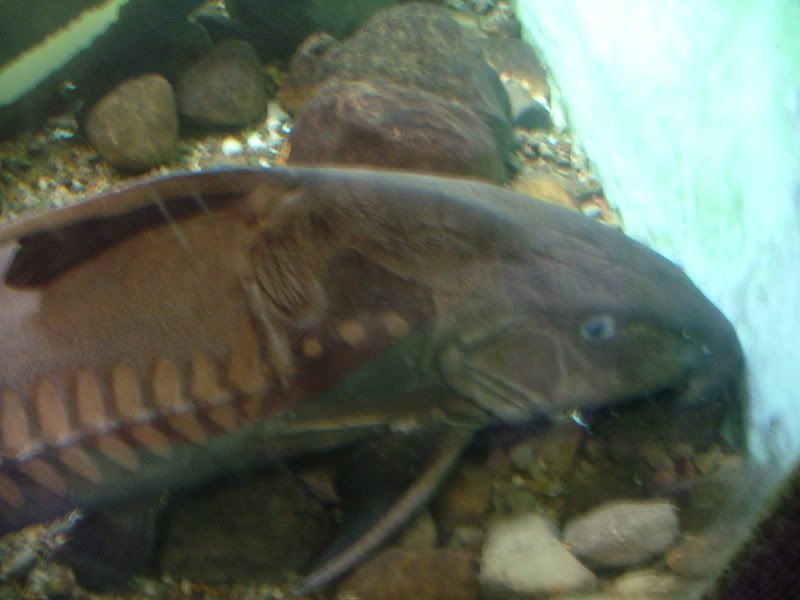
Yes, that is a picture of the Blobfish, and yes, that picture makes it look like someone let the air out of Ziggy’s oversized head. However, that picture was taken of a dead specimen on a research boat, right before it was pickled in formaldehyde. Blobfish don’t rely on swim bladders to remain buoyant like other fish, because the pressure of half a mile of water would squish the air right out of them. Instead, their flesh contains a gelatin-like substance that is nearly equal to the density of water. This means they can float effortlessly in the water, but makes it look like they melted above the surface. As to what they really look like, this is a much better picture:


These fish, who now resemble their Sculpin brethren much closer, bob along the ocean floor around the coast of Australia and New Zealand. There, they eat whatever floats or crawls by—mostly crabs, snails, and octopuses1.

Everyone seems to think Blobfish are lazy. Yes, they are adapted to using as little energy as possible to eat and move, but they are not deadbeats. While other fish spawn and leave, the Blobfish is an attentive parent. They will clean and sit on the eggs, protecting them from parasites and predators.

More efficient fishing methods have caused no end of trouble to all kinds of sea creatures. Trawling the ocean floor for crustaceans also picks up bycatch like the Blobfish. Callum Roberts and other scientists are worried about the future of this majestic fish. While it’s not officially listed as endangered, the government is certainly worried about it.

Public knowledge about bycatch in general, and the Blobfish in specific, is growing. Professor Roberts has certainly been trying to get the word out. There is also this British kids’ show that depicts the Blobfish fairly accurately, as well as adorably. They also sound like British Zoidbergs, which seems appropriate.

Photobucket

1You can argue all you want about the proper plural of “octopus.” There isn’t one.

Saturday, April 23, 2011

Mr. Bighead

Years ago, I read about this month’s EUT in the Animal Wonders edition of Zoobooks, the same place I first learned about the Axolotl. The illustration was strange enough to catch my eye and imagination for a good few months—a long time for my flighty young mind1. I recently rediscovered this animal whose complete disproportion struck me at such a young age.

Image from Asian Turtle Conservation Network


The scientific name of the Big-Headed Turtle (Platysternon megacephalum) means “flat-chest big-head,” which is obviously quite apt. Every article that mentions the Big-Headed Turtle states that its gigantic noggin is too large to fit in its narrow shell. So, to protect its head, the turtle uses a two pronged approach. One: the solid bone skull is covered with thick scales. Two: massive, very sharp jaws are coupled with a tendency to bite.

This turtle inhabits shallow, fast moving streams in Southeast Asia, where it enjoys a diet of fish and mussels. Swimming around in the heavy flow of these streams would take too much effort, so the Big-Headed turtle is an excellent climber instead, and ARKive has video to prove it. Its long flexible tail helps to prop it up as it uses its strong claws and beak to climb waterfalls. There are even stories of finding these turtles climbing trees and bushes. What they did when they got up there is anyone’s guess.

The Big-Headed Turtle’s big head seems to evoke one of two responses: it is either grotesquely disproportionate, or adorably baby-like. The second of these responses has led to a large number of them being caught for the pet-trade. While some captive breeding exists, there are not nearly enough Big-Head farms to supply demand for the pet trade. For this reason, it was placed on the IUCN Redlist in 2000, and is now CITES protected as well.

1An incomplete list of animals that have, at one point, been “my favorite animal”: giraffes, raccoons, pangolins, mosquitoes, jellyfish, frilled lizards, chameleons, fireflies, sloths, and many more I can’t think of right now.

Monday, September 13, 2010

Plague of Locusts

I’m sorry I missed the end of August, but I was kind of getting married, so I hope you’ll excuse the late post. Since I just moved to the Upper Peninsula of Michigan1, I decided I needed to write about a local Endangered Ugly Thing. Meet the Lake Huron Locust (Trimerotropis huroniana)

Image by Thomas Bentley, via BugGuide.net


This locust is a drab-looking grasshopper, and not one to stand out in a crowd. It’s about an inch long, slate grey, and looks like a large number of related insects. The biggest characteristic that sets them apart from other grasshoppers is their habitat. Instead of living in thick grasses or dense woodlands, they live on meagerly vegetated beaches. There, they blend in with the sand and eat the sparse grasses that grow there.

Like most grasshoppers, male Lake Huron Locusts use the familiar melodic (or grating, depending on your preference) chirping to attract a mate. They also add an aerial element to their ritual, flying up in the air, snapping their wings to make a crackling noise2. Eggs laid in the summer hatch the next spring, and mature in time to start the cycle again.

One of the largest threats to the Lake Huron Locust is the creation of summer homes on the dune habitats where these insects reside. This irks me, as the “summer” here lasts approximately from mid-July to mid-August. Protecting the dunes and the vegetation found there is the most effective method to keep these little locusts alive.

1This is properly pronounced “da U.P., eh?”
2Does it surprise you to know that entomologists have a name for this? It’s called “crepitating”.

Sunday, April 25, 2010

Groundhog Day

Greg, also from Not Extinct Yet, suggested that I write about the Blobfish. I really wanted to write about the Blobfish. If there’s any animal that could use a space on this blog, it’s the Blobfish. There’s really not enough information out there about it to get a full post out, though. My fiancĂ©e has been (strongly) suggesting a different animal since the Olympics in February. It’s somewhat cute, but in the end, it’s just a big Groundhog.

Image from Simply Wild Canada
The Vancouver Island Marmot (Marmota vancouverensis —that’s a Road Runner & Coyote scientific name if I ever heard one) has been cut off from the rest of the mainland Marmots since the end of the last ice age 10,000 years ago. Like many rodents, these Marmots hibernate during the winter. Unlike most rodents, that hibernation lasts eight months. Even during those brief summer months, they spend most of their time in the burrows, coming out only to feed, lounge on rocks, and goof off.

Being a rodent of smallish stature (the standardized size comparison seems to be "a large house cat") predation is a fact of life for the Vancouver Island Marmot. Cougars, Wolves, and Golden Eagles all find the Marmot to be a tasty treat—no wonder it spends most of its life underground. Also being rodents, they have a high reproduction rate, where babies made in May are out of the burrow by July. A single female can produce about 15 young in her life.

This high reproduction rate may save the species. Man-made habitat changes decreased their naturally low population numbers almost to the point of genetic collapse. It was estimated that there were 21 wild Marmots in 2003, the rest (75 or so) in breeding programs in zoos and conservation centres. That breeding program has been remarkably successful, as they have released a total of 223 Marmots since then. Yes, some of them have fallen victim to predation and other natural deaths, but the wild population is up to about 120 now, and the captive population is steadily growing.

Monday, March 29, 2010

Look Out For Mr. Stork

I’ve wanted to write about the Marabou Stork for a long time. It is amazingly ugly. It has a bald head, except for minimal scraggly hair. The giant, pointed beak, perfect for ripping into large African carrion, is the color of decaying bone. There is only one reason that it hasn’t appeared on this blog yet: it’s not endangered. Amrita from Not Extinct Yet has saved me though. No, she didn’t go and shoot enough Marabou Storks to put them on the list1. She found the Greater Adjutant (Leptoptilos dubius) which is closely related enough the Marabou Stork to fill its place on Endangered Ugly Things.

Image from MangoVerde

The Greater Adjutant hails from Southeast Asia, roosting near wetlands that teem with its prey. What kind of prey? Whatever it can catch. Insects, crustaceans, frogs, fish, carrion, rodents, even slow ducks. Much like the Marabou Stork (and the vultures they compete with), the ugly bald head is a great adaptation for shoving one's face deep inside a rotting carcass2.

Their large nesting colonies form in leafless trees around these wetlands during the dry season. As the water recedes, the aquatic animals this stork preys on are that much easier to grab. The Greater Adjutant uses this abundant resource to produce their eggs, and feed their hatchlings. I can't find any pictures of young Adjutants, but they can't be any uglier than the adults. Come the rainy season, they migrate to other wetlands in Northern India until the next breeding season.

The draining, clearing, and general messing-around-with of wetlands in the area has left only two breeding populations of these giant birds. One is in Cambodia, the other in Assam, India. Between these two areas, there are less than one thousand individuals. Along with the destruction of their habitat, the eggs and adults are also hunted, presumably because there's a lot of meat on a four-foot tall bird.

The Greater Adjutant is protected in the areas in which it's found, but enforcement is not always up to snuff. It seems that there was a big push to stop egg collection, which helped increase Adjutant numbers the next year. Hopefully these conservation efforts will continue to keep these magnificent, if horribly ugly, birds around.


1 I’m imagining the IUCN listing—Threats: Conservationists.
2Think about eating a bowl of jello without your hands. Wouldn't that be so much more pleasant if you were bald?

Monday, December 28, 2009

Hail to the Victors Valiant

I apologize for the unintentional two-month hiatus. Thanksgiving, leading right up to finals left me little time to search for Endangered Ugly Things. Next semester, I am only doing thesis work and teaching the Invertebrate Zoology lab, so hopefully I’ll be able to get back to my regular update schedule. This specific animal had to wait until after the regular college football season, to not upset my relatives who are Ohio State University alumni.

Image by Me
Image by me

The Wolverine (Gulo gulo) is, for all intents and purposes, a very big weasel. Forty-five pounds big. They are found around the world, under the Arctic Circle. Due to the large amount of food each individual requires, they have massive home ranges, with males wandering around an area of nearly 250 square miles. They can take down large prey (up to Caribou), but tend to scavenge when they have the opportunity.

The Wolverine has gained the same sort of reputation in North America as the Hyena does in Africa—a mangy, dangerous, scavenger (my dad has other names for the University of Michigan Wolverines). They aren’t mangy, but they are mainly scavengers—why fight a moose when it’ll die of starvation soon enough? They can also be quite dangerous, but name a fifty-pound animal that isn’t1.

I suppose what really irks me is the instant inclusion of scavengers into the “evil” category. Wolverines, hyenas, ravens and vultures all tend to get thrown into this role. I suppose this trend comes from the association with death, but I tend to see them more as janitors. They serve a vital role in cleaning up the ecosystem (would you like to be neck deep in deer carcasses?), and they get absolutely no respect for it. As the mutant Logan states "I'm the best there is at what I do, but what I do isn't very nice."

Despite their ferocious image, the mothers take good care of their young, keeping them close and safe for more than a year after they are born. It’s at this stage of life that Wolverines are the most vulnerable to other predators in the area, but when there’s a protective mother Wolverine in the area, that’s not all that vulnerable. Videos of the baby Wolverines are just as cute as you’d expect baby mammals playing to be.

Despite declining numbers due to the expanding range of humans, predator poisoning regimes, and trapping, Wolverines are not listed by the IUCN. They’re not even federally listed in the US (despite multiple petitions for such), due to lack of data on their numbers, though there may be some pressure from groups who still want to trap these animals. They are, however, listed as endangered in Canada. As information grows about these animals, hopefully we can begin to better protect this ferocious (sometimes) scavenger.

1Dad mentioned the Capybara. Wikipedia says they “…are gentle and will usually allow humans to pet and hand-feed them.” Dang. Alright, smart guy, name a second one.

Thursday, July 30, 2009

Song of the Shrimp

New visitors from the Scientific American article: Welcome! I hope you find some things that interest you here. My forum is starting to pick up, and I would love to see some new blood there. Bryan, who I met at the Green Futures expo, I hope you can forgive me for not writing about the animal you suggested, but I completely forgot. For two months. Sorry.

Image from Ann Dickinson

This is the California Freshwater Shrimp (Syncaris pacifica). It doesn't look like much, which is actually a anti-predatory device, as its translucency helps hide it from predators. If hiding doesn't work, it has a protective spine useful for jabbing into a predatory fish's mouth.

These shrimp are only found in a few counties in the Bay Area in California, and seem to be fairly picky about their habitat. They live in the runs1 of streams that have undercut banks, exposed roots, and overhanging vegetation. All of these features provide the Freshwater Shrimp with numerous hiding places.

The problem comes when those hiding places are disturbed. There are quite a few ways this can happen, all of which have the final result of removing the vegetation that these shrimp call home. The trees that provide the overhanging roots are removed when a stream is channelized, and agriculture and livestock fill the stream with runoff that buries those roots in silt.

There is quite a bit of good news going for the California Freshwater Shrimp. For one thing, its numbers appear to have almost quadrupled between 1991 and 2000. Another thing is that a number of teachers and students are using this as their rallying species to help teach people about freshwater habitat, and saving some endangered species in the process. If anyone in those programs reads this: I salute you. You will be able to tell future generations that you helped save a living thing from extinction.

1Runs are the areas in streams halfway between the shallow, fast moving riffles, and the slow, deep pools. This site explains these quite well.

Tuesday, December 23, 2008

I'm Not Dead

Last month, Phantom Midge made a wonderful suggestion for an EUT that I hadn’t thought about. I had known about it for ages, and, like her, had been pronouncing it wrong for years1. Somehow, without any foreknowledge, I’m managing to post this on an exceedingly appropriate day, as today is the 70th anniversary of its discovery as a living animal.
Image from Dinofish
Image from Dinofish

Order Coelacanth (pronounced See-la-canth) had been well documented since 1836, and fossils show that it lived for 345 million years between the Devonian period and the end of the Cretaceous period, when the dinosaurs died out. This must have come as a big surprise for the West Indian Ocean Coelacanth (Latimeria chalumnae) caught by fishermen off the coast of South Africa in 1938. These fishermen were friends with the curator of a small, local museum, and she would frequently check through their catch for anything interesting. Needless to say, something interesting was, in fact, found. Dinofish, who seem to be experts on this matter, have the whole long story on their site in far more detail than I can manage.

Coelacanths spend most of their time in deep (90-200m) caves, where they suction feed on any fish smaller than their head. Exceedingly sensitive eyes, along with an electro-sensory organ help them hunt. These are not small fish, getting up to about 6 feet in length and weighing about 175 pounds, thus surpassing the other “Living Fossil” fish I wrote about2. Coelacanth tail fins are split into three fleshy sections, and all eight of their fins move in a mesmerizing, visualized wonderfully—as always—in an ARKive video.

I was surprised the Coelacanth is listed at all, much less as Critically Endangered. I thought there would be far too little information on its numbers and habits to be called anything other than Data Deficient. Analyses of populations in 1989 suggested that there might only be 500 individuals left. The low population, ironically enough, might be attributed to by-catch. This could explain why all the natives were so perplexed when the Europeans got excited by the catch of a fish they knew to be inedible3. Since then, conservation and outreach programs have given fishermen the tools to release the fish directly back to the murky depths from which they came.


1In Freshman Zoology, I made a list of letter combinations that made an “s” sound. “Coe” always annoyed me, because I’ve never seen it outside of biology.
2Wikipedia has some nice articles about the term “Living Fossil.” Coelacanths are a “Lazarus taxon,” while the Australian Lungfish falls into the wider “Living Fossil” expression. I don’t think I’ll ever get a chance to write about an “Elvis taxon.”
3Never underestimate the local population when it comes to ecology.

Tuesday, April 08, 2008

Black Bead Game

I really wanted to write about the whipscorpion that Phantom Midge found, but I hate to say, there is little to no information about Trithyreus shoshonensis. So, my fall back this week is an animal that I got a picture of during my spring break trip to the Columbus Zoo. Growing up, I remember learning that the Gila Monster was one of two venomous lizards. This is the other one.

Image by Me
Image by me

Yes, the Mexican Beaded Lizard (Heloderma horridum) looks a whole lot like the Gila Monster. This so happens because they are within the same genus, and the major differences are that the Gila Monster is smaller and more colorful. Not having the hinged fangs of vipers, the Beaded Lizard delivers venom that flows along grooves in the teeth, and delivers by chewing. Digimorph gives a wonderful visual of that—check out the horizontal dynamic cutaway1 and watch for the hollow bottom teeth. The venom is used mainly as a defense mechanism, and is typically non-fatal to humans—if you get medical treatment quickly enough. The small animals they prey on…well, that’s a different story.

The “beads” from which this lizard gets its name are osteoderms2: tiny bits of bone growing within the skin that lead to its studded appearance. This adds another layer of protection on top of the fact that they can maim with a single bite. They inhabit the scrublands and other semi-arid habitats of Western and Southern Mexico, explaining the other part of their name. Like some other arid-adapted lizards, the Mexican Beaded Lizard can store fat in its tail to provide food and water during times of scarcity.

Habitat loss, due to clearing for agriculture, is one large factor in this species’ decline. The one that really surprises me, however, is the pet trade. I’ve always been an avid fan of reptiles, and have no problems with keeping some as pets. But I draw the line at an animal that can kill me if improperly handled. To help stop this problem, they are listed by CITES, and there are breeding and head start programs to replenish their numbers in the wild.

1Yes, it’s actually a Gila Monster. The principle is the same.
2Meaning “bone skin.”

Sunday, March 02, 2008

Throwing Copper

Recently, I was featured in an article in a magazine distributed around Ohio1. If you’re interested in reading it, I’ve linked to it here.

Two months ago, Pcrucifer asked if I take requests—indeed I do. While I’ve written about a number of snakes, I still get the feeling that the general public still thinks: “EEK! A snake!” Until that changes, I will continue writing about them. Water snakes are big and angry enough that they will always find a place here.


Image from Michigan DNR

The Copperbelly Water Snake (Nerodia erythrogaster neglecta), like the rest of the genus, is fond of water, though it is not as aquatic as some of its relatives. Typically found near wetlands and swampy forests in the Midwest, it hunts down any animal it can fit in its mouth2, usually frogs, tadpoles, and small fish. Unlike many Water Snakes, the Copperbelly has is uniform color on its back. Its belly, surprise-surprise, is bright orange. I was asked why they have a bright red belly. I can’t seem to find the answer.

While they are normally found near wetlands, they have a large enough range that they frequently move between wet spots, and even hibernate in the higher, drier areas. This movement causes some issues when there’s a human-made impediment in the way. Pcrucifer even called them “a snake for whom roads are a real problem.” I am familiar with this problem.

However, being squashed by cars is not their biggest threat. Some of these threats are becoming very predictable. I asked my English major girlfriend3: “They’re a wetland species, why are they endangered?” Without hesitation, she answered, “Because wetlands are disappearing.” Yes, I would be hard-pressed to find a wetland animal I’ve written about that doesn’t have “Habitat loss” as one of the threats.

There are people who worry about this snake, and lots of people who worry about wetlands. As the Copperbelly is only recently federally listed, recovery plans are still in the works, but I’m sure current wetland efforts can’t be hurting.

1To people with a certain electric company. So, if you live in Ohio and can’t find it, that’s why.
2Remember, this is a snake we’re talking about here. “Can fit in its mouth” is bigger than “the size of its head."
3Who wrote about the Andean Condor.

Friday, December 28, 2007

Swamp Rattler

There’s an EUT that I’ve known about for a long time that even I’m surprised I missed. In the second post, more than a year ago, I wrote about one of the endangered snakes I found in the road mortality survey in high school. Well, there was another endangered snake, and somehow, it has slipped through a year of blogging.

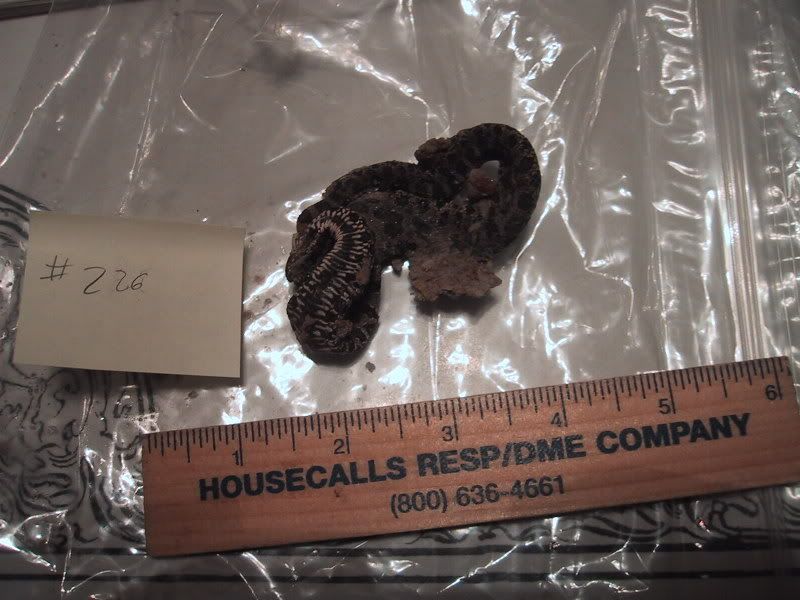
Image by me


This rattlesnake (Sistrurus catenatus) goes by a number of names, such as Swamp Rattler, Black Rattler, but I’ve always called it a Massasauga, which apparently means “Great River Mouth” in Chippewa. By those names, it should come as no surprise that these snakes are typically found in wetland areas, as well as near rivers and streams. They are typically ambush hunters, lying in wait for small rodents to wander within range. Since rattlesnakes are a group within pit vipers, they have heat-sensing organs to find their prey.

Unlike most rattlesnakes, Massasaugas hibernate alone, finding crayfish burrows in which to spend the winter, below the frost line. I don’t know how many of those crayfish are… uh… forcefully evicted from their burrows, but I wouldn’t be surprised if that was how most Massasaugas found their over-wintering hole. Females mate in the spring, yearly or every other year, depending how healthy she is. Birthing (remember, rattlesnakes have live young) happens in the late summer, with a litter of five to nineteen bouncing… uh, slithering babies.

While their range stretches from New York to Minnesota and from Missouri to Ontario, they are endangered within each state or province in their range. So, despite the fact that the Massasauga’s range takes up most of the Northeastern United States, it really only exists in small isolated populations. One of those happens to be the Killdeer Plains Wildlife Area, where I spent each fall in high school peeling dead snakes off the road. I suppose I can’t really let this post go by without a personal anecdote, so here goes. Freshman year, when we were still trying to figure out what we were doing, and I couldn’t yet drive, Dad and I came across a live Massasauga near the edge of the road. It wasn’t atypically big, probably two feet long. I had been given a two-foot long snake hook, but I hadn’t brought it with me, because I would pick up any non-venomous snake with my hands, and two feet wouldn’t be near long enough for any venomous snake. After collecting the data, we realized that we were supposed to take the snake off the road, so it wouldn’t get run over, which was achieved by stomping, yelling, and throwing roadside litter near it1.

So that was a little off topic. They are not particularly endangered due to road mortality (I only found four of them in four years of study), but for two other major reasons. The first reason is that people don’t like snakes, especially venomous ones. There are kind, little old ladies with wonderful stories about how they chopped a Swamp Rattler’s head off with a shovel. Reported cases of deaths due to Massasauga bites are few and far between, mostly due to the fact that the people did not get proper treatment in time. The second reason is simply habitat loss, just like for the Alligator Snapping Turtle, as wetlands continue to be developed.

Despite the fact that the Massasauga is state listed throughout its range, it is only listed federally as a species of concern. Most conservation programs focus on the education of the public in an attempt to let them see this snake as a part of the ecosystem, instead of a potential threat. Habitat conservation is also a big part of saving this snake, and there are a few captive breeding programs in Canada working to release more of these beauties into the wild.

1This was before we started taking photographs of each one. Otherwise, the picture would be much better than the above, or even my other option, this one.

Sunday, December 23, 2007

The Delhi Sands of Time

I think I may have found the most controversial EUT to date. Many websites still call this animal “the only fly presently on the Endangered Species List,” which was correct, until last year. I seem to have a thing for writing a fly post in December, but you’ll have to check back next year to see if the trend still holds.
Image from University of California Riverside

The Delhi Sands Flower-Loving Fly (Rhaphiomidas terminatus abdominalis) is endemic to the fine sand (also known as Delhi sand) dunes of southern California. The second part of its name comes from the fact that the adults feed on nectar from flowers in a manner reminiscent of hummingbirds, or, probably more accurately, hawk moths.

Parts of the lifestyle of this insect are still unknown. They are typically only seen as adults. There is a single mating season each year, from August to September, where the female will lay about 50 eggs into the sand. At that point, who knows? The larvae stay underground for probably two years, and may be predatory. I would be willing to guess that those suppositions come from studies of other Flower-Loving Flies (family Apioceridae).

The Delhi Sands area covers about 40 square miles, and it is thought that the Flower-Loving Fly occupied most of it. Now, with habitat degradation and loss, it now lives in 2.5 percent of that entire area. The conservation efforts for this animal, begun in 1993, has stirred tempers, and even gotten a (very brief) mention on NPR. To protect the habitat, the Fish and Wildlife Service set aside areas for the fly to thrive. The problem: some of that land is private property. Needless to say, landowners and developers got angry, which, of course, got conservationists angry. To this day, no one has stopped shouting.

Thursday, December 20, 2007

Catfish are Jumpin'

I know I’ve been way behind on my posts. My college has a schedule where the semesters are split into a twelve-week section, typically with three classes, and a three-week section, where one takes a single class and stuffs twelve weeks’ worth of information into it. So, the number of posts has suffered—in November due to finals, and in December due to heavy work load1. So, to make up for it, I’m going to see if I can put out two posts a week during Winter Break. First up, I present more evidence as to why Ugly Overload has an “Oversized Uglies” category.

Image from Fishbase
Image from Fishbase

This is the Mekong Giant Catfish (Pangasianodon gigas), whose upper size limit is nine feet and 660 pounds, making it the world’s largest freshwater fish. They inhabit the Mekong River, the eleventh longest river in the world, which stretches through China, Thailand, Laos, Burma, Cambodia, and Vietnam. While the young have the whiskers that give catfish their name, those are lost as they age. I can’t seem to find a maximum age for these, but they can get quite old, considering the generation time is listed as 14 years.

The Giant Catfish is a grazer, eating the aquatic vegetation growing on the bottom of the river, though this source states that they’ll take “other food [read: meat] in captivity.” During the course of their lives, these massive fish will migrate up and down the river, from upstream breeding sites to downstream feeding sites.

As there is a lot of meat on a 600-pound catfish, it came to no surprise to me that one of the major causes of their decline is overfishing; even though that has mostly stopped, they’re still getting over it. Despite this, the Mekong Giant Catfish was moved from Endangered to Critically Endangered in 2003. The IUCN cites habitat loss and degradation—that is, damming and pollution—as the major causes.

Not all hope is lost. In an interview with National Geographic, one of the researchers says that there’s still a chance that these giants can make a comeback. They’ve been working on artificial spawning since 1985, and captive breeding since 2001. These, along with better pollution regulations, could bring the Mekong Giant Catfish back from the brink.

1I just wrote a ten-page paper on genitalia evolution. Look up the Argentine Lake Duck (Oxyura vittata), if you dare. Or, for that matter, Echidna reproduction.

Monday, November 05, 2007

Indiana Jones

There’s a species that I mentioned in the original essay that I haven’t written about yet. Its ugliness is questionable, but there are a lot of people who don’t like bats. I had hoped to get this up by Halloween, but various factors conspired against it.
Image from FWS
Image from FWS

This is the Indiana Bat (Myotis sodalis), which, as its name suggests, is found in Indiana. About half of the entire world population roost there, with the rest of them spread out among the nineteen surrounding states. Their genus, Myotis, means “mouse-eared”, and includes more common species such as the Little Brown Bat, and three others that are found in Ohio1. The species name, sodalis, is Latin for “companion,” which is an appropriate name for them, as they roost in groups of at least one hundred individuals.

As far as shape and nightly habits go, the Indiana Bat is like most other small (they weigh up to 7.5 grams), insectivorous bat—hunting by echolocation, swooping after moths and mosquitoes all night, and coming back to roost at dawn. They make their roosts under sloughing bark of dead trees, typically near streams. In the winter, they find caves in which to hibernate. Their exacting standards for these hibernacula (the technical term) are one of the reasons that they are endangered. The caves must be between freezing and 50°F, and maintain about 95% humidity.

The National Fish and Wildlife Service states that one of the major threats to the Indiana Bat is human disturbances of their hibernating caves, much like the Virginia Long Eared Bat. However, even gating erected to keep people out can disturb the environment of the cave, if done improperly. Many people are also worried about their summer roosts being disturbed, or cut down.

There certainly are conservation programs in place to try to help them out. They are listed as endangered, federally and internationally. The major goal of the conservation programs is to prevent the disturbance of the nesting sites. In the Wayne National Forest, there is a single hibernaculum, but hardly a tree can be cut down without at least a few nights of monitoring for these furry fliers.

1And likely in nearby states as well. What can I say; I’ve lived in this state too long to not be a little biased.

Monday, October 01, 2007

She's a Rock.....House!

This is going to be another post where I’m going to try to whip up enough paragraphs with minimal information. I know enough about their order, but little about the species themselves. As adults, they look like small, oddly shaped moths.
Image from University of Michigan

On the other hand, as larvae, they are strangely shaped, grub-like, and quite ugly. On the Ohio Endangered Species list, there are three Caddisflies (Order Trichoptera, the species are Chimarra socia, Oecetis eddlestoni, and Brachycentrus numerosus). “Trichoptera” means “Hairy Wing,” not to be confused with their sister order, the Lepidoptera (“scaly wing”).

As larvae, Caddisflies inhabit streams and rivers all over the world, though I wouldn’t be surprised if the listed species had a much-reduced habitat range. Most of the life cycle is spent as a larva, usually at least a year. Many species attach bits of detritus to their bodies, such as in the picture, to act as a protective shell. The shape and material of the shell can even be used to classify the animals. To grow into big, strong adults, young Caddisflies will eat most anything they can catch. In fact, some even secrete a silky thread, like their caterpillar cousins. However, the Caddisflies use it to form a net and catch yummy detritus flowing by their home.

Most of that was off the top of my head, after spending the summer studying the small streams (technically known as Primary Headwaters) in the Cuyahoga Valley National Park. I know much less about them as adults. In fact, before doing some late night collecting for my Invertebrate Zoology course this fall, I couldn’t have told you what the adults even looked like. Of course, now I know they look like small, unexciting moths that hold their wings so they form a peak over their body1. Their mouthparts aren’t as exciting as butterflies’ or moths’, and about all they can do is suck up liquids. This doesn’t matter terribly much, because they have at most a month to have sex, lay eggs, and die.

Now, why are these three endangered, as opposed to the approximately 250 other species of Caddisflies found in Ohio? I’m not terribly sure. I’ve got guesses though. These might only be found in a few counties in Ohio2. They may also be endangered because the small stream habitats in which they are found are at risk from development, pollution, or the like.

That’s where Ohio is ahead of the game… to an extent. Because the Cuyahoga River burned in 1969, just in the midst of an environmental awakening3, state and federal Environmental Protection Agencies came into existence. Ohio developed some pretty good river assessment protocols. However, in 1999, they realized that small streams leading into the larger streams need to get cleaned as well. Therefore, they set up Primary Headwater Habitat conservation efforts that look at the quality of small streams, which are similar to the ones that our squirmy friends spend their childhood.

Oh, by the way, I noticed that I haven’t gotten a single comment in five weeks. If you feel like you have anything to say at all, good, bad or indifferent, please comment. Especially if I’ve gotten something wrong. I’d really like this blog to be as accurate as possible.

1I’m sure I’ve seen tons of them before that, I just couldn’t have told you it was a caddisfly.
2Phantom Midge, I don’t know how you found that out for Rheopelopia acra, but that was impressive.
3That wasn’t the first time it caught fire. It was just the one that got noticed.

Sunday, September 23, 2007

Hunchback of Colorado

It’s been a while since wrote about a fish, and I figured out I could search IUCN for all the Actinopterygii, that is, the ray-finned fish. Then found I could order the search by their category. While I found the pretty cool Shovelnose Sturgeon, there wasn’t enough information for me to write about1. The IUCN has recently highlighted the Humphead Parrotfish, which is ugly enough, but since they just highlighted it, I’ll let them talk about it.
Image by John Rinne via FishIndex
The Razorback Sucker (Xyrauchen texanus) is not too distantly related to the Blue Sucker that I wrote about a while ago. While it has a similar habit of eating organic detritus from the bottom of rivers, this one is lives in the Colorado River basin. It’s also larger, reaching lengths up to three feet, making it one of the biggest Suckers in North America. It has a big, sharp hump that gives it its name, which helps it navigate the fast moving rivers it calls home.

These Suckers are comparatively long lived, beginning to spawn at about 4 years old, and can live up to 40. However, despite their longevity, most of the young are dying early. This is mainly attributed to the large number of invasive predator fish that have been introduced into the Colorado River. Fragmented habitat and dams have also negatively affected their numbers. After all this, scientists estimate there are only about 500 adults left in the wild.

There are conservation efforts in place, many of which revolve around hatcheries in Utah and Colorado. The numbers are beginning to increase, and they’re certainly working on removing the invasive fish from the river.

1I’m getting pretty good at determining if I’ve got enough information fairly quickly anymore. A lot of that has to do with the number of photos Google has.

Sunday, July 01, 2007

Paddlin' Madeline Home

Phantom Midge1 gave me a few good suggestions recently, but alas, neither the Yeti Crab nor the Zombie Worm are listed, whether or not they are actually in danger of becoming extinct. There are gobs of disgusting-looking deep-sea critters, but since so little is known about their populations and habits, there is not enough information for them to be placed on an endangered species list. There is, however, an aquatic animal that I had known about for a while, but about which I have neglected to write.
Image from Texas Parks and Wildlife
This is the American Paddlefish (Polyodon spathula), which I have seen for years at the Columbus Zoo, and was sure it was on the Ohio Endangered Species List. It wasn’t which slightly upset me, since I was planning on writing about it for most of the week. Turns out it’s listed as vulnerable on the IUCN redlist, so I get to write about it anyway. It lives in large rivers of the Mississippi River basin, growing up to a size of seven feet, and living up to about twenty or thirty years.

The protruding…thingy (actually called a rostrum) from which the Paddlefish gets its name is covered with electroreceptors to help it find groups of zooplankton on which it feeds. The minute prey are swept unceremoniously from the water by the gaping maw of the Paddlefish, and then filtered from the water by raking protrusions on the gills. The fish’s mouth is specifically designed to open to an immense size to filter the largest amount of water possible. Wikipedia suggests that the rostrum also acts as a hydrofoil to help keep the head level in the water as filter feeding occurs, but I don’t really like to cite them as a source.

The American Paddlefish live in rivers, so of course dams affect their populations by impeding their moving patterns. Much like the sturgeon, they have been harvested for meat, and their eggs have been harvested for caviar. Agricultural runoff causes the streams to silt up, making filter feeding a difficult prospect. To help relieve some of these threats, farm-raised Paddlefish are released into the wild. Stricter regulations on Paddlefish harvesting have also been put into effect.

1Still no blog, so here’s her sister’s link again.

Tuesday, June 12, 2007

Birdhouse in your Waldrapp

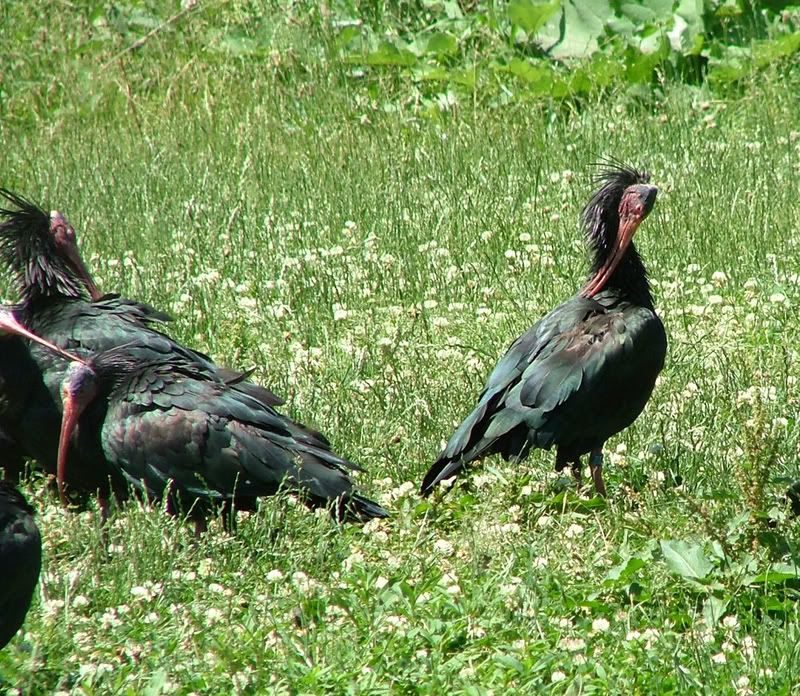
I had hoped that a trip to the Cleveland Zoo this last weekend with Miladyofthelake1 would prove fruitful, and, in fact, it did. Along with the Cinereous Vulture (near threatened—does that count?) and the Lappet-Faced Vulture (vulnerable), I found the Waldrapp Ibis (Geronticus eremita), which I think looks far more sinister than either of those adorably fuzzy carrion-eaters2.

Image from Me
Image by me

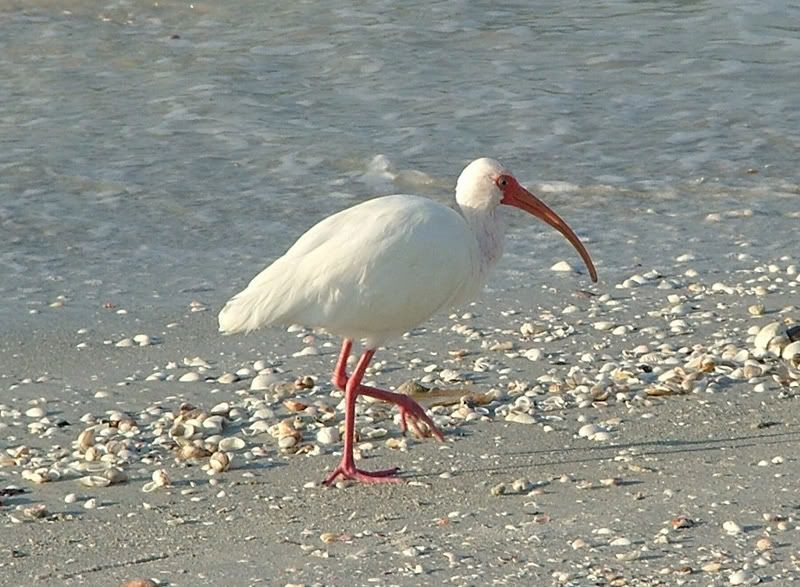
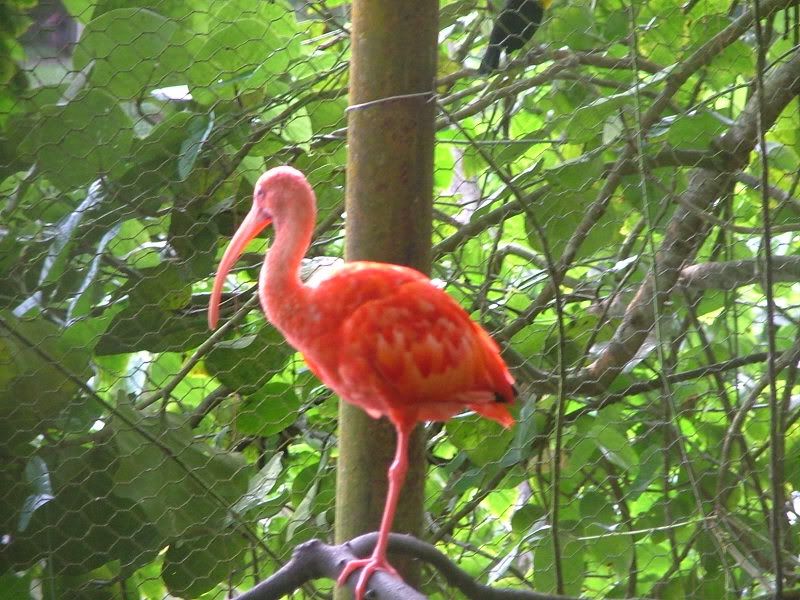
Yes, I said ibis, which most of you will associate with the American White Ibis or the Scarlet Ibis, which are much too bright and pretty. The Waldrapp Ibis (or Northern Bald Ibis, or Hermit Ibis) is oil-sheen black with a featherless head and a scraggly mane of black feathers that give it a buzzard look that no respectable shorebird should ever hope for. Not that the Waldrapp Ibis is really a shorebird, aside from being so phylogenetically. It lives in the grassy steppes of Morocco, Syria, and Turkey, as opposed to the marshes that its cousins inhabit. It still exhibits the same eating habits of other ibises by probing the mud (or dirt) for insects and lizards, and when the opportunity arises, small mammals. Completely shunning the aquatic lifestyle, they nest on cliff faces.

So why is it that these poor birds are critically endangered, and confined to three small areas, when it once roamed through all of Northern Africa, Central Europe, and the Middle East? It could be hunting, or nest site disturbances, or habitat loss. The insecticide DDT used in Turkey in the 1950s certainly didn’t help3, but they might be dying out due to natural causes. And these are suggestions from just one source. In other words, people do not know the exact reason why the Waldrapp Ibis is endangered.

Not that that’s stopping them from trying to help them out. Most zoos that house these ibises (and there are more of them in zoos than in the wild) are part of a Species Survival Plan, whose goal it is to breed animals in captivity to be released into the wild. Once there, the Waldrapp Ibis is protected by programs that are growing around them to see that they are undisturbed and happy.

1I have to thank her for editing most of the posts so graciously since, oh, about the lamprey post in late September. If you can read this without asking yourself, “What is he talking about?” thank her.
2I also found the Sturgeon Catfish, which is ugly enough to cause me to chastise myself for being disappointed that it’s not endangered. I have to keep reminding myself that I should not wish those sorts of things on an animal just so I can write about it.
3It has a tendency to wander up the food chain and kill whatever’s at top, cf. bald eagles in the United States.

Tuesday, June 05, 2007

Eye of the Tiger

I’ve been searching for more EUTs; rather, I’ve been searching for a new place to search for them. The Ohio list is all well and good, although a little small. I always worry that I won’t get enough information about the organism1. The IUCN Redlist has the opposite problem: it’s huge and I don’t know where to start looking. I’m starting to exhaust the U.S. list, as I cleared out the entire arachnid section in just three posts. This is why I keep begging my readers for suggestions. I don’t know how you guys find them, but when you do, it helps me out a ton.

Image from University of Connecticut

The Puritan Tiger Beetle (Cicindela puritana) was found on the United States endangered species list, and I couldn’t find why it was so puritanical, though it may simply refer to its New England upbringing (just a guess). The “tiger beetle” part of the name is much easier to place, as it (and others of its family) is a ferocious predator, hunting smaller insects. By virtue of their good eyesight and bursts of speed, the beetles are frequently successful. They inhabit the beaches along the Connecticut River in Connecticut and Massachusetts2.

They, or at least the males, have an interesting mating strategy. While the actual copulation only lasts a few minutes, the males will mount the females for up to six hours at a time. This is to ensure that their sperm is the one that fertilizes the eggs3. I’m pretty sure I’ve heard of this strategy with other animals, but it’s certainly an interesting one. The only problem with that strategy is that it means that the beetle is occupied for about six hours. Beachgoers to the Connecticut River thus have a high likelihood of disrupting their… "relationships." The little larvae live for two years in holes in the sand, grabbing prey that wanders too close to the air hole. Other threats to this little predator include dams (of course), habitat loss, and people walking over the grubs’ burrows.

The Connecticut Department of Environmental Protection is working hard to make sure people know about the Puritan Tiger Beetle’s plight, putting up signs, sending out flyers, and generally trying to keep people from coleopteran coitus interruptus.

1I’m looking at you, Rheopelopia acra.
2Of course! The two states that I simply can’t spell!
3This voids some ideas as to why they’re called Puritan Tiger Beetles.

Monday, April 23, 2007

I'm So Blue

I decided to look through the Ohio list to see if I could find anything of specific interest1. I realized that I hadn’t written about any fish for a while (though it seems I was on a bit of a fish-kick at the beginning). While in the fish section, I came across this blue sucker.

Image from Nature's Images Inc.

This is the Blue Sucker (Cycleptus elongatus), who populates fast moving streams in fast-moving Midwestern streams and rivers, mostly in the Mississippi river basin. Their mouth is the really disturbing bit: a pink, wart-covered maw used to suck up benthic aquatic invertebrates and some vegetative material. Their streamlined bodies (the elongatus part) and sickle-shaped dorsal fin help them manage their high-speed habitat. Spawning is fairly straightforward, occurring in spring and summer in deep rapids. The eggs are sticky, so they won’t immediately wash downstream.

It’s a freshwater species, so, like the Wartyback, the Lake Sturgeon, the Ohio Lamprey, the Eastern Hellbender, and the Queensland Lungfish, the Blue Sucker has a problem with dams2. In the sucker’s case, they’re built for fast-paced life, which is taken away by those concrete constructions3. Silt build-up is a by-product of dams that also isn’t too helpful, along with pollution draining into the rivers. Oh, and, they’re tasty, which is not a good thing for a fish trying to survive, as overfishing probably started the decline in the first place.

There’s good news for our azure friends: their numbers are increasing. Not, apparently, up to what they were pre-European, but they’re certainly on the rise. People who have never seen them before are reporting more and more. The reason given for this? The pollution levels are decreasing, and the Blue Suckers are finding alternative places to spawn. The fact that fishing them has been illegal since the ‘70s probably isn’t hurting.

1The Lake Erie Water Snake is on there, and I was considering writing about it, since it recently appeared on an episode of Dirty Jobs, along with someone I have worked with.
2Hydroelectric isn’t looking as good as it used to, is it?
3You’ve heard this one, but:
What did the fish say when it ran into the brick wall?
Dam.