Showing posts with label Birds. Show all posts

Thursday, March 31, 2011

Nevermore

Crows have been long associated with death in Western culture. In Medieval times, they were known to follow armored soldiers into battle for the prospect of feasting on the casualties. In modern times, people see them eating roadkill, as Halloween decorations, or as the monsters from The Birds. While Crows certainly enjoy carrion there is another side to them less frequently seen in modern interpretations. For one thing, they are omnivorous so dead things are only part of their diet. For another thing, they might be just as smart as the prettier parrots.

Our main method of determining animal intelligence is looking at how well they solve problems. Crows are masters. They bend wires into fishhooks to pull food from thin tubes. They have learned to use cars to crack hard nuts—while waiting for the light to turn red to retrieve them. One person is trying to teach them to use a vending machine. They can mimic human speech, with more clarity than most parrots. So, when you see a Crow walking down the sidewalk, don’t think, “portent of death,” think “Whosa prettybird?”

Image from Michael Westerfield


The Hawaiian Crow (Corvus hawaiiansis), is locally known as the ‘Alala. It has a lot in common with your more familiar American Crow: they eat whatever they want (mostly fruit and eggs), they hang out in groups, are strong fliers, and like to play wrestle. They use tools to get to their food. However, the ‘Alala is larger, and has a larger, rounder beak.

Why the Hawaiian Crow is in trouble is up for debate: it could be disease, habitat loss, or introduced predators, such as rats or mongooses. Chances are good that it’s all of the above. There is no question that it is in big trouble. The last wild ‘Alala pair were seen in 2003. All the rest of them alive today—about 70 individuals—are in two captive breeding facilities. Release programs have been unsuccessful. Part of that is due to the aforementioned predators, but there’s a problem that the conservationists didn’t foresee. Crows are smart, but because of that, they need to be taught. Without a whole society to teach them, the new crows haven’t learned how to properly forage or escape predators.

Monday, March 29, 2010

Look Out For Mr. Stork

I’ve wanted to write about the Marabou Stork for a long time. It is amazingly ugly. It has a bald head, except for minimal scraggly hair. The giant, pointed beak, perfect for ripping into large African carrion, is the color of decaying bone. There is only one reason that it hasn’t appeared on this blog yet: it’s not endangered. Amrita from Not Extinct Yet has saved me though. No, she didn’t go and shoot enough Marabou Storks to put them on the list1. She found the Greater Adjutant (Leptoptilos dubius) which is closely related enough the Marabou Stork to fill its place on Endangered Ugly Things.

Image from MangoVerde

The Greater Adjutant hails from Southeast Asia, roosting near wetlands that teem with its prey. What kind of prey? Whatever it can catch. Insects, crustaceans, frogs, fish, carrion, rodents, even slow ducks. Much like the Marabou Stork (and the vultures they compete with), the ugly bald head is a great adaptation for shoving one's face deep inside a rotting carcass2.

Their large nesting colonies form in leafless trees around these wetlands during the dry season. As the water recedes, the aquatic animals this stork preys on are that much easier to grab. The Greater Adjutant uses this abundant resource to produce their eggs, and feed their hatchlings. I can't find any pictures of young Adjutants, but they can't be any uglier than the adults. Come the rainy season, they migrate to other wetlands in Northern India until the next breeding season.

The draining, clearing, and general messing-around-with of wetlands in the area has left only two breeding populations of these giant birds. One is in Cambodia, the other in Assam, India. Between these two areas, there are less than one thousand individuals. Along with the destruction of their habitat, the eggs and adults are also hunted, presumably because there's a lot of meat on a four-foot tall bird.

The Greater Adjutant is protected in the areas in which it's found, but enforcement is not always up to snuff. It seems that there was a big push to stop egg collection, which helped increase Adjutant numbers the next year. Hopefully these conservation efforts will continue to keep these magnificent, if horribly ugly, birds around.


1 I’m imagining the IUCN listing—Threats: Conservationists.
2Think about eating a bowl of jello without your hands. Wouldn't that be so much more pleasant if you were bald?

Sunday, May 31, 2009

Unsung- Helmet

It’s been a while since I’ve written about a bird. The problem with them is that they tend to be cute, pretty, or majestic. Except, of course, for the carrion-eaters, but I can’t just write about vultures and pretend I’ve covered the entire class. So, like I always do, I went trolling through ARKive’s bird section and found this beauty.

Image by Doug Janson

The Helmeted Hornbill (Rhinoplax vigil), hails from Southeast Asia, where it spends its time eating fruit, like the majority of Hornbills. They also hunt bugs, using their pointy beak in much the same way that a woodpecker would. This is not a small bird, growing up to around a five feet from beak to tail. Wikipedia describes their call as “hoots followed by maniacal laughter.” Listen to any of the recordings on this site all the way to the end, and you’ll understand what they mean.

The casque—the helmet that gives them their name—is solid, as opposed to most hornbills, which means the skull is about ten percent of the total body weight of the bird1. This comes in handy, as the males participate in the aerial equivalent of Bighorn Sheep clashes, fighting over females and territory by running head-on into each other while flying. I can’t find any videos of this, but I’m sure it would be amazing.

Their headgear has also gotten them into some trouble. As it is solid keratin, it can be used as a reddish ivory-like substance for carving (called, surprisingly enough, hornbill ivory). As one can expect, this does not bode well for the bird. Well, it was all right when only the natives were doing it2, but once the civilized world got wind of this material, things were not looking good. CITES has now clamped down on this, making any trade of hornbill ivory completely illegal. The constant rainforest destruction that everyone has worried about for as long as I can remember isn’t helping the Helmeted Hornbills’ population either.


1Compare our atypically large head, with about 0.7 percent of our body weight.
2This tidbit isn’t entirely related, but I can’t think of anywhere else to put it: apparently the natives believe that a giant Helmeted Hornbill guarded the river between the land of the living and the land of the dead.

Friday, March 07, 2008

Blue Suede Shoes

I know I wrote about a bird recently, but as I said before, finding (non-vulture) ugly birds is difficult, so when ARKive has an ugly bird on their front page, I jump at the chance. It’s a bird I’ve known about for a while, but I didn’t realize it was endangered. Wikipedia states that Animal Planet’s “Beastly Countdown” lists this animal as “the #1 ugliest creature on Earth.” I don’t think so; I could probably come up with another ten uglier from earlier posts. But, I suppose, that’s for you to decide.1


Image from Wikipedia
The Shoebill (Balaeniceps rex) is a large stork (maybe), whose beak quite closely resembles footwear associated with 19th century Dutch (compare). They inhabit central African wetlands, where they feed on lungfish, catfish, frogs, lizards, and the like. ARKive puts their hunting strategy quite succinctly: “Prey is grasped from the water in the bird's sharp, hooked beak, which grips, crushes and pierces in one instant.”

When I said they were maybe a large stork, that was because scientists are still working on where to taxonomically put these huge wading birds. They could be with the storks, or the herons, or the pelicans, or the hammerkops2. The latest studies put it closest to either the herons or the pelicans.

Shoebills are solitary birds, aggressively defending their territory, and the only come together to mate. They build a nest of papyrus and brutally attack any potential predators. Baby shoebills (exceedingly cute) hatch after a month, can walk after two, and can hunt after three. It takes three years for the young to reach sexual maturity, and they can live up to 36 years.

As the population of Africa increases, more land is required for agriculture, which takes away the swamps necessary for this bird’s livelihood. Like any decent sized bird, it has a good amount of meat on it, and is subsequently hunted for food. CITES is attempting to limit trade, and may make it illegal for any trade of Shoebill parts. Conservation efforts are iffy, as they are found in some reserves, but Africa is notorious for its political instability. Consistent wildlife management is a lot to ask for. There are suggestions that toting these as a great African animal, like the Lion or the Wildebeest, will be the biggest aid to its conservation. The easiest way to do that is to tell people about it.
I feel my work here is done.

1Every once in a while, people take offence to me calling these animals ugly. I know that this is subjective, but there are animals that people will simply not find cute. The point is to show that those animals are just as important as the cute ones.
2I had never heard of these before. They look halfway between a
roadrunner and a ball-peen.

Tuesday, February 12, 2008

Let a Frown be Your Umbrella

It’s been a while since I’ve written about birds. The major problem with them is that they tend to be, well, cute. With vultures, much like snakes, it is easy to throw them all in due to deep-seated associations people have with the whole taxa. So, I set out to find an ugly, non-carrion eating bird. What I found was a Muppet.
Image from Oriental Bird Club

This is the Sri Lankan Frogmouth1(Batrachostomus moniliger), and I believe that if Jim Henson set out to create an animal, this would be the result. A comically wide, flat mouth. Bulbous, ping-pong eyes. A single, large eyebrow. Remind you of anyone2? There are good reasons for each of those traits, and in fact, the Sri Lankan Frogmouth is not the only one with those traits. There are a number of other Frogmouths—a relative of the Nightjar—though none look quite as cartoony as the Sri Lankan.

As a nocturnal insectivore, the Frogmouth needs to be able to pick moths out of thin air, while flying through dense jungle. This explains both the gigantic eyes, and the gaping mouth acts as a funnel to increase the chance of an unsuspecting insect getting drawn into their maw. I’m not sure of the exact purpose of the monobrow, but it certainly aids in the magnificent camouflage. These birds are able to sit perfectly still atop a mossy branch and look like nothing more exciting than a stump. While I can’t seem to find a major predator, there seem to be plenty of choices.

Alas, it was only after I had decided that I needed to write about this animal that I found out… it’s not really endangered3. For a time, it was considered Near Threatened (possibly due to its amazing camouflage), and ARKive suggests that if habitat loss by non-sustainable agriculture were to get out of hand, it could go right back there, or worse. And, frankly, such a thing is not hard to imagine.

1Please watch the videos. It's even stranger looking when it moves.
2If you really want to freak yourself out, compare the pictures side-by-side.
3I would like to know what you think about this week’s other option, the
Bare-Headed Rockfowl. Is it ugly enough for a future post? I value your opinions.

Thursday, November 22, 2007

Here We Come a-Wattling

Well, I had hoped to get this (or something) up earlier, but finals and the end of the semester got in my way. Today, in honor of Thanksgiving1, I’m writing about an Endangered Ugly Galliform. For those who don’t know the orders within Class Aves off the top of their heads, Galliformes is the order that includes the chicken-esque birds, such as pheasants, grouse, quails, and, of course, turkey2. Granted, this week’s EUT is none of those, but it’s the taxon that counts.


Image from Birding Peru

The Wattled Curassow (Crax globulosa) is a seven-pound bird that inhabits the rain forests of western South America. They are fairly omnivorous, finding what fruits they can, but mostly eating invertebrates they find in the flooded forest and riverbanks. Despite spending all day foraging on the forest floor, they roost in trees, though specific information on their nesting habits seems a little thin.

Surprisingly enough, the Wattled Curassow has, in fact, a wattle. Around their beak is a set of conspicuous, fleshy protrusions. These turn bright red on the males during the mating season in June. Another visual oddity in these birds is their crest, which, to my eyes, looks exactly like meticulously gelled curly hair. Their white rumps are prominently displayed in the mating ritual, in which the males make high-pitched whistling noises, as opposed to most other curassows, which “boom.”

As I did introduce these as chicken-like, it should be little surprise that the largest threat to these birds is hunting. The addition of shotguns to the arsenal of people in those areas is cited as the cause of the huge population drop of the Wattled Curassow. Human population expansion is the easiest along rivers, and since this is the Curassow’s habitat, they are frequently picked off.

There are a number of people working on the conservation of this bird. A Bolivian Bird Conservation group has a Wattled Curassow Project in place, and they are trying to find suitable habitats. Ecotourism may be used to better protect their habitats, and many groups are trying to determine how these methods might be used for conservation.

Edit: I just found out that WWF has an Eastern Hellbender plushie. This makes me exceedingly happy, and leads me to believe that maybe I should let up on the WWF just a little.

1The American one. The Canadians actually hold Thanksgiving about the same time of year the Puritans had theirs.
2I just found out that the North American Wild Turkey is the largest galliform in the world. Neat.

Sunday, September 02, 2007

And the Vultures Circle

Well, it’s high time for another bird post, and I have just the animal for it. It was mentioned in the Waldrapp Ibis post as another bird seen at the Cleveland Zoo, and I even linked to a picture of it. This picture, in fact:

Image by Me
Image by me

The Cinereous Vulture (Aegypius monachus) is also known as the Monk Vulture or Eurasian Black Vulture. They’re found in mountainous areas all the way from Spain to the Himalayas. Due to their high lifestyle, they’ve developed a special hemoglobin molecule to help take in oxygen at altitudes where we would be sucking on air tanks. This vulture has even been spotted 23,000 feet up Mount Everest; that’s about 80 percent up to the summit. The tree line would have been about 8,600 feet down.

With an 8-foot wingspan, the Cinereous Vulture is the world’s largest “falconiforme,” the group that contains the true birds of prey. Finding this led to an interesting discovery: Old World vultures are unrelated to the New World vultures; all similarities between the two are a result of convergent evolution. While the Old World vultures evolved from hawk- and eagle-like birds, New World vultures—such as our beloved turkey vulture, or the largest flying bird, the Andean Condor—evolved into a similar niche from storks. This confusion on relationships even led to the common name I’ve been calling Aegypius monachus. It needed to be distinguishable from the American Black Vulture, now considered unrelated, so it was given a name meaning “ashy colored,” thus, “Cinereous.”

While the Cinereous Vulture is only listed as Near Threatened according to the IUCN, Europe1 classifies it as Vulnerable. The population decline is frequently attributed to poisoned meat set out to kill potential livestock predators, and a general lack of carcasses lying around due to quicker removal of dead cows, which were a historical food source.

Thankfully, European conservationalists have kicked into gear, so the Cinereous Vulture may never have to see the Threatened category on the IUCN list. Breeding programs have been set up in France, Spain, and heck, there’s even a breeding program at the Cleveland Zoo. Due to good management practices, their numbers are increasing rapidly in Greece. Actual direct hunting of the Cinereous Vulture has pretty much stopped because of outreach programs to the public.

1I didn’t even realize there was a list for all of Europe! Though, I can’t seem to find the list itself.

Tuesday, June 12, 2007

Birdhouse in your Waldrapp

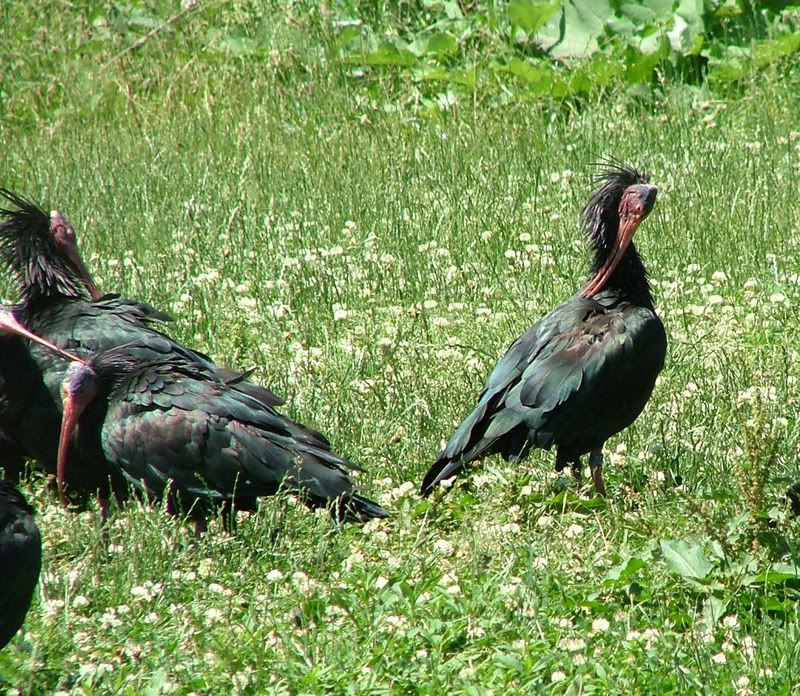
I had hoped that a trip to the Cleveland Zoo this last weekend with Miladyofthelake1 would prove fruitful, and, in fact, it did. Along with the Cinereous Vulture (near threatened—does that count?) and the Lappet-Faced Vulture (vulnerable), I found the Waldrapp Ibis (Geronticus eremita), which I think looks far more sinister than either of those adorably fuzzy carrion-eaters2.

Image from Me
Image by me

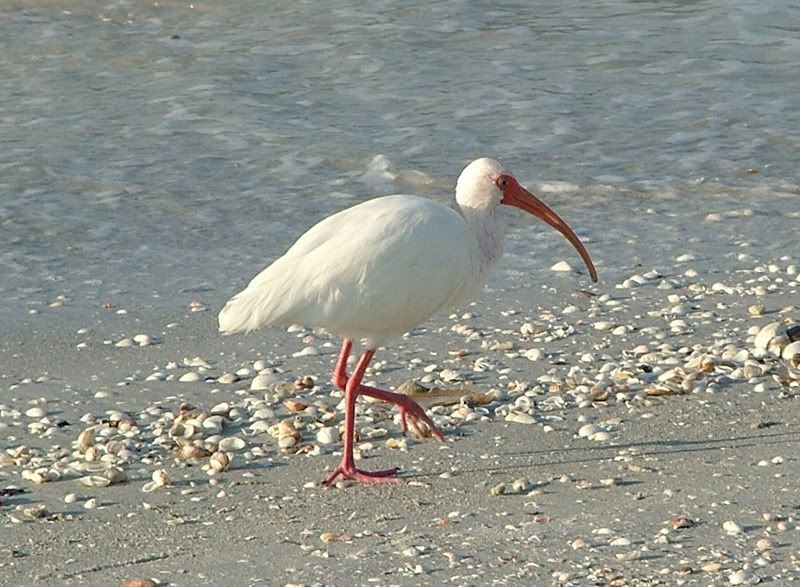
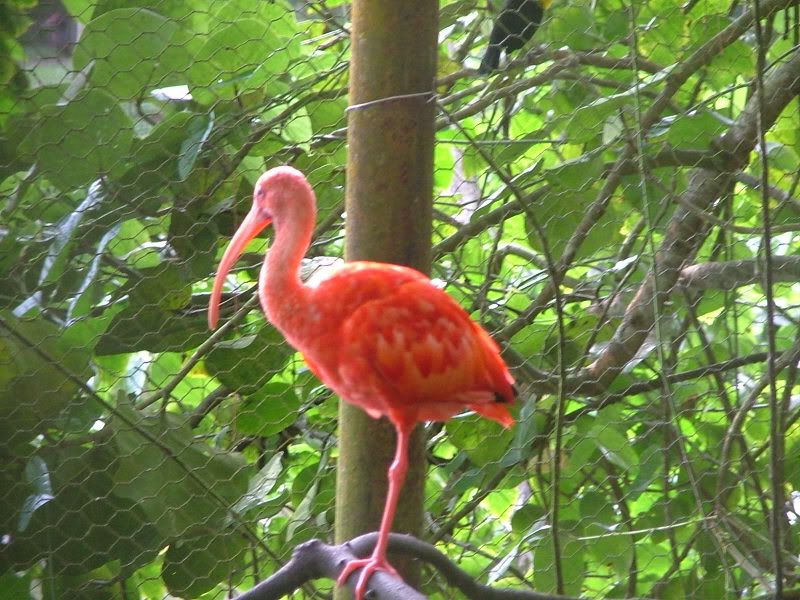
Yes, I said ibis, which most of you will associate with the American White Ibis or the Scarlet Ibis, which are much too bright and pretty. The Waldrapp Ibis (or Northern Bald Ibis, or Hermit Ibis) is oil-sheen black with a featherless head and a scraggly mane of black feathers that give it a buzzard look that no respectable shorebird should ever hope for. Not that the Waldrapp Ibis is really a shorebird, aside from being so phylogenetically. It lives in the grassy steppes of Morocco, Syria, and Turkey, as opposed to the marshes that its cousins inhabit. It still exhibits the same eating habits of other ibises by probing the mud (or dirt) for insects and lizards, and when the opportunity arises, small mammals. Completely shunning the aquatic lifestyle, they nest on cliff faces.

So why is it that these poor birds are critically endangered, and confined to three small areas, when it once roamed through all of Northern Africa, Central Europe, and the Middle East? It could be hunting, or nest site disturbances, or habitat loss. The insecticide DDT used in Turkey in the 1950s certainly didn’t help3, but they might be dying out due to natural causes. And these are suggestions from just one source. In other words, people do not know the exact reason why the Waldrapp Ibis is endangered.

Not that that’s stopping them from trying to help them out. Most zoos that house these ibises (and there are more of them in zoos than in the wild) are part of a Species Survival Plan, whose goal it is to breed animals in captivity to be released into the wild. Once there, the Waldrapp Ibis is protected by programs that are growing around them to see that they are undisturbed and happy.

1I have to thank her for editing most of the posts so graciously since, oh, about the lamprey post in late September. If you can read this without asking yourself, “What is he talking about?” thank her.
2I also found the Sturgeon Catfish, which is ugly enough to cause me to chastise myself for being disappointed that it’s not endangered. I have to keep reminding myself that I should not wish those sorts of things on an animal just so I can write about it.
3It has a tendency to wander up the food chain and kill whatever’s at top, cf. bald eagles in the United States.

Sunday, May 06, 2007

Mama Cass

Despite my pleas for ideas, no one sent in any suggestions. My girlfriend, who wrote the Andean Condor post, wanted another one on birds, and mentioned an animal that is widely regarded as one of the most dangerous animals to keep in captivity. I like to refer to them as the “Angry Technicolor Ostrich.”
Image from Australian Wildlife Conservancy

The Sothern Cassowary (Casuarius casuarius)1 is listed as vulnerable on the Australian endangered species list. They belong to the group of birds called Ratites, which also include ostriches, emus, rheas, and kiwis. None of them have the keel present in flighted birds, but have developed into strong runners.

They are strong kickers too. All of the ratites defend themselves with their sharp claws on their strong legs. Cassowaries are especially infamous for this. I had heard that they are able to disembowel a person, but I’m having problems finding any reliable source that confirms this. Not that they would eat anyone; they’re technically frugivores, and are a useful species for spreading the seeds of rainforest plants.

The name “Cassowary” comes from the Papuan word for the bird, which means “Horned Head.” The horn to which this name refers is also known as a casque. The purpose of the casque is only guessed at, with hypotheses ranging from pushing through rainforest foliage to establishing dominance. I haven’t seen anybody talking about why they’re bright blue with huge wattles, though.

Cassowaries are solitary animals, though, when they do get together, the males are subordinate to the females, since they’re smaller. The females lay several clutches of eggs, and then they leave. The males incubate the eggs and take care of the young, which look like zebra/leopard/goslings, and are fairly annoyingly cute.

As rainforest animals, the major threat comes in the form of habitat destruction for agricultural and developmental purposes. This also leads to fragmented populations, which has genetic diversity implications. Traffic accidents are becoming more frequent, and nobody wants to run into a four-foot tall, 130-pound bird with a helmeted head. The Australian government has conservation efforts in place, including education efforts

1The Northern Cassowary (C. unappendiculatus) is also listed as vulnerable, but there isn’t much difference between the species, so I just picked one.

Monday, January 15, 2007

Condor of Happiness

The following post was written by my girlfriend. She volunteered to write an ugly bird post, and I was more than glad to let her.
--Garfman

For the most part, birds are not considered to be terribly ugly. After all, they tend to be the object of many an extended metaphor involving ethereal instances such as flight and dazzling color elements. However, these correlations only extend to the surface of the animal. Humans mostly attracted to avian organisms with distinctions such as “songbird”, birds noted for their song or “parrots/parakeets,” which are noted for their plumage and ability to cross the border of “human speech.”

Never mind the sanitation officers of the avian world.

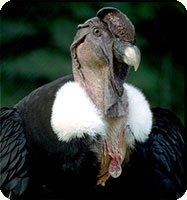
Image from National Zoo

Condors serve the biological niche required of them by being scavengers. The Andean Condor (Vultur gryphus1) is perhaps the most perfect example because they are known for being traditional scavengers. Their feet have blunt claws, unlike their cousin, the California condor (which has sharper claws and is known to hunt). In fact, the only time they hunt is in extreme cases, where they stalk, at a minimum, newborn or sickly creatures. On the menu for the average condor are assorted ungulates, sea bird eggs, and various rodents.

With a hideous head-crest and a fleshy comb on the males that rivals the common rooster, they can be considered rather “ugly.” However, these magnificent birds have the unique distinction of being one of the largest flying birds with an 11-foot wingspan and a body length of 43-51 inches. It is the only New World vulture/condor that is sexually dimorphic; the female is smaller at 17-24 pounds, sport garnet colored eyes, and lack a comb, while the male is 24-33 pounds with brown eyes. Both birds have rather “boring” plumage—black with white patches on the wings and neck.

They mate for life (huzzah) and lay a single egg per term directly on rock ledges or the cave. The incubation period lasts 54-58 days and the chick is raised for 1 ½ to 2 years. Due to the fact that they are sexually viable at six years, breeding and repopulation efforts face the issue of time.

Andean Condors inhabit South America (the Andes Mountains of South America from Venezuela to the islands of Tierra del Fuego in the Strait of Magellan), and due to hunting and poisoning, less than 3,000 exist in the wild. They used to frequent the northern portion, but there are as few as 75 birds in the area. Condors are not evasive and do not threaten farms—although it is due to misconceptions that these birds were killed to the point of being threatened. Conservation efforts do exist, however. Most zoos have breeding programs and raise condor chicks using a “puppet method” with the purpose of releasing them into the wild for repopulation. Personally, I would recommend viewing the webpage of the Cleveland Metroparks Zoo; they offer clear information and are very accessible to those of the younger age (side note: the younger one is aware, the more likely one will develop empathy for all living things).

1Being an English major, I had to include this bit of language eye candy: “The scientific name comes from the Latin words vultur and vello, meaning to pluck or tear and refers to its feeding habits and gryphus means a griffon and refers to the hooked bill. The common name refers to the bird’s range in the Andes Mountains.”