Sunday, March 18, 2007

Mussel of Love

In the very first post, I mentioned a particular animal and I haven’t gotten around to talking about them yet. It doesn’t have the distinction of being endangered anywhere save for Ohio and Minnesota (though it is threatened in Wisconsin). I wish I could find more detailed information about them, but I’ll share with you what I’ve found out about the Wartyback Mussel1.
Image from Indiana Natural History Survey

The Wartyback Mussel (Quadrula nodulata) inhabits deeper rivers in the Upper Mississippi system, such as the Ohio River. There’s no real mystery to the origin of its name; it has bumps all over its shell. It hangs out in sand or fine gravel, where it filter- feeds by sucking in water and digesting anything somewhat nutritious. The gills do double duty as both strainers and breathing apparatuses.

Mussel reproduction is weird. The female will hold eggs in her gills3, which are fertilized when the male’s sperm are drawn in as the females are siphoning water. The female then creates a prey mimic, which looks like some sort of minnow, and as a fish comes by to eat it, larvae are released. Parasitic larvae4. I can’t find if the Wartyback uses the lure, but seeing as the main hosts are catfish, it seems likely. The larvae aren’t harmful to the fish, but, like burrs from a plant, hitch on (in this case, to the gills) to get away from mom and dad, where there’ll be less competition and more genetic dispersal.

Because they filter so much water, pollution is the major problem facing freshwater mussels. Yes, we’re talking about the whole group. I started talking in generalities about a paragraph and a half ago. Dam construction and pretty much anything that messes with river flow also add to the problem of endangerment.

The Columbus Zoo, in conjunction with people like ODNR and OSU recently built an entire center on freshwater mussel conservation. Granted, the Wartyback doesn’t seem to be listed on the site, but anything that’s good for freshwater mussels is good for the Wartyback. Breeding programs have extra steps when dealing with mussels, since they need to catch and parasitize fish and then release them. The fish likely swim away wondering what on earth just happened to them.

1Does anyone want a “Save the Wartyback Mussel” t-shirt2? Just comment and I’ll make one.
2I’d make an Ohio Lamprey plush toy if I had any idea how to do so.
3At a science convention I went to, someone’s project was counting the eggs of local mussels. I think the numbers were in the hundreds for each individual. I couldn’t help feeling sorry for her, and I was counting roadkill snakes.
4Not co-endangered, because there are plenty of catfish to go around.

Saturday, March 10, 2007

Lichen Rock

Well, I wanted to spread the love to all the taxa, and since no one suggested anything last week, you get to read about lichens. Lucky you. Well, to what group do the lichens belong, you may ask. The answer: most of ‘em. The major part of the lichen is a fungus, but it has a symbiotic relationship with either an alga or a cyanobacterium (or both) that allows them to be photosynthetic.

Image from Lichens of North America

I’ll admit the Rock Gnome Lichen1 (Gymnoderma lineare) isn’t really ugly, it falls more into the category of endangered things you’d never hear or care about. Think about what I tend to write in other posts. What does it eat? Rocks. What behaviors does it have? It grows, very, very slowly, and eats rocks. Breeding habits? A piece of the lichen breaks off2.

I suppose some of those are some points of interest, since lichens have the distinction of being able to metabolize minerals straight from rock faces, setting the stage for “higher” plant forms to colonize. A blank rock face with a few greenish growths today could be a forest in 100 years. Or, just as likely, the same lichens that are there today. Not the same population, the same individuals; which brings us to our second point. Lichens are incredibly slow growing. Something like a millimeter a year. They can be used to estimate dates like glacial retreat or ancient landslides. Redwoods and giant tortoises can’t hold a candle to that3. Heck, continents move faster than that.

This particular lichen lives in southern Appalachia, where it likes its rock served moist and vertical. It's the only member of its genus in North America, the other Gymnoderma live in the Himalayas or other East Asian mountains. The rock gnome lichen is extremely sensitive to trampling (despite the fact it lives vertically), and to changes in moisture levels. Many lichens have issues with air pollution, and it’s likely that the rock gnome has the same problems. Scientific collection is an endangerment cause I haven’t talked about yet4. What do you do to study something that won’t grow in the lab and dies if you poke at it too much? I’m not sure.

1Good band name for, what, maybe a bluegrass band?
2Sex, when you’re two or three individual organisms per cell, is kinda difficult. Possible, just complicated.
3And not just because they don’t have opposable digits.
4Though a much smaller problem than in, say, the 1800s, when killing was the easiest way to document an animal and get it to as many museums as possible.

Saturday, March 03, 2007

Stuck on You

(Alternate title: Lice Lice Baby)

Well, Stephanie (who I can’t find a link for) suggested whale lice, but alas, they are not listed. I will get to them, because it’s very possible that they’re endangered. While looking for information on them, I came across an interesting term: coendangered. While this may refer to close-knit predator/prey or flower/pollinator relationships, that’s not the relationship I’m focusing on. The species that I will claim this post is about is the Pygmy Hog-Sucking Louse (Haematopinus oliveri). It is a louse that sucks Pygmy Hogs, not a pygmy louse that sucks hogs1.
Image from Texas A&M
This is just a common hog louse. Can you tell the difference?


These lice, which live normal, lousy lives (hanging on to hair and sucking the blood that springs eternal from the ground) suffer from habitat destruction. What else would you call it when a parasite’s only host is disappearing? The pygmy hog lives in India savannahs, and according to Ultimate Ungulate2 they build/dig a type of nest that “facilitates the transfer of ticks and lice - including one, the pygmy hog louse Haematopinus oliveri, which is found only on this species.” Since the pygmy hogs are dying out due to, well, habitat destruction, so are the lice.

Other animals have this problem as well. All whale species have a specific whale louse3, which must be as endangered as the whales they inhabit, since those whales are their only habitat. None of them are on the IUCN Redlist. The Galapagos hawk has a skin mite that is almost certainly endangered and not listed. Scientists have now used both of these species to get a better idea of their hosts’ evolutionary history. NPR even did a segment (in 2005) about the parasitologists who were discovering the Galapagos hawks’ past.

There are some parasites that we’re too late to save. When California condors were brought into captivity to save them from extinction in the ‘80s, they were, understandably, deloused. Thus passed Colpocephalum californici, the California condor-chewing louse. The article that described this extinction stated that “…charismatic animals hog conservation dollars; the only ethic that makes the condor more important than its louse is its aesthetic value.” This is a good statement of what led me to start this blog, though when a condor beats out something in “aesthetic value”, you know that thing is ugly.

The simple fact that people are now (within the last few years) worrying about parasite conservation is about all I can ask for. Science magazine reported in 2004 that, based on average parasite levels, there are approximately 6,300 coendangered species that don’t appear on any list. I suppose the easiest conservation method is to save their hosts. And watch out for the little guys.

1Because, quite frankly, who’s going to call an almost microscopic animal “pygmy”?
2Should I be surprised this exists?
3Actually crustaceans that cling onto the whale’s face, creating crusty white patches.

Sunday, February 25, 2007

Rudolph the Long-Nosed Antelope

A few weeks ago, Greg1 suggested some animals about which I could possibly write. I thank you profusely for your suggestions, and urge other people to send their ideas. I would never have thought to look at some endangered antelope to see if it was ugly.

Image from CITES
Image from CITES

Yes, this is the Saiga Antelope2 (Saiga tatarica), which I mentioned in the footnote of the last post; it’s the one that looks like that informant from Star Wars3. They are more than just their big nose, but it’s big and ugly enough to make one ask: Why the nose?

It took a bit of searching to find an answer. ARKive states that the gigantic schnoz is used for warming the cold air of the winter, and for keeping the dust out in the dry summers. I don’t just have to take their word for it, since this article (which also has some rockin’-cool skull images) also mentions it (I think):

The enlarged nasal vestibule, lateral vestibular recess, repositioned basal fold, and septal cavernous mass are regarded as a coordinated adaptation to dusty habitats, such that nasal air flow can be dynamically regulated allowing for collection of inspired particulates in the vestibule and thus cleansing of air destined for the lungs.
Moving away from the nose (seriously, stop staring), the Saiga lives in Eastern Europe and Western Asia, wintering in the deserts and summering in the dry steppes, moving up to 70 miles per day during their migration north in April and south in November. Rutting happens at their wintering sites, where males gather up harems of females and fight fiercely for them. I’m sure many of you have heard that most animal fights are ritualistic and don’t end in death—most. The male mortality rate of the Saiga can reach 90%, much of that due to exhaustion. Those who survive start the trek back north to the steppes.

CITES has banned trade of Saiga parts, and hunting is banned in their range, but overgrazing, as domestic ungulates are introduced, is thought to be a major threat to the Saiga. The horns are considered aphrodisiacs, so poaching is rife. Under the Soviet Union, major controls were put in place that boosted its numbers, but since the collapse, poaching has come back into play. Sine only the males have horns, and have their own problems, this leads to a very female-heavy population, who don’t have enough males to inseminate them. The males are already dying from exhaustion; we shouldn’t add sexual exhaustion to the mix.

1See, if you suggest an animal, I'll link to you.
2The name is almost a misnomer. Taxonomists have argued whether these are antelopes or sheep. Current thought says that they’re an intermediate, halfway between the two.
3The first one, IV (not to be confused with the fourth one, I)

Sunday, February 18, 2007

Does Whatever A Spider Can

After the post on most of the arachnids on the US List, I couldn’t help but look at the non-cave spider. I will get to your suggestions1, but I’m still trying to spread the love to all the taxa2.
Image from Animal Diversity Web

The Spruce-fir Moss Spider (Microhexura montivaga) is a small (3-5 mm) member of the tarantula group. They live above 5,400 feet in the Appalachian Mountains in North Carolina and Tennessee, where it can get colder and snowier than many spiders mind to handle. The prominent vegetation of these areas (surprise, surprise) is Frasier fir and red spruce, and the spiders inhabit the mosses found in association with those trees.

Like most tarantulas, the moss spider is an ambush predator, feeding on arthropods smaller than itself. This does not mean they don’t make webs; they weave tunnel-shaped nests between the rock and the moss. After mating, the males make a run for it, since many female spiders find the male to be a readily available protein. Females stay with the egg sac until it hatches, and will carry it around if she’s disturbed. When the spiderlings3 hatch, they disperse to other areas by a process called ballooning4, where the babies extend a strand of silk to be caught by the wind.

They’re not terribly sure why the spruce-fir moss spider is endangered, though there are some good ideas. The primary suspect: the balsam wooly adelgid, an invasive insect that attacks fir trees, which mess up the spider’s habitat. There’s a possibility of throwing out the baby with the bathwater, as it’s possible that the insecticide used to kill these tree-borers could also be killing the spiders.

The Louisville Zoo is working on a breeding program, though there are no cute little spiderlings yet. I’m finding enough information that I know someone is worried about the species. Heck, someone even named a debugging program after it.

1I’m really looking forward to learning more about the antelope that looks like something out of Star Wars.
2There are two lichens that I might have to write something about to spread the love even further.
3This is the actual term for a baby spider. Another Cute Endangered Ugly Thing design?
4Popularized by the animated version of Charlotte’s Web.

Sunday, February 11, 2007

Heroes in a Soft Shell

I want to thank people for beginning to send in suggestions. I will get to them soon enough, but I want to step away from mammals for a bit. I had thought of the Ohio soft-shelled turtles, and encountered the matamata online, but neither was endangered. Every time I see a perfectly ugly animal that is not endangered, I get a little disappointed, and then feel bad for wishing this animal was endangered just so I could write about it.

Image from Reptiles and Amphibians of Europe

The Nile Soft-shelled turtle (Trionyx triunguis), also known as the African Softshell turtle, lives up to its name well. It lives in slow-moving freshwater rivers in northern Africa and along the Mediterranean, one such being the Nile, though the populations in Turkey are the largest. The shell on these turtles, and others like it, is in fact, soft. They rely more on stealth for protection and hunting than their hard-shelled brethren. They will lie, covered in sand with just their snout sticking out of the substrate, as both a protective and ambush method.

Not that the Nile softshell is picky about what it eats. They hunt fish and snails, mostly, and some aquatic arthropods, amphibians and reptiles. That’s only what they’ll hunt. They’ll eat palm nuts and dates, and there’s apparently a report of four of them feeding on a goat carcass. Unlike many of the soft-shelled turtles, the Nile softshell will live in the brackish water found at mouths of the rivers it inhabits. Nests are dug in banks along the river, or, for the ones closer to sea, on the sandy beaches.

Much like the solenodon, these took quite some time after being described in the 1800s to be rediscovered in the 1970’s. Their population is terribly fragmented, so there is little genetic interchange between sub-populations. Major threats to the Nile soft-shelled turtle include habitat destruction, as tourists develop where the turtles nest; issues with fisheries, since they are both caught in the nets, and will actively attack the nets to get at the fish; and human disturbance, such as boat traffic, affects their breeding habits.

There are certainly people worried about the Nile soft-shelled turtle, as I found conservation reports, and many scientific papers on their habits and phylogenies. The issue is finding them on broad enough topics for me to give you a picture of their lifestyle.

Sunday, February 04, 2007

Solenodon is Gonna Get You

An anonymous contributor from a previous blog suggested I take a look at the Cuban Solenodon. I did, and what I found was not pretty. Perfect. While I did just write about a mammal, I have to keep the viewers happy. That, and I don’t know where to look for my next post. Dear readers, please follow the example held by this nameless person, and give me suggestions for ugly things for me to relate to the world.


Image from Encyclopaedia Britannica
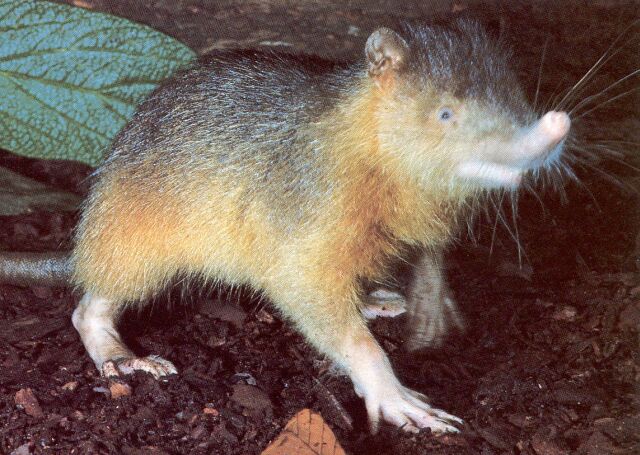
The Cuban Solenodon (Solenodon cubanus) is a shrew-like insectivore whose look reminds me most of a scaled down (to 6 or 7 inches) Rodent Of Unusual Size from The Princess Bride. They hail from the southeastern end of Cuba1, where they inhabit the dense, moist forests. They are nocturnal, relying on their sense of touch and their long snout to hunt.

They use toxic saliva to kill. Yes, the solenodon is a venomous mammal2, and its bite is used to subdue their prey—various arthropods. It is also used as defense against potential predators like snakes and birds of prey. Their name means “channel tooth,” which is likely the way to channel the venom, though I can’t find a source for that. Solenodons have an obviously positive impact on people, since their insectivorous habits help remove pests, and they are unlikely to hurt anyone unless you try to get bitten.

The solenodon is another island species that has been destroyed by the introduction of various carnivorous mammals. While rats, cats, and dogs have shown up in past posts, mongooses (mongeese?) have been introduced to Cuba, and destroyed the population. Enough that they were thought to be extinct, since none were found between 1890 and 1975.

Conservation is minimal, mostly relying on the fact that much of their habitat is within two Cuban National Parks.

1There also exists the Hispanolan solenodon, which is very similar to the Cuban variety, only on a different Caribbean Island. And cuter.
2I swore I had heard that the platypus, with a small spur, was the only venomous mammal. I was wrong.