Saturday, May 26, 2007

Reel Big Salamander

In the footnote for the Sagala Caecilian1, I mentioned some big, ugly salamanders. Both are endangered, and closely related to the Hellbender2, in the family Cryptobranchidae, and the three species are together known as the Giant Salamanders. I’ll skip over the second largest salamander (the Japanese Giant Salamander, Andrias japonicus, you can look up information on your own), and start talking about the largest salamander in the world.

Image from Giant Salamander Protection International

The Chinese Giant Salamander (Andrias davidianus) is visually quite a lot like the Hellbender: flattened body and head with tiny, beady eyes, and folds of skin hanging from its body through which it breathes. The major visual difference, which will cause no one to mistake the two, is that the Hellbender is about a foot long, while the Chinese Salamander gets up to about, oh, six feet or so. This picture is the only one I could find that uses a person for scale. I don’t think anyone will disagree with me writing about this animal here.

They live in the cold mountain streams of China. Since they’ve got no gills or lungs, these streams must be well oxygenated. They are nocturnal, and hunt with a quick sideways snap of their mouth. What they hunt seems only to be limited by what they can catch. The Giant Salamanders mate in late August, where, according to ARKive, “hundreds of individuals congregate at nest sites.” Take a look at the videos they’ve got3. Now imagine hundreds of those things in a single place, mating.

IUCN has a nice long list of why these stream-leviathans are endangered, such as wood plantations, mining, clear-cutting, hunting, and pollution. There’s a BBC article about the poaching problems. Conservation methods are coming into place, as they are a protected species. There’s even a Giant Salamander Protection International website, and protected areas in these mountains are starting to appear. While other people want to make sure there are tigers for their grandchildren to see, I want to make sure my grandchildren get the chance to see a six-foot long salamander. Heck, I want to see it.

1That was eight months ago! I’m impressed by how long I’ve kept this up, even if no one else is.
2I just got a job studying headwater streams in a nearby national park. My boss had a poster about Hellbender conservation in her office, and I asked if that meant they were local to the area. Alas, they are not. I was really hoping, too.
3I’m sure this is required viewing for CGI animators of Discovery Channel shows that involve prehistoric amphibians.

Saturday, May 19, 2007

Golden Nosering

Two weeks ago, Phantom Midge1 threw a suggestion into the ring. I like the fact that when I complain about having been given no suggestions, there are always a few people who feel bad enough for me and find some. I’ll admit that this one isn’t horribly ugly, but once again, it’s the creepy, creepy nose.

Image by Galen Rathbun


This is the Golden-Rumped Sengi (Rhynchocyon chrysopygus). “Sengi” is the new, fashionable term for elephant shrews, because elephant shrews are more closely related to elephants than shrews. All of the following (and proceeding) information I just found while looking up stuff on the Sengi2. Currently, taxonomists are having a field day with a wide variety of African mammals. It turns out that elephants, manatees, hyraxes, sengis, golden moles, tenrecs and the aardvark all are related to an ancient African mammal. Everything within is now grouped into the superorder Afrotheria, which, if I’m not too wrong with my Latin, means African Beast.

The Golden-Rumped Sengi is about nine inches long (bigger than I thought an elephant shrew was; that’s about the size of a full-grown Norway rat), with surprise, surprise, a yellowish orange patch on its rear. Under this patch is a thick dermal shield, which is used to protect against the biting attacks of other Sengis. They mate for life, living in monogamous pairs, and they jointly protect their territory. Males will chase off intruding males, and females will chase off intruding females.

The sengis use their long, flexible snout3 to seek and destroy insects and other yummy invertebrates that inhabit the leaf litter in the Kenyan forests in which they live. Being a small, and apparently tasty, mammal they’ve got to watch out for hawks and snakes. They escape by running up to 15 miles per hour, which is dang fast for something that small. After spotting such danger and sprinting away, they slap their tail on the ground as a warning. The predator then knows that it’s been spotted, so an ambush is out of the question.

Living, as they do in Kenya, habitat loss and fragmentation is the major issue facing the Golden-Rumped Sengi. In fact, their range is limited to two patches on the Kenyan coast; luckily (or more likely, because) those places are protected. Illegal hunting for food does happen, but ARKive says, “current levels are thought to be sustainable.” The California Academy of Sciences even says that it is possible to breed them in captivity.


1She really should get a blog, so I can link to her instead of her sister, who I’ve linked to enough that it’s easier just to put her on the sidebar.
2This blog is as much for my edification as anyone else’s. Heck, in just the last three weeks, I’ve learned to correctly pronounce “uakari,” what the thing on the top of a cassowary’s head is called, and of the existence of a blind wolf spider.
3You should really check out the ARKive videos on this. So creepy.

Sunday, May 13, 2007

The Monkey with the Red Face

Natalie1 suggested2 that I write about the White Uakari. The only problem was the species, the Bald Uakari, was listed as “near threatened” on the IUCN redlist. I’d like it to be at least “vulnerable” before I write about it. But then I looked at the page for the White Uakari subspecies, and, lo and behold, it’s vulnerable.
Image by Luiz Claudio Marigo


Bald Uakari3 are a bunch of red-faced, cat-sized monkeys. I’ll get to the face later. The White Uakari (Cacajao calvus calvus) is the subspecies of which has a white coat. Other notable Uakaris are the red one, the Ucayli one, and Novae’s one, all of which are listed as vulnerable. I’m not quite sure how each subspecies can be vulnerable while the species is not, but IUCN said something about changing definitions of “vulnerable.”

Alright, back to the face. The deep Amazon of western Brazil, where the White Uakaris live, is a malaria hot-zone. Pale faces are a symptom of malaria. So, having a red face is the Uakari’s equivalent to a six-pack: I’m so exceedingly healthy, you just gotta mate with me. Redder faces get more mates, and the paler faces, well, get malaria.

The rest of the White Uakari is, well, white. It has a shortish (for a monkey), non-prehensile tail. They live in large troops, up to 100, though there are smaller subgroups within each troop. They are foragers, living mostly on fruits, with snacks of buds, leaves, and bugs. With the thickness of the Amazonian rainforest, they have little need to land on the ground, and spend most of their lives in the treetops.

Being a rainforest species, no one will be surprised when I tell you that their major concern is habitat loss. Human hunting also occurs, which certainly can’t help. Conservation, therefore, is still an issue. Though, as much as I harp on them, the WWF is doing their part to help. They alone are a major driving source behind rainforest protection.

1Who has linked to me for quite some time now, it’s only fair that she gets a link back.
2Phantom Midge, look out for a Sengi post soon.
3Which I just now learned is pronounced wuh-KAR-ee. I had been horribly mispronouncing it my entire life.

Sunday, May 06, 2007

Mama Cass

Despite my pleas for ideas, no one sent in any suggestions. My girlfriend, who wrote the Andean Condor post, wanted another one on birds, and mentioned an animal that is widely regarded as one of the most dangerous animals to keep in captivity. I like to refer to them as the “Angry Technicolor Ostrich.”
Image from Australian Wildlife Conservancy

The Sothern Cassowary (Casuarius casuarius)1 is listed as vulnerable on the Australian endangered species list. They belong to the group of birds called Ratites, which also include ostriches, emus, rheas, and kiwis. None of them have the keel present in flighted birds, but have developed into strong runners.

They are strong kickers too. All of the ratites defend themselves with their sharp claws on their strong legs. Cassowaries are especially infamous for this. I had heard that they are able to disembowel a person, but I’m having problems finding any reliable source that confirms this. Not that they would eat anyone; they’re technically frugivores, and are a useful species for spreading the seeds of rainforest plants.

The name “Cassowary” comes from the Papuan word for the bird, which means “Horned Head.” The horn to which this name refers is also known as a casque. The purpose of the casque is only guessed at, with hypotheses ranging from pushing through rainforest foliage to establishing dominance. I haven’t seen anybody talking about why they’re bright blue with huge wattles, though.

Cassowaries are solitary animals, though, when they do get together, the males are subordinate to the females, since they’re smaller. The females lay several clutches of eggs, and then they leave. The males incubate the eggs and take care of the young, which look like zebra/leopard/goslings, and are fairly annoyingly cute.

As rainforest animals, the major threat comes in the form of habitat destruction for agricultural and developmental purposes. This also leads to fragmented populations, which has genetic diversity implications. Traffic accidents are becoming more frequent, and nobody wants to run into a four-foot tall, 130-pound bird with a helmeted head. The Australian government has conservation efforts in place, including education efforts

1The Northern Cassowary (C. unappendiculatus) is also listed as vulnerable, but there isn’t much difference between the species, so I just picked one.

Monday, April 30, 2007

"Will You Walk Into My Parlor?"

Sorry for such a late post. I don’t have any good excuses; I’ve just been slacking. A few weeks ago, Greg (who also suggested the Siaga Antelope) suggested an EUT for me1. I found out that its story is unavoidably attached to another Endangered Ugly Thing.
Image from Fish and Wildlife Service

This is the suggested animal, the Kauai Cave Amphipod (Spelaeorchestia koloana). It’s a blind, terrestrial, shrimp-like crustacean that inhabits the small caves formed by gas escaping through the Hawaiian lava2. It lives happily on the detritus to be found in those caves. The Kauai Cave Wolf Spider (Adelocosa anops) inhabits the same habitat, except it lives happily on the Cave Amphipods to be found there. They’re only found in about five different locations on the island of Kauai, most of which are on private property.

Everyone seems to find it strange that the government would protect both a predator and its main prey item. Someone even did a cartoon on it, and, quite frankly, I don’t often see people trying to anthropomorphize blind amphipods. Or amphipods of any kind.

Look, it’s not that strange. The Kauai Cave Amphipod is not endangered because the Kauai Cave Wolf Spider eats it. The amphipod has had millions of years to evolve defenses against the spider. They’re both endangered because of Hawaii’s3 rapid development. Y’know, paving over the lava, agriculture, and heavy use of insecticides for invasive species control (and other less noble goals). Protection is just starting, as they only got added to the list in 2003, though they’ve been working on restoring the caves since 1995.

1Please, please, please keep sending in those suggestions. It makes life so much easier for me.
2Yes, I know I just wrote about a Hawaiian EUT. See above footnote.
3I’m trying to decide if “Hawai’i’s” would look weird. Yeah it does.

Monday, April 23, 2007

I'm So Blue

I decided to look through the Ohio list to see if I could find anything of specific interest1. I realized that I hadn’t written about any fish for a while (though it seems I was on a bit of a fish-kick at the beginning). While in the fish section, I came across this blue sucker.

Image from Nature's Images Inc.

This is the Blue Sucker (Cycleptus elongatus), who populates fast moving streams in fast-moving Midwestern streams and rivers, mostly in the Mississippi river basin. Their mouth is the really disturbing bit: a pink, wart-covered maw used to suck up benthic aquatic invertebrates and some vegetative material. Their streamlined bodies (the elongatus part) and sickle-shaped dorsal fin help them manage their high-speed habitat. Spawning is fairly straightforward, occurring in spring and summer in deep rapids. The eggs are sticky, so they won’t immediately wash downstream.

It’s a freshwater species, so, like the Wartyback, the Lake Sturgeon, the Ohio Lamprey, the Eastern Hellbender, and the Queensland Lungfish, the Blue Sucker has a problem with dams2. In the sucker’s case, they’re built for fast-paced life, which is taken away by those concrete constructions3. Silt build-up is a by-product of dams that also isn’t too helpful, along with pollution draining into the rivers. Oh, and, they’re tasty, which is not a good thing for a fish trying to survive, as overfishing probably started the decline in the first place.

There’s good news for our azure friends: their numbers are increasing. Not, apparently, up to what they were pre-European, but they’re certainly on the rise. People who have never seen them before are reporting more and more. The reason given for this? The pollution levels are decreasing, and the Blue Suckers are finding alternative places to spawn. The fact that fishing them has been illegal since the ‘70s probably isn’t hurting.

1The Lake Erie Water Snake is on there, and I was considering writing about it, since it recently appeared on an episode of Dirty Jobs, along with someone I have worked with.
2Hydroelectric isn’t looking as good as it used to, is it?
3You’ve heard this one, but:
What did the fish say when it ran into the brick wall?
Dam.

Saturday, April 14, 2007

Maxwell's Silver Sword

My parents just came back from a cruise in Hawai’i1, and I felt compelled to ask if they found any exciting wildlife. They had, in fact, found a plant with this blog in mind. Instead of saddling Florabot with this one, I figured I’d write my first plant post.

Image from Dad
Image by Dan Yaussy

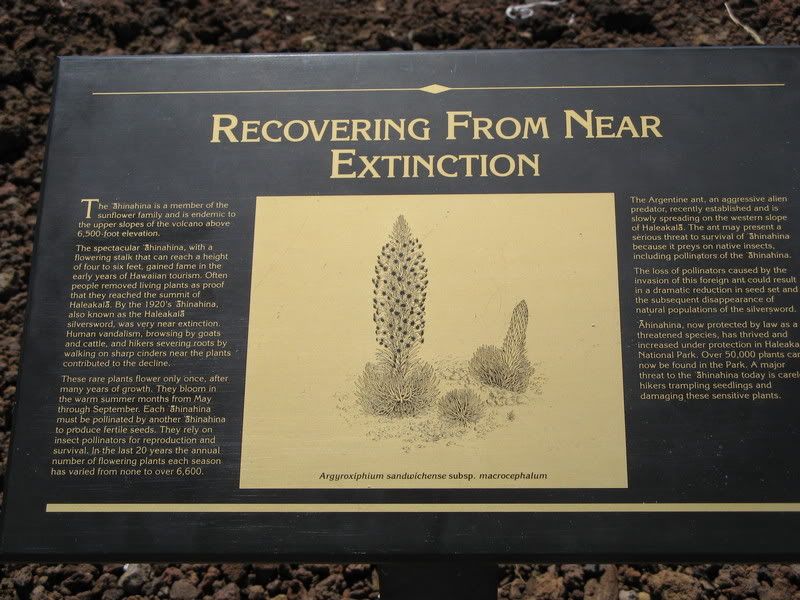
The Hawaiian Silversword (Argyroxiphium sandwicense) is a spiky, once-flowering relative of asters and sunflowers. There are two subspecies, the Halekala Silversword (ssp. macrocephalum), shown above, and found on Maui, and the Mauna Kea Silversword (ssp. sandwicense), which is found on that mountain on the Big Island. There are some differences between the subspecies. This means, that to tell which one you’re looking at, it helps to have a botanist and a dichotomous key.

The Silversword gets its name from the sharp, sword-like leaves that are covered with silvery hairs. These hairs reflect the hot Hawaiian sun, cooling down the plant, and the bristly leaves protect the center from predation. They grow on the sides of volcanoes with very shallow roots. They spend fifteen to fifty years growing as a short, sharp rosette, and then send a single stalk up to nine feet high with fifty to six hundred flowers2, set seed, and die.

Since the roots are so shallow, goats, sheep, and cattle easily uproot this plant when trying to eat it. Other invasive species, like Argentine ants, are also causing problems. Hikers can accidentally do same, or intentionally. Apparently, hikers used to pick them as proof they climbed the mountains where they grow. There’s no information on when “used to” was.

Lots of people are working on saving this prickle-ball. For example, people at the University of Arizona are currently working on making sure the Mauna Kea Silverswords don’t become terribly inbred after only a few were saved in the late ‘70s. Also, better signage and visitor education has helped remove some threats.

1I suppose I really can’t complain.
2They’re fairly small flowers.