This version of Endangered Ugly Things is at an end. You probably should have guessed that with the two years without posting.
However, don't despair! Endangered Ugly Things is now reborn as a Tumblr! I will be updating there with new EUTs, as well as shorter, punchier posts of favorite EUTs from the past!
Join me in the future of the internet, which I've only reached a good five years after everyone else.

Thursday, August 23, 2012
Tastes Like Chicken
I’m sorry for the lack of posts this year. It’s been a bit of a rough year, and, long story short, I’m now in a one-year master’s program to become a high-school Biology teacher. This came with 17 graduate credits this summer, so I’ve been a bit swamped. However, I have been able to get to the Akron Zoo every once in a while. There, I saw an animal that was perfect to pull EUT out of its eight-month slump. Meet the Mountain Chicken.

No, that’s the correct picture. Leptodactylus fallax also goes by Giant Ditch Frog or Crapaud (French for “toad). It is an impressively large frog1, weighing in at eight inches long and 1 and a half pounds. It hails from a few Caribbean islands, namely Dominica and Montserrat.
With a common name like “Mountain Chicken,” it isn’t really difficult to understand the main reason this animal is endangered: it’s delicious. Other problems like habitat destruction and the Cytrid fungus that have ravaged all amphibian populations are also plaguing this regal animal2.
As conservation programs tried to raise young froglets to maintain the population, they had to figure out the strange breeding and rearing habits of the Mountain Chicken. First, they don’t breed in water like other frogs. Instead, they dig burrows that fill with rainwater and do their business there. In this underground pool, the female releases a liquid that the male whips into a foamy nest. Then things get weird.

The above video gives a wonderful description of Mountain Chicken childcare, but I’ll give you a synopsis. Rather than resorting to grazing, hunting, or cannibalism like other tadpoles, the Mountain Chicken tadpoles rely on mom, who spews forth tens of thousands of unfertilized eggs. These are quickly gobbled up by the little babies, and the feeding frenzy is an image you’ll try to scrub from your mind for days.
Recently, hunting the Mountain Chicken has been outlawed. Scientists are still working on curing amphibians of the Chytrid fungus. Hopefully these, along with those breeding programs, can bring this Chicken back from the brink.
1The Mountain Chicken is only about half the size of the Goliath Frog, but that’s still pretty hefty.
2When held, they make an alarm call that sounds exactly like a giant squeaky toy. It’s ear-shatteringly adorable.

No, that’s the correct picture. Leptodactylus fallax also goes by Giant Ditch Frog or Crapaud (French for “toad). It is an impressively large frog1, weighing in at eight inches long and 1 and a half pounds. It hails from a few Caribbean islands, namely Dominica and Montserrat.
With a common name like “Mountain Chicken,” it isn’t really difficult to understand the main reason this animal is endangered: it’s delicious. Other problems like habitat destruction and the Cytrid fungus that have ravaged all amphibian populations are also plaguing this regal animal2.
As conservation programs tried to raise young froglets to maintain the population, they had to figure out the strange breeding and rearing habits of the Mountain Chicken. First, they don’t breed in water like other frogs. Instead, they dig burrows that fill with rainwater and do their business there. In this underground pool, the female releases a liquid that the male whips into a foamy nest. Then things get weird.
The above video gives a wonderful description of Mountain Chicken childcare, but I’ll give you a synopsis. Rather than resorting to grazing, hunting, or cannibalism like other tadpoles, the Mountain Chicken tadpoles rely on mom, who spews forth tens of thousands of unfertilized eggs. These are quickly gobbled up by the little babies, and the feeding frenzy is an image you’ll try to scrub from your mind for days.
Recently, hunting the Mountain Chicken has been outlawed. Scientists are still working on curing amphibians of the Chytrid fungus. Hopefully these, along with those breeding programs, can bring this Chicken back from the brink.
1The Mountain Chicken is only about half the size of the Goliath Frog, but that’s still pretty hefty.
2When held, they make an alarm call that sounds exactly like a giant squeaky toy. It’s ear-shatteringly adorable.
Sunday, January 29, 2012
Waltzing Matilda
Recently, a new species of snake was discovered in the Tanzanian rainforest. It belongs to a genus of viper whose hemotoxic1 venom has no known antidote. It is named after a young woman who has the honor of being one of the first people to take care of it. She happens to be seven.
This is Matilda's Horned Viper (Atheris matildae). The Matilda in question is Matilda Davenport, daughter of Tim Davenport, director of the Wildlife Conservation Society's Tanzania program. She took an early interest in the specimens the research team brought in. They began to unofficially refer to the snake as "Matilda's Viper," and, before long, it was no longer unofficial. Though it seems that Matilda's younger sister now wants a species named after her too.
The location of Matilda's Horned Viper are being kept under wraps, as the researchers fear poachers may come after this exotic and brightly colored snake for the pet trade. They've started a breeding program to provide individuals to zoos to allow the public to get their first glimpse of this gorgeous snake.
On a more personal note, I now have an Etsy shop where you can order needle-felted versions of Endangered Ugly Things. I can even make things just for you; to order, click the "Request custom item" button on the side of the shop.
1Short definition of hemotoxin: it kills your blood.
 |
| Image by Tim Davenport |
This is Matilda's Horned Viper (Atheris matildae). The Matilda in question is Matilda Davenport, daughter of Tim Davenport, director of the Wildlife Conservation Society's Tanzania program. She took an early interest in the specimens the research team brought in. They began to unofficially refer to the snake as "Matilda's Viper," and, before long, it was no longer unofficial. Though it seems that Matilda's younger sister now wants a species named after her too.
The location of Matilda's Horned Viper are being kept under wraps, as the researchers fear poachers may come after this exotic and brightly colored snake for the pet trade. They've started a breeding program to provide individuals to zoos to allow the public to get their first glimpse of this gorgeous snake.
On a more personal note, I now have an Etsy shop where you can order needle-felted versions of Endangered Ugly Things. I can even make things just for you; to order, click the "Request custom item" button on the side of the shop.
1Short definition of hemotoxin: it kills your blood.
Saturday, December 10, 2011
They Call Him Flipper
Dolphins are charismatic, no question about that. They play, they learn, they do amazing acrobatics. Their smiling faces draw people to aquatic parks worldwide. The freshwater dolphins have gotten some press lately, but they aren’t the prettiest dolphins around.

I suppose the Gharial-like snout on the Ganges River Dolphin (Platanista gangetica) is what bothers me about it. Its stubby dorsal fin gives it a humpbacked appearance that is far less pleasing than the torpedo-shaped marine dolphins we’re used to. However, both of these serve an important purpose: maneuverability. The shorter dorsal fin allows for faster turns, and the thin, tooth-filled rostrum is perfect for slashing sideways into an unsuspecting fish.
The Ganges River Dolphin is also effectively blind. The lack of a lens means that any light entering the eye is only seen as unfocused blurs of shadow. However, for a creature with echolocation living in the silt-filled rivers of India, this is less of a problem than one would expect.
As those silt-filled rivers are in some of the most densely human populated areas of the world, you can expect there to be some environmental issues. Damming, pollution, boat traffic, and by-catch are all problems that this blind dolphin faces. The Yangtze River Dolphin faced similar problems, and is now listed as “functionally extinct”.
The Ganges River Dolphin may have some support to save it from that fate. Dolphin reserves are being established, and the WWF is trying its darndest to educate the public. India even named this dolphin the National Aquatic Animal. However, there is still a lot of work to be done to make sure it doesn’t go the way of the Yangtze River Dolphin.

I suppose the Gharial-like snout on the Ganges River Dolphin (Platanista gangetica) is what bothers me about it. Its stubby dorsal fin gives it a humpbacked appearance that is far less pleasing than the torpedo-shaped marine dolphins we’re used to. However, both of these serve an important purpose: maneuverability. The shorter dorsal fin allows for faster turns, and the thin, tooth-filled rostrum is perfect for slashing sideways into an unsuspecting fish.
The Ganges River Dolphin is also effectively blind. The lack of a lens means that any light entering the eye is only seen as unfocused blurs of shadow. However, for a creature with echolocation living in the silt-filled rivers of India, this is less of a problem than one would expect.
As those silt-filled rivers are in some of the most densely human populated areas of the world, you can expect there to be some environmental issues. Damming, pollution, boat traffic, and by-catch are all problems that this blind dolphin faces. The Yangtze River Dolphin faced similar problems, and is now listed as “functionally extinct”.
The Ganges River Dolphin may have some support to save it from that fate. Dolphin reserves are being established, and the WWF is trying its darndest to educate the public. India even named this dolphin the National Aquatic Animal. However, there is still a lot of work to be done to make sure it doesn’t go the way of the Yangtze River Dolphin.
Thursday, October 20, 2011
No One Like You
For October, Jonathan Wojcik of Bogleech agreed to do a guest post for Endangered Ugly Things. Check out his site for all the information you could ever want about monsters, real or imagined. Enjoy!
-Garfman
There are over a hundred thousand named Arachnids crawling around on our planet's surface, and America is more aware of them this time of year than any other season. Famous though they are, these ubiquitous terrestrial predators are seldom evaluated for their conservation status, and the exceptions have consisted almost entirely of spiders - really only one of several strange and incredibly ancient Arachnid groups.
Currently, there are at least two non-spider Arachnida recognized as threatened, and both of them belong to the family Lycosidae, or "pseudoscorpions." Though found virtually everywhere, these mostly blind predators go largely unnoticed due to their subterranean habits and incredibly small size - so small you can find them preying upon mites, lice and springtails between grains of soil, under the wing cases of beetles, in the fur of mice or between the pages of dusty, moldy old books. Many species will even use far larger, flying insects as transportation, grabbing into their leg hairs with a single claw and letting go at the next landing.
As their names imply, pseudoscorpions are entirely separate from the true scorpions, lacking the venomous tails but bearing very similar pincers which, in many species, can inject venom through the lower thumb-like claw. As an added bonus, they can also regurgitate a corrosive enzyme over stunned prey and secrete silk from their jaws, usually used to build igloo-shaped cocoons in which they molt and overwinter. Mating typically involves a "dancing" ritual where the male, locking pincers with the female, guides her over a sperm packet he lays on the ground. Like many other arachnids, females will carry their babies on their backs until tough enough to fend for themselves.
These minute animals have existed in more or less the same form for over 380 million years, but at least two species could disappear on us at any moment. Known endangered Lycosids include Fissilicreagris imperialis and Tartarocreagris texana, the Empire cave and Tooth Cave pseudoscorpions. Like many other creatures you can read about on EUT, these troglobytes are completely unique to their respective cave systems and have adapted to survive in no other environment. Any unusual activity can be disastrous for cave dwelling organisms; even a few careless spelunkers or a trickle of urban runoff can disrupt conditions that have remained unchanged for eons.
A staggering portion of the human race suffers from unreasonable levels of terror associated with eight-legged arthropods, but it's not fair to let a widespread phobia cloud our concern for the plight of any species, large or small. If more of us could get past our fears and appreciate just how weird, cool and useful the Arachnids are, we might be seeing quite a few more of them not only listed, but actively protected. Right now, eyeless micromonsters are dancing in each other's arms in pitch darkness, and surely deserve as much as any other animal to continue doing so for ages to come.
-Garfman
There are over a hundred thousand named Arachnids crawling around on our planet's surface, and America is more aware of them this time of year than any other season. Famous though they are, these ubiquitous terrestrial predators are seldom evaluated for their conservation status, and the exceptions have consisted almost entirely of spiders - really only one of several strange and incredibly ancient Arachnid groups.
 | ||
| Image by Gilles San Martin |
Currently, there are at least two non-spider Arachnida recognized as threatened, and both of them belong to the family Lycosidae, or "pseudoscorpions." Though found virtually everywhere, these mostly blind predators go largely unnoticed due to their subterranean habits and incredibly small size - so small you can find them preying upon mites, lice and springtails between grains of soil, under the wing cases of beetles, in the fur of mice or between the pages of dusty, moldy old books. Many species will even use far larger, flying insects as transportation, grabbing into their leg hairs with a single claw and letting go at the next landing.
As their names imply, pseudoscorpions are entirely separate from the true scorpions, lacking the venomous tails but bearing very similar pincers which, in many species, can inject venom through the lower thumb-like claw. As an added bonus, they can also regurgitate a corrosive enzyme over stunned prey and secrete silk from their jaws, usually used to build igloo-shaped cocoons in which they molt and overwinter. Mating typically involves a "dancing" ritual where the male, locking pincers with the female, guides her over a sperm packet he lays on the ground. Like many other arachnids, females will carry their babies on their backs until tough enough to fend for themselves.
These minute animals have existed in more or less the same form for over 380 million years, but at least two species could disappear on us at any moment. Known endangered Lycosids include Fissilicreagris imperialis and Tartarocreagris texana, the Empire cave and Tooth Cave pseudoscorpions. Like many other creatures you can read about on EUT, these troglobytes are completely unique to their respective cave systems and have adapted to survive in no other environment. Any unusual activity can be disastrous for cave dwelling organisms; even a few careless spelunkers or a trickle of urban runoff can disrupt conditions that have remained unchanged for eons.
A staggering portion of the human race suffers from unreasonable levels of terror associated with eight-legged arthropods, but it's not fair to let a widespread phobia cloud our concern for the plight of any species, large or small. If more of us could get past our fears and appreciate just how weird, cool and useful the Arachnids are, we might be seeing quite a few more of them not only listed, but actively protected. Right now, eyeless micromonsters are dancing in each other's arms in pitch darkness, and surely deserve as much as any other animal to continue doing so for ages to come.
Saturday, July 23, 2011
Beware! The Blob
I’ve tried to write about the Blobfish (Psychrolutes marcidus) before, but gave up due to lack of information. It was first suggested to me about a year and a half ago, and has been suggested a few times since then. I think I’ve found enough information about it and its close relatives to do it justice. First things first, though: the Blobfish does not look like a deflated Ziggy.

Yes, that is a picture of the Blobfish, and yes, that picture makes it look like someone let the air out of Ziggy’s oversized head. However, that picture was taken of a dead specimen on a research boat, right before it was pickled in formaldehyde. Blobfish don’t rely on swim bladders to remain buoyant like other fish, because the pressure of half a mile of water would squish the air right out of them. Instead, their flesh contains a gelatin-like substance that is nearly equal to the density of water. This means they can float effortlessly in the water, but makes it look like they melted above the surface. As to what they really look like, this is a much better picture:

These fish, who now resemble their Sculpin brethren much closer, bob along the ocean floor around the coast of Australia and New Zealand. There, they eat whatever floats or crawls by—mostly crabs, snails, and octopuses1.
Everyone seems to think Blobfish are lazy. Yes, they are adapted to using as little energy as possible to eat and move, but they are not deadbeats. While other fish spawn and leave, the Blobfish is an attentive parent. They will clean and sit on the eggs, protecting them from parasites and predators.
More efficient fishing methods have caused no end of trouble to all kinds of sea creatures. Trawling the ocean floor for crustaceans also picks up bycatch like the Blobfish. Callum Roberts and other scientists are worried about the future of this majestic fish. While it’s not officially listed as endangered, the government is certainly worried about it.
Public knowledge about bycatch in general, and the Blobfish in specific, is growing. Professor Roberts has certainly been trying to get the word out. There is also this British kids’ show that depicts the Blobfish fairly accurately, as well as adorably. They also sound like British Zoidbergs, which seems appropriate.

1You can argue all you want about the proper plural of “octopus.” There isn’t one.
Yes, that is a picture of the Blobfish, and yes, that picture makes it look like someone let the air out of Ziggy’s oversized head. However, that picture was taken of a dead specimen on a research boat, right before it was pickled in formaldehyde. Blobfish don’t rely on swim bladders to remain buoyant like other fish, because the pressure of half a mile of water would squish the air right out of them. Instead, their flesh contains a gelatin-like substance that is nearly equal to the density of water. This means they can float effortlessly in the water, but makes it look like they melted above the surface. As to what they really look like, this is a much better picture:
These fish, who now resemble their Sculpin brethren much closer, bob along the ocean floor around the coast of Australia and New Zealand. There, they eat whatever floats or crawls by—mostly crabs, snails, and octopuses1.
Everyone seems to think Blobfish are lazy. Yes, they are adapted to using as little energy as possible to eat and move, but they are not deadbeats. While other fish spawn and leave, the Blobfish is an attentive parent. They will clean and sit on the eggs, protecting them from parasites and predators.
More efficient fishing methods have caused no end of trouble to all kinds of sea creatures. Trawling the ocean floor for crustaceans also picks up bycatch like the Blobfish. Callum Roberts and other scientists are worried about the future of this majestic fish. While it’s not officially listed as endangered, the government is certainly worried about it.
Public knowledge about bycatch in general, and the Blobfish in specific, is growing. Professor Roberts has certainly been trying to get the word out. There is also this British kids’ show that depicts the Blobfish fairly accurately, as well as adorably. They also sound like British Zoidbergs, which seems appropriate.
1You can argue all you want about the proper plural of “octopus.” There isn’t one.
Sunday, June 19, 2011
Trapped Under Ice - Metallica
For this month’s EUT, I was looking for an invertebrate in a new taxon. While I technically found one, “invertebrate” usually implies an animal. As to what it looks like… well… it looks like someone shoved a bottle of glitter up their nose, and then sneezed on a branch1.

This is a slime mold known only as Diacheopsis metallica. Despite appearances, it is a single-celled amoeba. Slime molds spend a large amount of the time as you would expect an amoeba to: gooping around as an individual cell, eating things smaller than itself. When things get rough the individuals band together, Voltron-syle, to search for food or water. This isn’t to say the cells form together into a multi-cellular creature. Instead, they form a gigantic, multi-nucleated cell that is able to pick up and move, slug-like, to a more favorable location. They also use this time to produce spores, which will spread if things don’t get any better.
Scientists have found this aspect of slime molds absolutely fascinating. In this form, slime molds can solve mazes. It will even re-create the Tokyo Rail map when food is placed at junction points. Computer scientists are researching how slime molds solve problems to help programs search, move, and problem solve more organically.
D. metallica is a cold-adapted slime mold that lives on the tops of mountains in scattered ranges throughout the world. While they hibernate as spores during the winter, they become active in spring. They use the melting snow to create the correct temperature and the right amount of water to create favorable conditions to eat and multiply.
While the IUCN doesn’t have this slime mold officially listed, they are beginning to worry about it. On their Species of the Day fact sheet, they say it “has a provisional listing of ‘Near Threatened’.” This is because global climate change is shrinking the snow-covered habitat that these glittery globules rely on. Individual conservation actions for a slime mold are near impossible to carry out, but trying to fix climate change is a good start.
1My wife says this is something Ke$ha would do.
This is a slime mold known only as Diacheopsis metallica. Despite appearances, it is a single-celled amoeba. Slime molds spend a large amount of the time as you would expect an amoeba to: gooping around as an individual cell, eating things smaller than itself. When things get rough the individuals band together, Voltron-syle, to search for food or water. This isn’t to say the cells form together into a multi-cellular creature. Instead, they form a gigantic, multi-nucleated cell that is able to pick up and move, slug-like, to a more favorable location. They also use this time to produce spores, which will spread if things don’t get any better.
Scientists have found this aspect of slime molds absolutely fascinating. In this form, slime molds can solve mazes. It will even re-create the Tokyo Rail map when food is placed at junction points. Computer scientists are researching how slime molds solve problems to help programs search, move, and problem solve more organically.
D. metallica is a cold-adapted slime mold that lives on the tops of mountains in scattered ranges throughout the world. While they hibernate as spores during the winter, they become active in spring. They use the melting snow to create the correct temperature and the right amount of water to create favorable conditions to eat and multiply.
While the IUCN doesn’t have this slime mold officially listed, they are beginning to worry about it. On their Species of the Day fact sheet, they say it “has a provisional listing of ‘Near Threatened’.” This is because global climate change is shrinking the snow-covered habitat that these glittery globules rely on. Individual conservation actions for a slime mold are near impossible to carry out, but trying to fix climate change is a good start.
1My wife says this is something Ke$ha would do.
Monday, May 23, 2011
He Put the Taz in Taz-Mania

Much like the Hyena and the Wolverine, the Tasmanian Devil (Sarcophilus harrisii) has a reputation. Once again, that reputation as a fierce predator and unscrupulous scavenger is not entirely unfounded. As the largest marsupial predator alive, the Tasmanian Devil will kill and eat most anything smaller than itself, and happily scavenge the remains of anything larger. The name “Devil" seems harsh for an animal the size of a lapdog, but when early settlers heard them fighting through the night, “Devil” came readily to mind.
Tasmanian Devils don’t typically hang out together except when a particularly large carcass has been found. Disagreements soon break out1 about who gets to eat first. However, like its Warner Brothers counterpart, the Tasmanian Devil is more loudmouth than fighter, especially to its own species2. There is a lot of growling, and baring teeth, and even some nipping, but physical fights are rare.
The home life of the Tasmanian Devil is nearly as dysfunctional (by human standards) as its table manners. When a female is ready to mate, she will visit a number of males to make sure she’s pregnant. She will give birth to about 30 raisin-sized babies, which is an issue, because she only has four teats. The newborns race to the pouch, and only the winners survive to weaning. In eight months, the young are ready to head out on their own.
Since European settlers arrived in Tasmania, the Devils have had a roller-coaster ride in terms of population. Initially they were killed for raiding chicken coops and the like. In the 1940s, they became protected by law. This increased their numbers enough that they were once again considered a pest species by the 1980s. Then, in the 1990s, a new threat emerged: Devil Facial Tumor Disease. This is a contagious cancer that has once again reduced Tasmanian Devil population to a fraction of what it once was.
The Tasmanian government has lost no time in trying to protect these animals, including quickly having the Tasmanian Devil listed as endangered. Breeding programs, disease research, and awareness campaigns have popped up all over the island in an attempt to save this little loudmouth.
1 While the Tasmanian Devil in that video is eating, he sounds exactly like my cat.
2For your listening pleasure, please compare Mel Blanc’s interpretation with the real thing. I’m sure your co-workers won’t mind if you’re listening at work.
Saturday, April 23, 2011
Mr. Bighead
Years ago, I read about this month’s EUT in the Animal Wonders edition of Zoobooks, the same place I first learned about the Axolotl. The illustration was strange enough to catch my eye and imagination for a good few months—a long time for my flighty young mind1. I recently rediscovered this animal whose complete disproportion struck me at such a young age.

The scientific name of the Big-Headed Turtle (Platysternon megacephalum) means “flat-chest big-head,” which is obviously quite apt. Every article that mentions the Big-Headed Turtle states that its gigantic noggin is too large to fit in its narrow shell. So, to protect its head, the turtle uses a two pronged approach. One: the solid bone skull is covered with thick scales. Two: massive, very sharp jaws are coupled with a tendency to bite.
This turtle inhabits shallow, fast moving streams in Southeast Asia, where it enjoys a diet of fish and mussels. Swimming around in the heavy flow of these streams would take too much effort, so the Big-Headed turtle is an excellent climber instead, and ARKive has video to prove it. Its long flexible tail helps to prop it up as it uses its strong claws and beak to climb waterfalls. There are even stories of finding these turtles climbing trees and bushes. What they did when they got up there is anyone’s guess.
The Big-Headed Turtle’s big head seems to evoke one of two responses: it is either grotesquely disproportionate, or adorably baby-like. The second of these responses has led to a large number of them being caught for the pet-trade. While some captive breeding exists, there are not nearly enough Big-Head farms to supply demand for the pet trade. For this reason, it was placed on the IUCN Redlist in 2000, and is now CITES protected as well.
1An incomplete list of animals that have, at one point, been “my favorite animal”: giraffes, raccoons, pangolins, mosquitoes, jellyfish, frilled lizards, chameleons, fireflies, sloths, and many more I can’t think of right now.
The scientific name of the Big-Headed Turtle (Platysternon megacephalum) means “flat-chest big-head,” which is obviously quite apt. Every article that mentions the Big-Headed Turtle states that its gigantic noggin is too large to fit in its narrow shell. So, to protect its head, the turtle uses a two pronged approach. One: the solid bone skull is covered with thick scales. Two: massive, very sharp jaws are coupled with a tendency to bite.
This turtle inhabits shallow, fast moving streams in Southeast Asia, where it enjoys a diet of fish and mussels. Swimming around in the heavy flow of these streams would take too much effort, so the Big-Headed turtle is an excellent climber instead, and ARKive has video to prove it. Its long flexible tail helps to prop it up as it uses its strong claws and beak to climb waterfalls. There are even stories of finding these turtles climbing trees and bushes. What they did when they got up there is anyone’s guess.
The Big-Headed Turtle’s big head seems to evoke one of two responses: it is either grotesquely disproportionate, or adorably baby-like. The second of these responses has led to a large number of them being caught for the pet-trade. While some captive breeding exists, there are not nearly enough Big-Head farms to supply demand for the pet trade. For this reason, it was placed on the IUCN Redlist in 2000, and is now CITES protected as well.
1An incomplete list of animals that have, at one point, been “my favorite animal”: giraffes, raccoons, pangolins, mosquitoes, jellyfish, frilled lizards, chameleons, fireflies, sloths, and many more I can’t think of right now.
Thursday, March 31, 2011
Nevermore
Crows have been long associated with death in Western culture. In Medieval times, they were known to follow armored soldiers into battle for the prospect of feasting on the casualties. In modern times, people see them eating roadkill, as Halloween decorations, or as the monsters from The Birds. While Crows certainly enjoy carrion there is another side to them less frequently seen in modern interpretations. For one thing, they are omnivorous so dead things are only part of their diet. For another thing, they might be just as smart as the prettier parrots.
Our main method of determining animal intelligence is looking at how well they solve problems. Crows are masters. They bend wires into fishhooks to pull food from thin tubes. They have learned to use cars to crack hard nuts—while waiting for the light to turn red to retrieve them. One person is trying to teach them to use a vending machine. They can mimic human speech, with more clarity than most parrots. So, when you see a Crow walking down the sidewalk, don’t think, “portent of death,” think “Whosa prettybird?”

The Hawaiian Crow (Corvus hawaiiansis), is locally known as the ‘Alala. It has a lot in common with your more familiar American Crow: they eat whatever they want (mostly fruit and eggs), they hang out in groups, are strong fliers, and like to play wrestle. They use tools to get to their food. However, the ‘Alala is larger, and has a larger, rounder beak.
Why the Hawaiian Crow is in trouble is up for debate: it could be disease, habitat loss, or introduced predators, such as rats or mongooses. Chances are good that it’s all of the above. There is no question that it is in big trouble. The last wild ‘Alala pair were seen in 2003. All the rest of them alive today—about 70 individuals—are in two captive breeding facilities. Release programs have been unsuccessful. Part of that is due to the aforementioned predators, but there’s a problem that the conservationists didn’t foresee. Crows are smart, but because of that, they need to be taught. Without a whole society to teach them, the new crows haven’t learned how to properly forage or escape predators.
Our main method of determining animal intelligence is looking at how well they solve problems. Crows are masters. They bend wires into fishhooks to pull food from thin tubes. They have learned to use cars to crack hard nuts—while waiting for the light to turn red to retrieve them. One person is trying to teach them to use a vending machine. They can mimic human speech, with more clarity than most parrots. So, when you see a Crow walking down the sidewalk, don’t think, “portent of death,” think “Whosa prettybird?”
The Hawaiian Crow (Corvus hawaiiansis), is locally known as the ‘Alala. It has a lot in common with your more familiar American Crow: they eat whatever they want (mostly fruit and eggs), they hang out in groups, are strong fliers, and like to play wrestle. They use tools to get to their food. However, the ‘Alala is larger, and has a larger, rounder beak.
Why the Hawaiian Crow is in trouble is up for debate: it could be disease, habitat loss, or introduced predators, such as rats or mongooses. Chances are good that it’s all of the above. There is no question that it is in big trouble. The last wild ‘Alala pair were seen in 2003. All the rest of them alive today—about 70 individuals—are in two captive breeding facilities. Release programs have been unsuccessful. Part of that is due to the aforementioned predators, but there’s a problem that the conservationists didn’t foresee. Crows are smart, but because of that, they need to be taught. Without a whole society to teach them, the new crows haven’t learned how to properly forage or escape predators.
Sunday, November 14, 2010
Jabberjaw
I was looking through IUCN’s Species of the Day list and found something adorable. It fits the two facial features that define “cute”—big eyes and a short snout. Unlike most members of its group, it has been known to play by grabbing vegetation and trailing it behind itself as others give chase. It exhibits curiosity with man-made objects. It has a cutesy name that sounds like an embarrassing nickname.
It’s a six-foot long shark.

Where the Porbeagle (Lamna nasus) gets its name no one is quite sure. The commonly cited combination of “porpoise” and “beagle” seems awkward to me, but there are a number of other etymological theories to pick from. They are built for speed, with crescent tails for powerful strokes, keels on the base of the tail for balance, and large gills for better efficiency. These adaptations help them chase after mackerel and other schooling fish to eat.
Their playful antics have been widely documented. They play tag using kelp, as mentioned above, as well as playing catch with driftwood. They will also poke at fishers’ balloon floats, and appear to be confused when they pop. The phrase “mindless killing machines” is so frequently thrown around with sharks, but the Porbeagle’s actions are causing a number of shark experts to question that concept. Other sharks (including the infamous Great White) have been described as “curious,” but they only have one tool with which to explore the world, and it’s filled with enough teeth to turn the object of their curiosity into mincemeat.
Despite their potential danger (see previous statement regarding teeth and mincemeat), the Porbeagle hardly attacks anyone - ever. The International Shark Attack File lists 5 total attacks, fatal and non-fatal, from the Porbeagle in 2003. Compare that to the Great White Shark with 244 fatal, unprovoked attacks. In fact, looking at the rest of the list, anything with fewer attacks than the Porbeagle either have no teeth, are impossible to find, or are too small to be a threat to humans. The infrequency of attacks may be due to the fact that “if the water is warm enough for you to be swimming, it is too warm for the porbeagle,” but it seems that this is a very docile shark.
One place the Porbeagle will fight ferociously is on a fishing line, and for good reason. Overfishing in the north Atlantic caused population crashes that devastated not only the shark, but the fishing industry that created the problem. These incidents have led to regulations to limit Porbeagle catch. Earlier this year, CITES set trade regulations in place to help save this playful, docile “mindless killing machine.”
It’s a six-foot long shark.
Where the Porbeagle (Lamna nasus) gets its name no one is quite sure. The commonly cited combination of “porpoise” and “beagle” seems awkward to me, but there are a number of other etymological theories to pick from. They are built for speed, with crescent tails for powerful strokes, keels on the base of the tail for balance, and large gills for better efficiency. These adaptations help them chase after mackerel and other schooling fish to eat.
Their playful antics have been widely documented. They play tag using kelp, as mentioned above, as well as playing catch with driftwood. They will also poke at fishers’ balloon floats, and appear to be confused when they pop. The phrase “mindless killing machines” is so frequently thrown around with sharks, but the Porbeagle’s actions are causing a number of shark experts to question that concept. Other sharks (including the infamous Great White) have been described as “curious,” but they only have one tool with which to explore the world, and it’s filled with enough teeth to turn the object of their curiosity into mincemeat.
Despite their potential danger (see previous statement regarding teeth and mincemeat), the Porbeagle hardly attacks anyone - ever. The International Shark Attack File lists 5 total attacks, fatal and non-fatal, from the Porbeagle in 2003. Compare that to the Great White Shark with 244 fatal, unprovoked attacks. In fact, looking at the rest of the list, anything with fewer attacks than the Porbeagle either have no teeth, are impossible to find, or are too small to be a threat to humans. The infrequency of attacks may be due to the fact that “if the water is warm enough for you to be swimming, it is too warm for the porbeagle,” but it seems that this is a very docile shark.
One place the Porbeagle will fight ferociously is on a fishing line, and for good reason. Overfishing in the north Atlantic caused population crashes that devastated not only the shark, but the fishing industry that created the problem. These incidents have led to regulations to limit Porbeagle catch. Earlier this year, CITES set trade regulations in place to help save this playful, docile “mindless killing machine.”
Monday, October 18, 2010
Dirty Little Sea Kraits
(Alternative title: Krait Expectations)
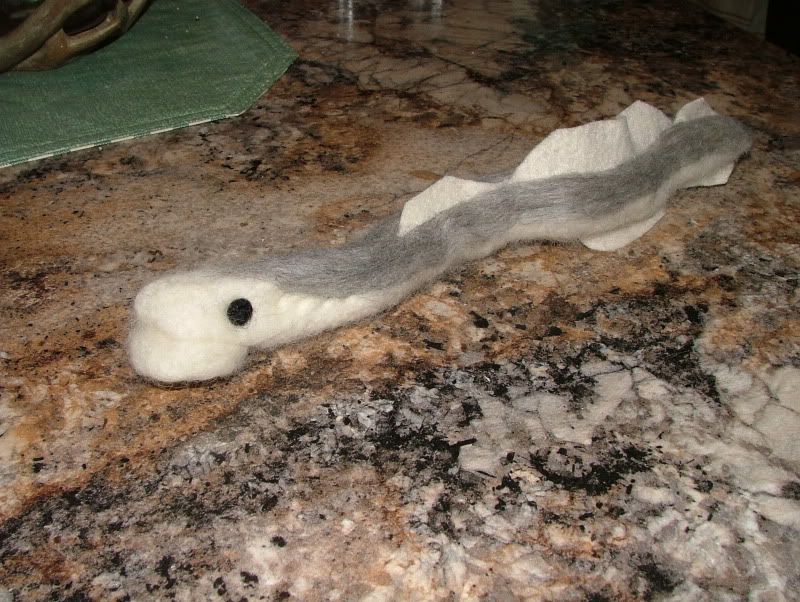
It seems that media attention of non-charismatic species is growing. I recently had an interview with a French news site, which can be found here. Also, my wife (I’m still getting used to saying that) has taught me how to needle felt. Remember how I complained that there’s no such thing as a plush Lamprey? There is now. I would like to make more plush EUTs, but I need suggestions about which ones to create. Please leave suggestions, and I promise you’ll see them by the next post.

The Rennell Island Sea Krait (Laticauda crockeri) is like most other Sea Kraits in many ways: it uses its wide paddle tail and venomous bite to hunt fish. On the other hand, it is smaller, not striped, and, oh yeah, doesn’t live in the sea. Instead, they’re found in the brackish Lake Tegano in the Solomon Islands.
I suppose I should back up somewhat. Sea Snakes are exactly what they sound like—snakes that are well-adapted to marine life. They have large, oar-like tails for propulsion, smooth scales for less drag, big long lungs for hours of underwater hunting, and potent venom for easy hunting. Because of these traits, most of them hardly ever make it on to dry ground. Sea Kraits, however, are the least aquatically adapted of the Sea Snakes, with rougher scales and smaller tail fins that allow them to manage better on land.
Due to the small size of the range of the Rennell Island Sea Krait—that is, half of a small island in the South Pacific—it is automatically considered Vulnerable by the IUCN. However, the minimalistic human use of the island has helped keep the area pristine. While there is tourism, it seems to stay within the realm of nature observation with little impact on the ecosystem.
It seems that media attention of non-charismatic species is growing. I recently had an interview with a French news site, which can be found here. Also, my wife (I’m still getting used to saying that) has taught me how to needle felt. Remember how I complained that there’s no such thing as a plush Lamprey? There is now. I would like to make more plush EUTs, but I need suggestions about which ones to create. Please leave suggestions, and I promise you’ll see them by the next post.
The Rennell Island Sea Krait (Laticauda crockeri) is like most other Sea Kraits in many ways: it uses its wide paddle tail and venomous bite to hunt fish. On the other hand, it is smaller, not striped, and, oh yeah, doesn’t live in the sea. Instead, they’re found in the brackish Lake Tegano in the Solomon Islands.
I suppose I should back up somewhat. Sea Snakes are exactly what they sound like—snakes that are well-adapted to marine life. They have large, oar-like tails for propulsion, smooth scales for less drag, big long lungs for hours of underwater hunting, and potent venom for easy hunting. Because of these traits, most of them hardly ever make it on to dry ground. Sea Kraits, however, are the least aquatically adapted of the Sea Snakes, with rougher scales and smaller tail fins that allow them to manage better on land.
Due to the small size of the range of the Rennell Island Sea Krait—that is, half of a small island in the South Pacific—it is automatically considered Vulnerable by the IUCN. However, the minimalistic human use of the island has helped keep the area pristine. While there is tourism, it seems to stay within the realm of nature observation with little impact on the ecosystem.
Monday, September 13, 2010
Plague of Locusts
I’m sorry I missed the end of August, but I was kind of getting married, so I hope you’ll excuse the late post. Since I just moved to the Upper Peninsula of Michigan1, I decided I needed to write about a local Endangered Ugly Thing. Meet the Lake Huron Locust (Trimerotropis huroniana)

This locust is a drab-looking grasshopper, and not one to stand out in a crowd. It’s about an inch long, slate grey, and looks like a large number of related insects. The biggest characteristic that sets them apart from other grasshoppers is their habitat. Instead of living in thick grasses or dense woodlands, they live on meagerly vegetated beaches. There, they blend in with the sand and eat the sparse grasses that grow there.
Like most grasshoppers, male Lake Huron Locusts use the familiar melodic (or grating, depending on your preference) chirping to attract a mate. They also add an aerial element to their ritual, flying up in the air, snapping their wings to make a crackling noise2. Eggs laid in the summer hatch the next spring, and mature in time to start the cycle again.
One of the largest threats to the Lake Huron Locust is the creation of summer homes on the dune habitats where these insects reside. This irks me, as the “summer” here lasts approximately from mid-July to mid-August. Protecting the dunes and the vegetation found there is the most effective method to keep these little locusts alive.
1This is properly pronounced “da U.P., eh?”
2Does it surprise you to know that entomologists have a name for this? It’s called “crepitating”.
This locust is a drab-looking grasshopper, and not one to stand out in a crowd. It’s about an inch long, slate grey, and looks like a large number of related insects. The biggest characteristic that sets them apart from other grasshoppers is their habitat. Instead of living in thick grasses or dense woodlands, they live on meagerly vegetated beaches. There, they blend in with the sand and eat the sparse grasses that grow there.
Like most grasshoppers, male Lake Huron Locusts use the familiar melodic (or grating, depending on your preference) chirping to attract a mate. They also add an aerial element to their ritual, flying up in the air, snapping their wings to make a crackling noise2. Eggs laid in the summer hatch the next spring, and mature in time to start the cycle again.
One of the largest threats to the Lake Huron Locust is the creation of summer homes on the dune habitats where these insects reside. This irks me, as the “summer” here lasts approximately from mid-July to mid-August. Protecting the dunes and the vegetation found there is the most effective method to keep these little locusts alive.
1This is properly pronounced “da U.P., eh?”
2Does it surprise you to know that entomologists have a name for this? It’s called “crepitating”.
Tuesday, July 27, 2010
Black and White and Red All Over
This marks the 100th post on this blog. To celebrate, I intend to do something a little different from what I’ve done in the past. For this month’s species, I’ll be writing about an animal widely considered to be one of the cutest around. It has become China’s golden child and the face of the World Wildlife fund. I am, of course, talking about the Giant Panda (Ailuropoda melanoleuca). While previously thought to be halfway between bears and raccoons, recent evidence puts them squarely in the bear family. Keep that in mind as you read this, as there is a depth to these animals that isn’t widely publicized.

The idea that Pandas eat only bamboo isn’t too far from the truth, as it makes up the large majority of their diet1. However, they are not above enjoying carrion if they happen to come across it. This is beautifully illustrated in this ARKive video, where a Panda saunters up to a rotting deer carcass, rips off a leg, and sits back to enjoy his meal. There are even reports of a wild Panda killing sheep, though it didn’t eat any of them.
Carnivory is one thing, but surely aggression isn’t a trait of these cute fuzzy-wuzzys, right? I’m sure that’s what went through mind of the drunk man who jumped into a zoo enclosure to give Gu Gu the Panda a hug, right before Gu Gu bit his legs. Or the teenager that scared Gu Gu into biting his legs. Or the man who jumped into Gu Gu’s enclosure to retrieve his 5-year old’s toy. Guess what happened to him. “Not so Cute” or “Not too Cuddly” seems to be the response of reporters on incidents like these. How surprised would we be if these had occurred with a Grizzly Bear? This is just an increasingly frustrated animal trying to defend its territory. The story is likely the same for the Panda in this video, attacking a man sitting outside its enclosure.
While it may seem like I’m trying to vilify the Panda, it's only to prove a point. I’ve got nothing against scavengers, or even dangerous animals. But the Giant Panda just dropped a few levels in the cuteness scale in the last two paragraphs, didn’t it? I’ve got all sorts of tidbits that could make any Charismatic Megafauna seem less charismatic2. Putting an animal on a pedestal just makes it that much easier to knock off, and turning an animal into a symbol makes you forget that it’s an animal. All creatures have behaviors that humans aren’t fond of, but we can’t expect them to act like giant teddy bears. While conservation efforts have helped the Giant Panda in the wild, over-exposure of the “cute” version of their life has left more and more people bored by its plight. The solution, as I see it, is to spread the exposure around to any other species that could use the help. Which is where I come in, I suppose. I hope I’ve managed to achieve that since I started this blog.
I really want to thank all of my readers who have stuck with me through these one hundred posts. I also have to thank my fiancée and my parents, who have helped with editing and ideas, but far more importantly have completely and utterly supported this fool idea of mine for four years. Thank you.
1 All bears are omnivorous, but the meat to veggie ratio depends mostly on the availability of the food.
2For example, Gorillas and Lions will commonly kill the young of competing males. Chimpanzees and Dolphins commit murder of their own species. Black Rhinoceroses have the highest rates of death from fighting each other than any other animal. I could go on.
The idea that Pandas eat only bamboo isn’t too far from the truth, as it makes up the large majority of their diet1. However, they are not above enjoying carrion if they happen to come across it. This is beautifully illustrated in this ARKive video, where a Panda saunters up to a rotting deer carcass, rips off a leg, and sits back to enjoy his meal. There are even reports of a wild Panda killing sheep, though it didn’t eat any of them.
Carnivory is one thing, but surely aggression isn’t a trait of these cute fuzzy-wuzzys, right? I’m sure that’s what went through mind of the drunk man who jumped into a zoo enclosure to give Gu Gu the Panda a hug, right before Gu Gu bit his legs. Or the teenager that scared Gu Gu into biting his legs. Or the man who jumped into Gu Gu’s enclosure to retrieve his 5-year old’s toy. Guess what happened to him. “Not so Cute” or “Not too Cuddly” seems to be the response of reporters on incidents like these. How surprised would we be if these had occurred with a Grizzly Bear? This is just an increasingly frustrated animal trying to defend its territory. The story is likely the same for the Panda in this video, attacking a man sitting outside its enclosure.
While it may seem like I’m trying to vilify the Panda, it's only to prove a point. I’ve got nothing against scavengers, or even dangerous animals. But the Giant Panda just dropped a few levels in the cuteness scale in the last two paragraphs, didn’t it? I’ve got all sorts of tidbits that could make any Charismatic Megafauna seem less charismatic2. Putting an animal on a pedestal just makes it that much easier to knock off, and turning an animal into a symbol makes you forget that it’s an animal. All creatures have behaviors that humans aren’t fond of, but we can’t expect them to act like giant teddy bears. While conservation efforts have helped the Giant Panda in the wild, over-exposure of the “cute” version of their life has left more and more people bored by its plight. The solution, as I see it, is to spread the exposure around to any other species that could use the help. Which is where I come in, I suppose. I hope I’ve managed to achieve that since I started this blog.
I really want to thank all of my readers who have stuck with me through these one hundred posts. I also have to thank my fiancée and my parents, who have helped with editing and ideas, but far more importantly have completely and utterly supported this fool idea of mine for four years. Thank you.
1 All bears are omnivorous, but the meat to veggie ratio depends mostly on the availability of the food.
2For example, Gorillas and Lions will commonly kill the young of competing males. Chimpanzees and Dolphins commit murder of their own species. Black Rhinoceroses have the highest rates of death from fighting each other than any other animal. I could go on.
Wednesday, June 30, 2010
Night on Bald Mountain
My fiancée has had a deep-seated dislike of non-human primates for a long time. So when she told me to look at this ugly monkey she saw on the ARKive front page, I was doubtful of its ugliness. I was wrong. It looks like the gremlins from, well, Gremlins (Use this picture for comparison).

The Brazilian Bare-Faced Tamarin, or Pied Tamarin (Saguinus bicolor), is unsurprisingly found in the Amazon basin in Brazil. Like most tamarins, it spends its time avoiding predators and eating fruits, tree sap, and small animals. They live in small groups, with between four and fifteen individuals.
Their group structure is a reverse harem—the alpha female gets to mate with whatever male she likes. Most tamarins give birth to twins, and the Pied Tamarin is no different. Dad takes care of most of the child rearing (other than nursing, of course), with the other subordinates helping out. The whole group sleeps in one big pile, which I’m sure would be adorable if their faces didn’t look like gargoyles’.
There is one main unanswered question I have about the Bare-Faced Tamarin—why is it bare-faced? What purpose does a hairless face serve? It’s not like these guys bury their head in carcasses, like storks and vultures. My guess, which is only a guess, is that it may have something to do with keeping their head free of parasites. The problem with this theory is that they groom each other, meaning that other members of their group should be able to help with the nit picking.
As far as their status is concerned, the Pied Tamarin isn’t doing so well. They are considered one of the most endangered Amazonian primates due to their small, fragmented range coupled with the constant rainforest destruction we’ve all been hearing about for the last decade. Primate conservation programs, as well as captive breeding programs are working on keeping this goblin-faced monkey around.

The Brazilian Bare-Faced Tamarin, or Pied Tamarin (Saguinus bicolor), is unsurprisingly found in the Amazon basin in Brazil. Like most tamarins, it spends its time avoiding predators and eating fruits, tree sap, and small animals. They live in small groups, with between four and fifteen individuals.
Their group structure is a reverse harem—the alpha female gets to mate with whatever male she likes. Most tamarins give birth to twins, and the Pied Tamarin is no different. Dad takes care of most of the child rearing (other than nursing, of course), with the other subordinates helping out. The whole group sleeps in one big pile, which I’m sure would be adorable if their faces didn’t look like gargoyles’.

There is one main unanswered question I have about the Bare-Faced Tamarin—why is it bare-faced? What purpose does a hairless face serve? It’s not like these guys bury their head in carcasses, like storks and vultures. My guess, which is only a guess, is that it may have something to do with keeping their head free of parasites. The problem with this theory is that they groom each other, meaning that other members of their group should be able to help with the nit picking.
As far as their status is concerned, the Pied Tamarin isn’t doing so well. They are considered one of the most endangered Amazonian primates due to their small, fragmented range coupled with the constant rainforest destruction we’ve all been hearing about for the last decade. Primate conservation programs, as well as captive breeding programs are working on keeping this goblin-faced monkey around.
Wednesday, May 26, 2010
My Hovercraft is Full of Eels
A spokesperson for EDGE e-mailed me, hoping to get me to plug their fundraiser. I think they do a great job of informing the public about strange animals, and could definitely use your £2 (about $2.88 if the online conversion calculator is correct).
This month’s animal I found after I discovered that the IUCN Redlist highlighted a new species every day. Looking through past Species of the Day, I saw some familiar faces1, and a few new ones. One that caught my eye, featured in January, was the European Eel (Anguilla anguilla).

The lifecycle of the European Eel is confusing, surpassing many arthropods in complexity2. Spawning and hatching take place in the Sargasso Sea, the same area that makes up the Bermuda Triangle. As transparent, ribbon-shaped larvae called leptocephali, they eat whatever plankton is available to them. As they grow, the Gulf Stream carries them to the coast of Europe, where they metamorphose into round, but still transparent larvae called glass eels or elvers. Once at the coast, they migrate en masse up rivers and streams. Videos of this seem reminiscent of something you might have seen in a health class.
After finding their way upstream, the eels gain pigment and size in a third metamorphosis, after which they are called yellow eels. Here they spend their time eating small arthropods and growing. Then after a number of years (between five and twenty) they undergo a fourth metamorphosis to adulthood (finally!), gaining larger eyes and a silvery coloration, all the better to survive the open ocean3. However, they have to get to the ocean first, and they will even cross land to get there. Eventually, they find their way back to the Sargasso Sea, mate, die, and the process starts all over again.
There is one main cause for them to go from not listed in 2006 to critically endangered in 2008. They’re delicious. They work as sushi, as soup, smoked, and even as pie. There are eel farms, but those only collect the glass eels and raise them from there. Breeding is still done the old fashioned way, and if that doesn’t increase along with the increased global demand, they will be literally eaten up.
Research into captive breeding (read: more effective farming) is ongoing by fisheries who don’t want to see that size of a drop in a main export. Please don't read that as bitter, as industry support is one of the better methods of conservation. The Monterey Bay Aquarium has set up a program known as Seafood Watch, which educates the public on which seafood is sustainably harvested, and which is being overfished to death. So, watch what you eat.
1 These are some featured animals from the last year that have been posted here: the Goliath Frog, the Vancouver Island Marmot, the Indiana Bat, the Sailfin Lizard, the Brown Hyena, the Boreal Felt Lichen, and the Chinese Giant Salamander.
2Though, their lifecycle isn’t quite as confusing as Malaria. To be fair, I’m not sure I’ve seen any lifecycle as confusing as Malaria.
3Wikipedia says that they lose their stomachs at this stage. I couldn’t verify that anywhere else, but it wouldn’t surprise me. A number of insects do something similar: the larva’s job is to eat; the adult’s job is to breed.
This month’s animal I found after I discovered that the IUCN Redlist highlighted a new species every day. Looking through past Species of the Day, I saw some familiar faces1, and a few new ones. One that caught my eye, featured in January, was the European Eel (Anguilla anguilla).
The lifecycle of the European Eel is confusing, surpassing many arthropods in complexity2. Spawning and hatching take place in the Sargasso Sea, the same area that makes up the Bermuda Triangle. As transparent, ribbon-shaped larvae called leptocephali, they eat whatever plankton is available to them. As they grow, the Gulf Stream carries them to the coast of Europe, where they metamorphose into round, but still transparent larvae called glass eels or elvers. Once at the coast, they migrate en masse up rivers and streams. Videos of this seem reminiscent of something you might have seen in a health class.
After finding their way upstream, the eels gain pigment and size in a third metamorphosis, after which they are called yellow eels. Here they spend their time eating small arthropods and growing. Then after a number of years (between five and twenty) they undergo a fourth metamorphosis to adulthood (finally!), gaining larger eyes and a silvery coloration, all the better to survive the open ocean3. However, they have to get to the ocean first, and they will even cross land to get there. Eventually, they find their way back to the Sargasso Sea, mate, die, and the process starts all over again.
There is one main cause for them to go from not listed in 2006 to critically endangered in 2008. They’re delicious. They work as sushi, as soup, smoked, and even as pie. There are eel farms, but those only collect the glass eels and raise them from there. Breeding is still done the old fashioned way, and if that doesn’t increase along with the increased global demand, they will be literally eaten up.
Research into captive breeding (read: more effective farming) is ongoing by fisheries who don’t want to see that size of a drop in a main export. Please don't read that as bitter, as industry support is one of the better methods of conservation. The Monterey Bay Aquarium has set up a program known as Seafood Watch, which educates the public on which seafood is sustainably harvested, and which is being overfished to death. So, watch what you eat.
1 These are some featured animals from the last year that have been posted here: the Goliath Frog, the Vancouver Island Marmot, the Indiana Bat, the Sailfin Lizard, the Brown Hyena, the Boreal Felt Lichen, and the Chinese Giant Salamander.
2Though, their lifecycle isn’t quite as confusing as Malaria. To be fair, I’m not sure I’ve seen any lifecycle as confusing as Malaria.

3Wikipedia says that they lose their stomachs at this stage. I couldn’t verify that anywhere else, but it wouldn’t surprise me. A number of insects do something similar: the larva’s job is to eat; the adult’s job is to breed.
Sunday, April 25, 2010
Groundhog Day
Greg, also from Not Extinct Yet, suggested that I write about the Blobfish. I really wanted to write about the Blobfish. If there’s any animal that could use a space on this blog, it’s the Blobfish. There’s really not enough information out there about it to get a full post out, though. My fiancée has been (strongly) suggesting a different animal since the Olympics in February. It’s somewhat cute, but in the end, it’s just a big Groundhog.
The Vancouver Island Marmot (Marmota vancouverensis —that’s a Road Runner & Coyote scientific name if I ever heard one) has been cut off from the rest of the mainland Marmots since the end of the last ice age 10,000 years ago. Like many rodents, these Marmots hibernate during the winter. Unlike most rodents, that hibernation lasts eight months. Even during those brief summer months, they spend most of their time in the burrows, coming out only to feed, lounge on rocks, and goof off.
Being a rodent of smallish stature (the standardized size comparison seems to be "a large house cat") predation is a fact of life for the Vancouver Island Marmot. Cougars, Wolves, and Golden Eagles all find the Marmot to be a tasty treat—no wonder it spends most of its life underground. Also being rodents, they have a high reproduction rate, where babies made in May are out of the burrow by July. A single female can produce about 15 young in her life.
This high reproduction rate may save the species. Man-made habitat changes decreased their naturally low population numbers almost to the point of genetic collapse. It was estimated that there were 21 wild Marmots in 2003, the rest (75 or so) in breeding programs in zoos and conservation centres. That breeding program has been remarkably successful, as they have released a total of 223 Marmots since then. Yes, some of them have fallen victim to predation and other natural deaths, but the wild population is up to about 120 now, and the captive population is steadily growing.

 |
| Image from Simply Wild Canada |
Being a rodent of smallish stature (the standardized size comparison seems to be "a large house cat") predation is a fact of life for the Vancouver Island Marmot. Cougars, Wolves, and Golden Eagles all find the Marmot to be a tasty treat—no wonder it spends most of its life underground. Also being rodents, they have a high reproduction rate, where babies made in May are out of the burrow by July. A single female can produce about 15 young in her life.
This high reproduction rate may save the species. Man-made habitat changes decreased their naturally low population numbers almost to the point of genetic collapse. It was estimated that there were 21 wild Marmots in 2003, the rest (75 or so) in breeding programs in zoos and conservation centres. That breeding program has been remarkably successful, as they have released a total of 223 Marmots since then. Yes, some of them have fallen victim to predation and other natural deaths, but the wild population is up to about 120 now, and the captive population is steadily growing.
Monday, March 29, 2010
Look Out For Mr. Stork
I’ve wanted to write about the Marabou Stork for a long time. It is amazingly ugly. It has a bald head, except for minimal scraggly hair. The giant, pointed beak, perfect for ripping into large African carrion, is the color of decaying bone. There is only one reason that it hasn’t appeared on this blog yet: it’s not endangered. Amrita from Not Extinct Yet has saved me though. No, she didn’t go and shoot enough Marabou Storks to put them on the list1. She found the Greater Adjutant (Leptoptilos dubius) which is closely related enough the Marabou Stork to fill its place on Endangered Ugly Things.
The Greater Adjutant hails from Southeast Asia, roosting near wetlands that teem with its prey. What kind of prey? Whatever it can catch. Insects, crustaceans, frogs, fish, carrion, rodents, even slow ducks. Much like the Marabou Stork (and the vultures they compete with), the ugly bald head is a great adaptation for shoving one's face deep inside a rotting carcass2.
Their large nesting colonies form in leafless trees around these wetlands during the dry season. As the water recedes, the aquatic animals this stork preys on are that much easier to grab. The Greater Adjutant uses this abundant resource to produce their eggs, and feed their hatchlings. I can't find any pictures of young Adjutants, but they can't be any uglier than the adults. Come the rainy season, they migrate to other wetlands in Northern India until the next breeding season.
The draining, clearing, and general messing-around-with of wetlands in the area has left only two breeding populations of these giant birds. One is in Cambodia, the other in Assam, India. Between these two areas, there are less than one thousand individuals. Along with the destruction of their habitat, the eggs and adults are also hunted, presumably because there's a lot of meat on a four-foot tall bird.
The Greater Adjutant is protected in the areas in which it's found, but enforcement is not always up to snuff. It seems that there was a big push to stop egg collection, which helped increase Adjutant numbers the next year. Hopefully these conservation efforts will continue to keep these magnificent, if horribly ugly, birds around.
1 I’m imagining the IUCN listing—Threats: Conservationists.
2Think about eating a bowl of jello without your hands. Wouldn't that be so much more pleasant if you were bald?
 |
| Image from MangoVerde |
The Greater Adjutant hails from Southeast Asia, roosting near wetlands that teem with its prey. What kind of prey? Whatever it can catch. Insects, crustaceans, frogs, fish, carrion, rodents, even slow ducks. Much like the Marabou Stork (and the vultures they compete with), the ugly bald head is a great adaptation for shoving one's face deep inside a rotting carcass2.
Their large nesting colonies form in leafless trees around these wetlands during the dry season. As the water recedes, the aquatic animals this stork preys on are that much easier to grab. The Greater Adjutant uses this abundant resource to produce their eggs, and feed their hatchlings. I can't find any pictures of young Adjutants, but they can't be any uglier than the adults. Come the rainy season, they migrate to other wetlands in Northern India until the next breeding season.
The draining, clearing, and general messing-around-with of wetlands in the area has left only two breeding populations of these giant birds. One is in Cambodia, the other in Assam, India. Between these two areas, there are less than one thousand individuals. Along with the destruction of their habitat, the eggs and adults are also hunted, presumably because there's a lot of meat on a four-foot tall bird.
The Greater Adjutant is protected in the areas in which it's found, but enforcement is not always up to snuff. It seems that there was a big push to stop egg collection, which helped increase Adjutant numbers the next year. Hopefully these conservation efforts will continue to keep these magnificent, if horribly ugly, birds around.
1 I’m imagining the IUCN listing—Threats: Conservationists.
2Think about eating a bowl of jello without your hands. Wouldn't that be so much more pleasant if you were bald?
Monday, December 28, 2009
Hail to the Victors Valiant
I apologize for the unintentional two-month hiatus. Thanksgiving, leading right up to finals left me little time to search for Endangered Ugly Things. Next semester, I am only doing thesis work and teaching the Invertebrate Zoology lab, so hopefully I’ll be able to get back to my regular update schedule. This specific animal had to wait until after the regular college football season, to not upset my relatives who are Ohio State University alumni.
The Wolverine (Gulo gulo) is, for all intents and purposes, a very big weasel. Forty-five pounds big. They are found around the world, under the Arctic Circle. Due to the large amount of food each individual requires, they have massive home ranges, with males wandering around an area of nearly 250 square miles. They can take down large prey (up to Caribou), but tend to scavenge when they have the opportunity.
The Wolverine has gained the same sort of reputation in North America as the Hyena does in Africa—a mangy, dangerous, scavenger (my dad has other names for the University of Michigan Wolverines). They aren’t mangy, but they are mainly scavengers—why fight a moose when it’ll die of starvation soon enough? They can also be quite dangerous, but name a fifty-pound animal that isn’t1.
I suppose what really irks me is the instant inclusion of scavengers into the “evil” category. Wolverines, hyenas, ravens and vultures all tend to get thrown into this role. I suppose this trend comes from the association with death, but I tend to see them more as janitors. They serve a vital role in cleaning up the ecosystem (would you like to be neck deep in deer carcasses?), and they get absolutely no respect for it. As the mutant Logan states "I'm the best there is at what I do, but what I do isn't very nice."
Despite their ferocious image, the mothers take good care of their young, keeping them close and safe for more than a year after they are born. It’s at this stage of life that Wolverines are the most vulnerable to other predators in the area, but when there’s a protective mother Wolverine in the area, that’s not all that vulnerable. Videos of the baby Wolverines are just as cute as you’d expect baby mammals playing to be.
Despite declining numbers due to the expanding range of humans, predator poisoning regimes, and trapping, Wolverines are not listed by the IUCN. They’re not even federally listed in the US (despite multiple petitions for such), due to lack of data on their numbers, though there may be some pressure from groups who still want to trap these animals. They are, however, listed as endangered in Canada. As information grows about these animals, hopefully we can begin to better protect this ferocious (sometimes) scavenger.
1Dad mentioned the Capybara. Wikipedia says they “…are gentle and will usually allow humans to pet and hand-feed them.” Dang. Alright, smart guy, name a second one.
 |
| Image by me |
The Wolverine (Gulo gulo) is, for all intents and purposes, a very big weasel. Forty-five pounds big. They are found around the world, under the Arctic Circle. Due to the large amount of food each individual requires, they have massive home ranges, with males wandering around an area of nearly 250 square miles. They can take down large prey (up to Caribou), but tend to scavenge when they have the opportunity.
The Wolverine has gained the same sort of reputation in North America as the Hyena does in Africa—a mangy, dangerous, scavenger (my dad has other names for the University of Michigan Wolverines). They aren’t mangy, but they are mainly scavengers—why fight a moose when it’ll die of starvation soon enough? They can also be quite dangerous, but name a fifty-pound animal that isn’t1.
I suppose what really irks me is the instant inclusion of scavengers into the “evil” category. Wolverines, hyenas, ravens and vultures all tend to get thrown into this role. I suppose this trend comes from the association with death, but I tend to see them more as janitors. They serve a vital role in cleaning up the ecosystem (would you like to be neck deep in deer carcasses?), and they get absolutely no respect for it. As the mutant Logan states "I'm the best there is at what I do, but what I do isn't very nice."
Despite their ferocious image, the mothers take good care of their young, keeping them close and safe for more than a year after they are born. It’s at this stage of life that Wolverines are the most vulnerable to other predators in the area, but when there’s a protective mother Wolverine in the area, that’s not all that vulnerable. Videos of the baby Wolverines are just as cute as you’d expect baby mammals playing to be.
Despite declining numbers due to the expanding range of humans, predator poisoning regimes, and trapping, Wolverines are not listed by the IUCN. They’re not even federally listed in the US (despite multiple petitions for such), due to lack of data on their numbers, though there may be some pressure from groups who still want to trap these animals. They are, however, listed as endangered in Canada. As information grows about these animals, hopefully we can begin to better protect this ferocious (sometimes) scavenger.
1Dad mentioned the Capybara. Wikipedia says they “…are gentle and will usually allow humans to pet and hand-feed them.” Dang. Alright, smart guy, name a second one.
Wednesday, September 30, 2009
Alabama on My Mind
(Alternate title: Plays by Sense of Smell)
I got an urge this month to write about a blind cave animal, knowing that there are some exciting organisms that I've missed so far. I even went so far as to search "endangered blind cave," knowing that something interesting could fit after that description. Well, a number of animals can, such as the endangered Texas Blind Salamander, which lives within the same cave system as the Arachnids I've written about previously. However, on the second page, I saw a mention of the Alabama Cavefish (Speoplatyrhinus poulsoni) and decided tosee find what I could find.
The "proper" term for a completely cave-dwelling animal is "troglobite," and this term comes with a set of characteristics that the Alabama Cavefish does a wonderful job of illustrating. Troglobites1 are small (not a lot of nutrients make their way into the caves), eyeless (when it's this dark, eyes aren't sensory organs, they're disease ports), and a range of colors from white to transparent (color just wastes precious nutrients when a] it's pitch black and b] no one around has eyes anyway). Other sensory organs go into overdrive to make up for the lack of eyes. Take, for example, the lateral line. In most fish, it is a row of cells that allow fish to sense vibrations in the water--effectively acting as fish ears. Well, in the Alabama Cavefish, that line becomes a network covering the entirety of the fish, shown beautifully in these pictures. If we stick with the "fish ear" analogy, I suppose it's not that different than most bats developing big honkin' ears. They also have large sensory papillae (read: fish noses) that help them sniff out prey in the dark.
The discovery of the Alabama Cavefish sounds like quite an interesting story. In 1966, John Cooper was a Ph.D. student studying the ecology and taxonomy of cave crayfish, and was thus well versed in the common troglobitic fish found in the area. Seeing what he thought was a Southern Cavefish, he caught it, looked at it, and yelled to his wife (who was apparently fine with following her husband down dark, cold, wet cracks in the earth), "This ain't Typhlichthys, it's something nobody ever seen before."2 After a few more sampling trips to Key Cave, and years in front of a dissecting scope, the species was officially named.
Three years later, it was listed as threatened. Despite frequent (and difficult) excursions into Key Cave, no more than ten Alabama Cavefish have been seen at the same time, causing guesses about the population size to be nothing more than guesses. One of the biggest worries that researchers have is that something will happen to the Gray Bats (also endangered) that roost in the cave and bring nutrients into the cave in the form of poop. The bats eat outside insects (mosquitoes and the like), poop in the cave, which is eaten by bacteria, which is eaten by amphipods and isopods, which are eaten by the Cavefish. If the bats get messed with, then the whole system falls apart.
To protect these now critically endangered fish and their habitat, the entire site is now a National Wildlife Refuge. The cave is not open to the public, which protects the bats and fish, and the refuge itself provides a buffer between the caves and nearby development, which would mess with the groundwater flowing into these isolated sanctuaries.
1 Alabama Cavefish are more properly called "stygiobites," which are aquatic cave-dwellers. While "troglo-" refers to caves, "stygio-" refers to the River Styx. If you're wondering, the "-bite" is just "bio-" as a suffix.
2Don't even bother trying that five times fast. Try saying it twice, at any speed.
I got an urge this month to write about a blind cave animal, knowing that there are some exciting organisms that I've missed so far. I even went so far as to search "endangered blind cave," knowing that something interesting could fit after that description. Well, a number of animals can, such as the endangered Texas Blind Salamander, which lives within the same cave system as the Arachnids I've written about previously. However, on the second page, I saw a mention of the Alabama Cavefish (Speoplatyrhinus poulsoni) and decided to
 |
| Image from Aldemaro Romero |
The "proper" term for a completely cave-dwelling animal is "troglobite," and this term comes with a set of characteristics that the Alabama Cavefish does a wonderful job of illustrating. Troglobites1 are small (not a lot of nutrients make their way into the caves), eyeless (when it's this dark, eyes aren't sensory organs, they're disease ports), and a range of colors from white to transparent (color just wastes precious nutrients when a] it's pitch black and b] no one around has eyes anyway). Other sensory organs go into overdrive to make up for the lack of eyes. Take, for example, the lateral line. In most fish, it is a row of cells that allow fish to sense vibrations in the water--effectively acting as fish ears. Well, in the Alabama Cavefish, that line becomes a network covering the entirety of the fish, shown beautifully in these pictures. If we stick with the "fish ear" analogy, I suppose it's not that different than most bats developing big honkin' ears. They also have large sensory papillae (read: fish noses) that help them sniff out prey in the dark.
The discovery of the Alabama Cavefish sounds like quite an interesting story. In 1966, John Cooper was a Ph.D. student studying the ecology and taxonomy of cave crayfish, and was thus well versed in the common troglobitic fish found in the area. Seeing what he thought was a Southern Cavefish, he caught it, looked at it, and yelled to his wife (who was apparently fine with following her husband down dark, cold, wet cracks in the earth), "This ain't Typhlichthys, it's something nobody ever seen before."2 After a few more sampling trips to Key Cave, and years in front of a dissecting scope, the species was officially named.
Three years later, it was listed as threatened. Despite frequent (and difficult) excursions into Key Cave, no more than ten Alabama Cavefish have been seen at the same time, causing guesses about the population size to be nothing more than guesses. One of the biggest worries that researchers have is that something will happen to the Gray Bats (also endangered) that roost in the cave and bring nutrients into the cave in the form of poop. The bats eat outside insects (mosquitoes and the like), poop in the cave, which is eaten by bacteria, which is eaten by amphipods and isopods, which are eaten by the Cavefish. If the bats get messed with, then the whole system falls apart.
To protect these now critically endangered fish and their habitat, the entire site is now a National Wildlife Refuge. The cave is not open to the public, which protects the bats and fish, and the refuge itself provides a buffer between the caves and nearby development, which would mess with the groundwater flowing into these isolated sanctuaries.
1 Alabama Cavefish are more properly called "stygiobites," which are aquatic cave-dwellers. While "troglo-" refers to caves, "stygio-" refers to the River Styx. If you're wondering, the "-bite" is just "bio-" as a suffix.
2Don't even bother trying that five times fast. Try saying it twice, at any speed.
Subscribe to:
Posts (Atom)