Friday, December 28, 2007

Swamp Rattler

There’s an EUT that I’ve known about for a long time that even I’m surprised I missed. In the second post, more than a year ago, I wrote about one of the endangered snakes I found in the road mortality survey in high school. Well, there was another endangered snake, and somehow, it has slipped through a year of blogging.

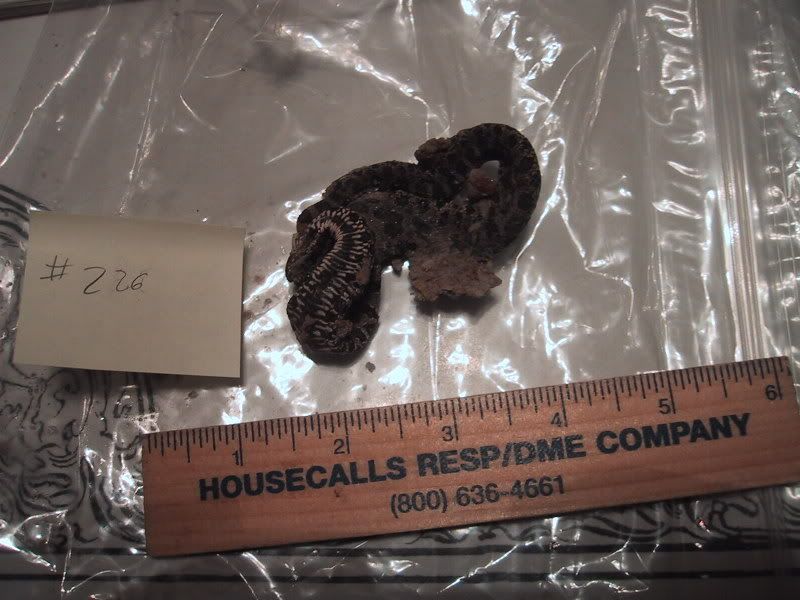
Image by me


This rattlesnake (Sistrurus catenatus) goes by a number of names, such as Swamp Rattler, Black Rattler, but I’ve always called it a Massasauga, which apparently means “Great River Mouth” in Chippewa. By those names, it should come as no surprise that these snakes are typically found in wetland areas, as well as near rivers and streams. They are typically ambush hunters, lying in wait for small rodents to wander within range. Since rattlesnakes are a group within pit vipers, they have heat-sensing organs to find their prey.

Unlike most rattlesnakes, Massasaugas hibernate alone, finding crayfish burrows in which to spend the winter, below the frost line. I don’t know how many of those crayfish are… uh… forcefully evicted from their burrows, but I wouldn’t be surprised if that was how most Massasaugas found their over-wintering hole. Females mate in the spring, yearly or every other year, depending how healthy she is. Birthing (remember, rattlesnakes have live young) happens in the late summer, with a litter of five to nineteen bouncing… uh, slithering babies.

While their range stretches from New York to Minnesota and from Missouri to Ontario, they are endangered within each state or province in their range. So, despite the fact that the Massasauga’s range takes up most of the Northeastern United States, it really only exists in small isolated populations. One of those happens to be the Killdeer Plains Wildlife Area, where I spent each fall in high school peeling dead snakes off the road. I suppose I can’t really let this post go by without a personal anecdote, so here goes. Freshman year, when we were still trying to figure out what we were doing, and I couldn’t yet drive, Dad and I came across a live Massasauga near the edge of the road. It wasn’t atypically big, probably two feet long. I had been given a two-foot long snake hook, but I hadn’t brought it with me, because I would pick up any non-venomous snake with my hands, and two feet wouldn’t be near long enough for any venomous snake. After collecting the data, we realized that we were supposed to take the snake off the road, so it wouldn’t get run over, which was achieved by stomping, yelling, and throwing roadside litter near it1.

So that was a little off topic. They are not particularly endangered due to road mortality (I only found four of them in four years of study), but for two other major reasons. The first reason is that people don’t like snakes, especially venomous ones. There are kind, little old ladies with wonderful stories about how they chopped a Swamp Rattler’s head off with a shovel. Reported cases of deaths due to Massasauga bites are few and far between, mostly due to the fact that the people did not get proper treatment in time. The second reason is simply habitat loss, just like for the Alligator Snapping Turtle, as wetlands continue to be developed.

Despite the fact that the Massasauga is state listed throughout its range, it is only listed federally as a species of concern. Most conservation programs focus on the education of the public in an attempt to let them see this snake as a part of the ecosystem, instead of a potential threat. Habitat conservation is also a big part of saving this snake, and there are a few captive breeding programs in Canada working to release more of these beauties into the wild.

1This was before we started taking photographs of each one. Otherwise, the picture would be much better than the above, or even my other option, this one.

Sunday, December 23, 2007

The Delhi Sands of Time

I think I may have found the most controversial EUT to date. Many websites still call this animal “the only fly presently on the Endangered Species List,” which was correct, until last year. I seem to have a thing for writing a fly post in December, but you’ll have to check back next year to see if the trend still holds.
Image from University of California Riverside

The Delhi Sands Flower-Loving Fly (Rhaphiomidas terminatus abdominalis) is endemic to the fine sand (also known as Delhi sand) dunes of southern California. The second part of its name comes from the fact that the adults feed on nectar from flowers in a manner reminiscent of hummingbirds, or, probably more accurately, hawk moths.

Parts of the lifestyle of this insect are still unknown. They are typically only seen as adults. There is a single mating season each year, from August to September, where the female will lay about 50 eggs into the sand. At that point, who knows? The larvae stay underground for probably two years, and may be predatory. I would be willing to guess that those suppositions come from studies of other Flower-Loving Flies (family Apioceridae).

The Delhi Sands area covers about 40 square miles, and it is thought that the Flower-Loving Fly occupied most of it. Now, with habitat degradation and loss, it now lives in 2.5 percent of that entire area. The conservation efforts for this animal, begun in 1993, has stirred tempers, and even gotten a (very brief) mention on NPR. To protect the habitat, the Fish and Wildlife Service set aside areas for the fly to thrive. The problem: some of that land is private property. Needless to say, landowners and developers got angry, which, of course, got conservationists angry. To this day, no one has stopped shouting.

Thursday, December 20, 2007

Catfish are Jumpin'

I know I’ve been way behind on my posts. My college has a schedule where the semesters are split into a twelve-week section, typically with three classes, and a three-week section, where one takes a single class and stuffs twelve weeks’ worth of information into it. So, the number of posts has suffered—in November due to finals, and in December due to heavy work load1. So, to make up for it, I’m going to see if I can put out two posts a week during Winter Break. First up, I present more evidence as to why Ugly Overload has an “Oversized Uglies” category.

Image from Fishbase
Image from Fishbase

This is the Mekong Giant Catfish (Pangasianodon gigas), whose upper size limit is nine feet and 660 pounds, making it the world’s largest freshwater fish. They inhabit the Mekong River, the eleventh longest river in the world, which stretches through China, Thailand, Laos, Burma, Cambodia, and Vietnam. While the young have the whiskers that give catfish their name, those are lost as they age. I can’t seem to find a maximum age for these, but they can get quite old, considering the generation time is listed as 14 years.

The Giant Catfish is a grazer, eating the aquatic vegetation growing on the bottom of the river, though this source states that they’ll take “other food [read: meat] in captivity.” During the course of their lives, these massive fish will migrate up and down the river, from upstream breeding sites to downstream feeding sites.

As there is a lot of meat on a 600-pound catfish, it came to no surprise to me that one of the major causes of their decline is overfishing; even though that has mostly stopped, they’re still getting over it. Despite this, the Mekong Giant Catfish was moved from Endangered to Critically Endangered in 2003. The IUCN cites habitat loss and degradation—that is, damming and pollution—as the major causes.

Not all hope is lost. In an interview with National Geographic, one of the researchers says that there’s still a chance that these giants can make a comeback. They’ve been working on artificial spawning since 1985, and captive breeding since 2001. These, along with better pollution regulations, could bring the Mekong Giant Catfish back from the brink.

1I just wrote a ten-page paper on genitalia evolution. Look up the Argentine Lake Duck (Oxyura vittata), if you dare. Or, for that matter, Echidna reproduction.

Monday, December 03, 2007

Up to My Neck in Trouble

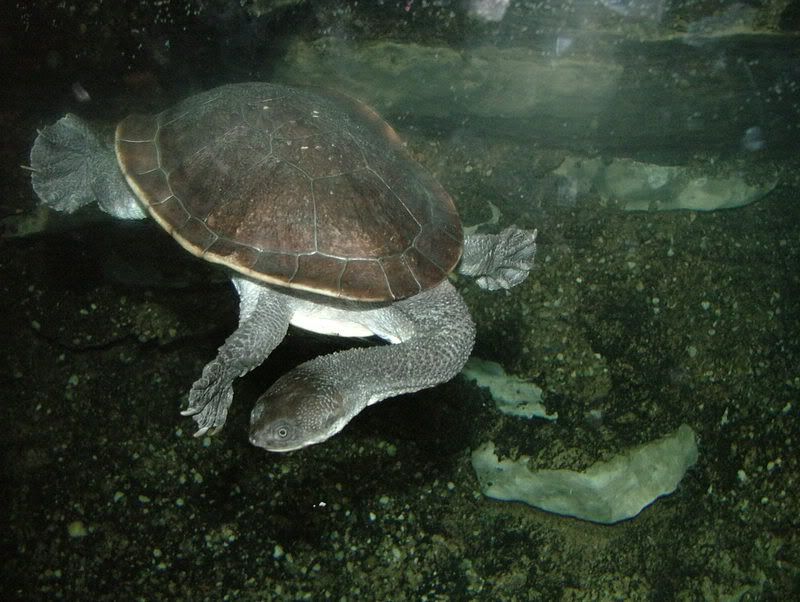
I have found that I can no longer visit zoos without specifically looking for EUTs. I suppose this isn’t a bad thing, as it’s always useful to expand my repertoire. On the other hand, it makes the experience slightly insufferable for people who come with me. Sorry. This time, it was again my home zoo, the Columbus Zoo and Aquarium. There were a few good turtles, but I had to choose one over the other. One had to fall by the wayside, because a) it is slightly cute (as evidenced by my girlfriend going “aww” upon seeing it), and b) the picture didn’t turn out nearly as well1.

Image by Me
Image by me

The Roti Island Snake-Necked Turtle (Chelodina mccordi) is fairly aptly named. It is found on Roti Island, which is a 460 square mile Indonesian island, and it does, in fact, have a snake-like neck. There is even a video of this turtle on YouTube, taken at the Columbus Zoo. Like a number of EUTs before it, it’s creepier when it’s moving.

For some reason, I am having problems finding specific answers to why it has such an elongate neck. It is an opportunistic carnivore, and having a neck it can whip around is probably helpful in catching the quicker things, like small fish and tadpoles. Much like the Map Turtles and Red-Eared Sliders I’m used to, the Snake-Necked Turtle is semi-aquatic, so it typically spends most of its time in lakes, swamps, and rice paddies.

There are two major threats to the Snake-Neck’s survival. The first one is simply the fact that it has a small natural range, so there were fewer of them to begin with. The big issue, however, is the pet trade. Its sister species, the Eastern Snake-Necked Turtle (Chelodina longicollis) is one of the most frequently-kept turtle species in Australia, and the Roti Island Snake-Neck is paying for it. As demand increases, the most economic thing to do is to increase supply, and up the price. Roti Island Snake-Necked Turtles can fetch anywhere from $300 to $500 on the black market.

This is exactly the sort of thing that CITES was created for. Now, any international trade of this turtle requires the right permits. It’s also been upgraded (downgraded?) to Critically Endangered on the IUCN red list. Other conservation programs have taken an interest, and there are breeding programs set up, though some confusions with similar species2 has slowed down the process some.

1For those who are curious, it was the Fly River Turtle (Carettochelys insculpta), which is neat because it’s a freshwater turtle that looks like a sea turtle.
2As infallible as we’d like to think we are, biologists don’t always get it right.

Thursday, November 22, 2007

Here We Come a-Wattling

Well, I had hoped to get this (or something) up earlier, but finals and the end of the semester got in my way. Today, in honor of Thanksgiving1, I’m writing about an Endangered Ugly Galliform. For those who don’t know the orders within Class Aves off the top of their heads, Galliformes is the order that includes the chicken-esque birds, such as pheasants, grouse, quails, and, of course, turkey2. Granted, this week’s EUT is none of those, but it’s the taxon that counts.


Image from Birding Peru

The Wattled Curassow (Crax globulosa) is a seven-pound bird that inhabits the rain forests of western South America. They are fairly omnivorous, finding what fruits they can, but mostly eating invertebrates they find in the flooded forest and riverbanks. Despite spending all day foraging on the forest floor, they roost in trees, though specific information on their nesting habits seems a little thin.

Surprisingly enough, the Wattled Curassow has, in fact, a wattle. Around their beak is a set of conspicuous, fleshy protrusions. These turn bright red on the males during the mating season in June. Another visual oddity in these birds is their crest, which, to my eyes, looks exactly like meticulously gelled curly hair. Their white rumps are prominently displayed in the mating ritual, in which the males make high-pitched whistling noises, as opposed to most other curassows, which “boom.”

As I did introduce these as chicken-like, it should be little surprise that the largest threat to these birds is hunting. The addition of shotguns to the arsenal of people in those areas is cited as the cause of the huge population drop of the Wattled Curassow. Human population expansion is the easiest along rivers, and since this is the Curassow’s habitat, they are frequently picked off.

There are a number of people working on the conservation of this bird. A Bolivian Bird Conservation group has a Wattled Curassow Project in place, and they are trying to find suitable habitats. Ecotourism may be used to better protect their habitats, and many groups are trying to determine how these methods might be used for conservation.

Edit: I just found out that WWF has an Eastern Hellbender plushie. This makes me exceedingly happy, and leads me to believe that maybe I should let up on the WWF just a little.

1The American one. The Canadians actually hold Thanksgiving about the same time of year the Puritans had theirs.
2I just found out that the North American Wild Turkey is the largest galliform in the world. Neat.

Monday, November 05, 2007

Indiana Jones

There’s a species that I mentioned in the original essay that I haven’t written about yet. Its ugliness is questionable, but there are a lot of people who don’t like bats. I had hoped to get this up by Halloween, but various factors conspired against it.
Image from FWS
Image from FWS

This is the Indiana Bat (Myotis sodalis), which, as its name suggests, is found in Indiana. About half of the entire world population roost there, with the rest of them spread out among the nineteen surrounding states. Their genus, Myotis, means “mouse-eared”, and includes more common species such as the Little Brown Bat, and three others that are found in Ohio1. The species name, sodalis, is Latin for “companion,” which is an appropriate name for them, as they roost in groups of at least one hundred individuals.

As far as shape and nightly habits go, the Indiana Bat is like most other small (they weigh up to 7.5 grams), insectivorous bat—hunting by echolocation, swooping after moths and mosquitoes all night, and coming back to roost at dawn. They make their roosts under sloughing bark of dead trees, typically near streams. In the winter, they find caves in which to hibernate. Their exacting standards for these hibernacula (the technical term) are one of the reasons that they are endangered. The caves must be between freezing and 50°F, and maintain about 95% humidity.

The National Fish and Wildlife Service states that one of the major threats to the Indiana Bat is human disturbances of their hibernating caves, much like the Virginia Long Eared Bat. However, even gating erected to keep people out can disturb the environment of the cave, if done improperly. Many people are also worried about their summer roosts being disturbed, or cut down.

There certainly are conservation programs in place to try to help them out. They are listed as endangered, federally and internationally. The major goal of the conservation programs is to prevent the disturbance of the nesting sites. In the Wayne National Forest, there is a single hibernaculum, but hardly a tree can be cut down without at least a few nights of monitoring for these furry fliers.

1And likely in nearby states as well. What can I say; I’ve lived in this state too long to not be a little biased.

Monday, October 22, 2007

Blacksnake

Image from FWS
Image from FWS
In April, I mentioned an Ohio endangered species that got some cable airtime, and rightfully so. Mike Rowe from Dirty Jobs1 traveled to Ohio’s north coast (that is, Lake Erie) to spend some quality time with someone I am proud to say that I (very briefly) worked with.

The Lake Erie Water Snake (Nerodia sipedon insularum) is, like most water snakes, very angry. They’re not venomous or dangerous in any way, just large and inclined to bite and musk. How large, you ask? They can get up to 3.5 feet. This “musking” is a defensive mechanism in which they spray the smelly contents of their cloaca3 all over whomever has grabbed them. It’s not pleasant.

They make their home on Kelley’s Island, a small (8 square miles) island just 3 miles off the coast of “Mainland” Ohio. I suppose that’s inaccurate, as that may be their geographic location, but they really make their homes squeezed among boulders of the rocky coast. From there, it is a short slither into the lake for some fishing. Water Snakes live up to their name well, as they are agile hunters in the water, and eat their share of small fish, frogs, and other similarly sized aquatic wildlife. They may be the same species as the common Northern Water Snake (Nerodia sipedon sipedon), but as a separate population, they are entitled to their own protection.

As Kelly’s Island is a popular resort town, the snakes were not exactly the most welcomed of natives. For years, they were tormented by locals and visitors until, in 1999, there were less than 2,000 left. In May 2000, they were added to the Ohio and Federal Endangered Species Lists, and signs declaring “Save Our Snakes” were distributed through the island. Kristen Stanford, in an effort to change public thought surrounding these snakes, has become the Island Snake Lady, and the Lake Erie Water Snake population is now up to a minimum estimate of 6,500 individuals—not bad for seven years. The way she reaches the public is by reaching the children. At one herpetological meeting, she talked about a grandmother who wouldn’t harm the snakes any more because little Jimmy (name changed to protect the innocent) had talked with the Snake Lady, and the Snake Lady said the snakes were good.

Anybody who lives around the Great Lakes knows that the invasive Zebra Mussels have become an ecological nightmare. Well, not long after they were introduced, a natural predator of theirs, the Round Goby, was also (accidentally) brought into the lakes. This didn’t particularly lower Zebra Mussel populations, and Round Gobies boomed. However, the Lake Erie Water Snake seems to feed increasingly on these alien invaders. If the Gobies eat the Mussels, and the Water Snakes eat the Gobies, we might be one step closer to solving that problem.

1One of my dreams is to have a research job so disgusting that it can be featured on a show like that2.
2Another is to host a show like that.
3Latin for “sewer”. You can probably guess what it is.