Monday, May 23, 2011

He Put the Taz in Taz-Mania

Image from Tasmanian Parks and Wildlife Service
Much like the Hyena and the Wolverine, the Tasmanian Devil (Sarcophilus harrisii) has a reputation. Once again, that reputation as a fierce predator and unscrupulous scavenger is not entirely unfounded. As the largest marsupial predator alive, the Tasmanian Devil will kill and eat most anything smaller than itself, and happily scavenge the remains of anything larger. The name “Devil" seems harsh for an animal the size of a lapdog, but when early settlers heard them fighting through the night, “Devil” came readily to mind.

Tasmanian Devils don’t typically hang out together except when a particularly large carcass has been found. Disagreements soon break out1 about who gets to eat first. However, like its Warner Brothers counterpart, the Tasmanian Devil is more loudmouth than fighter, especially to its own species2. There is a lot of growling, and baring teeth, and even some nipping, but physical fights are rare.

The home life of the Tasmanian Devil is nearly as dysfunctional (by human standards) as its table manners. When a female is ready to mate, she will visit a number of males to make sure she’s pregnant. She will give birth to about 30 raisin-sized babies, which is an issue, because she only has four teats. The newborns race to the pouch, and only the winners survive to weaning. In eight months, the young are ready to head out on their own.

Since European settlers arrived in Tasmania, the Devils have had a roller-coaster ride in terms of population. Initially they were killed for raiding chicken coops and the like. In the 1940s, they became protected by law. This increased their numbers enough that they were once again considered a pest species by the 1980s. Then, in the 1990s, a new threat emerged: Devil Facial Tumor Disease. This is a contagious cancer that has once again reduced Tasmanian Devil population to a fraction of what it once was.

The Tasmanian government has lost no time in trying to protect these animals, including quickly having the Tasmanian Devil listed as endangered. Breeding programs, disease research, and awareness campaigns have popped up all over the island in an attempt to save this little loudmouth.

1 While the Tasmanian Devil in that video is eating, he sounds exactly like my cat.
2For your listening pleasure, please compare Mel Blanc’s interpretation with the real thing. I’m sure your co-workers won’t mind if you’re listening at work.

Saturday, April 23, 2011

Mr. Bighead

Years ago, I read about this month’s EUT in the Animal Wonders edition of Zoobooks, the same place I first learned about the Axolotl. The illustration was strange enough to catch my eye and imagination for a good few months—a long time for my flighty young mind1. I recently rediscovered this animal whose complete disproportion struck me at such a young age.

Image from Asian Turtle Conservation Network


The scientific name of the Big-Headed Turtle (Platysternon megacephalum) means “flat-chest big-head,” which is obviously quite apt. Every article that mentions the Big-Headed Turtle states that its gigantic noggin is too large to fit in its narrow shell. So, to protect its head, the turtle uses a two pronged approach. One: the solid bone skull is covered with thick scales. Two: massive, very sharp jaws are coupled with a tendency to bite.

This turtle inhabits shallow, fast moving streams in Southeast Asia, where it enjoys a diet of fish and mussels. Swimming around in the heavy flow of these streams would take too much effort, so the Big-Headed turtle is an excellent climber instead, and ARKive has video to prove it. Its long flexible tail helps to prop it up as it uses its strong claws and beak to climb waterfalls. There are even stories of finding these turtles climbing trees and bushes. What they did when they got up there is anyone’s guess.

The Big-Headed Turtle’s big head seems to evoke one of two responses: it is either grotesquely disproportionate, or adorably baby-like. The second of these responses has led to a large number of them being caught for the pet-trade. While some captive breeding exists, there are not nearly enough Big-Head farms to supply demand for the pet trade. For this reason, it was placed on the IUCN Redlist in 2000, and is now CITES protected as well.

1An incomplete list of animals that have, at one point, been “my favorite animal”: giraffes, raccoons, pangolins, mosquitoes, jellyfish, frilled lizards, chameleons, fireflies, sloths, and many more I can’t think of right now.

Thursday, March 31, 2011

Nevermore

Crows have been long associated with death in Western culture. In Medieval times, they were known to follow armored soldiers into battle for the prospect of feasting on the casualties. In modern times, people see them eating roadkill, as Halloween decorations, or as the monsters from The Birds. While Crows certainly enjoy carrion there is another side to them less frequently seen in modern interpretations. For one thing, they are omnivorous so dead things are only part of their diet. For another thing, they might be just as smart as the prettier parrots.

Our main method of determining animal intelligence is looking at how well they solve problems. Crows are masters. They bend wires into fishhooks to pull food from thin tubes. They have learned to use cars to crack hard nuts—while waiting for the light to turn red to retrieve them. One person is trying to teach them to use a vending machine. They can mimic human speech, with more clarity than most parrots. So, when you see a Crow walking down the sidewalk, don’t think, “portent of death,” think “Whosa prettybird?”

Image from Michael Westerfield


The Hawaiian Crow (Corvus hawaiiansis), is locally known as the ‘Alala. It has a lot in common with your more familiar American Crow: they eat whatever they want (mostly fruit and eggs), they hang out in groups, are strong fliers, and like to play wrestle. They use tools to get to their food. However, the ‘Alala is larger, and has a larger, rounder beak.

Why the Hawaiian Crow is in trouble is up for debate: it could be disease, habitat loss, or introduced predators, such as rats or mongooses. Chances are good that it’s all of the above. There is no question that it is in big trouble. The last wild ‘Alala pair were seen in 2003. All the rest of them alive today—about 70 individuals—are in two captive breeding facilities. Release programs have been unsuccessful. Part of that is due to the aforementioned predators, but there’s a problem that the conservationists didn’t foresee. Crows are smart, but because of that, they need to be taught. Without a whole society to teach them, the new crows haven’t learned how to properly forage or escape predators.

Sunday, November 14, 2010

Jabberjaw

I was looking through IUCN’s Species of the Day list and found something adorable. It fits the two facial features that define “cute”—big eyes and a short snout. Unlike most members of its group, it has been known to play by grabbing vegetation and trailing it behind itself as others give chase. It exhibits curiosity with man-made objects. It has a cutesy name that sounds like an embarrassing nickname.

It’s a six-foot long shark.

Image by Steven Campana


Where the Porbeagle (Lamna nasus) gets its name no one is quite sure. The commonly cited combination of “porpoise” and “beagle” seems awkward to me, but there are a number of other etymological theories to pick from. They are built for speed, with crescent tails for powerful strokes, keels on the base of the tail for balance, and large gills for better efficiency. These adaptations help them chase after mackerel and other schooling fish to eat.

Their playful antics have been widely documented. They play tag using kelp, as mentioned above, as well as playing catch with driftwood. They will also poke at fishers’ balloon floats, and appear to be confused when they pop. The phrase “mindless killing machines” is so frequently thrown around with sharks, but the Porbeagle’s actions are causing a number of shark experts to question that concept. Other sharks (including the infamous Great White) have been described as “curious,” but they only have one tool with which to explore the world, and it’s filled with enough teeth to turn the object of their curiosity into mincemeat.

Despite their potential danger (see previous statement regarding teeth and mincemeat), the Porbeagle hardly attacks anyone - ever. The International Shark Attack File lists 5 total attacks, fatal and non-fatal, from the Porbeagle in 2003. Compare that to the Great White Shark with 244 fatal, unprovoked attacks. In fact, looking at the rest of the list, anything with fewer attacks than the Porbeagle either have no teeth, are impossible to find, or are too small to be a threat to humans. The infrequency of attacks may be due to the fact that “if the water is warm enough for you to be swimming, it is too warm for the porbeagle,” but it seems that this is a very docile shark.

One place the Porbeagle will fight ferociously is on a fishing line, and for good reason. Overfishing in the north Atlantic caused population crashes that devastated not only the shark, but the fishing industry that created the problem. These incidents have led to regulations to limit Porbeagle catch. Earlier this year, CITES set trade regulations in place to help save this playful, docile “mindless killing machine.”

Monday, October 18, 2010

Dirty Little Sea Kraits

(Alternative title: Krait Expectations)

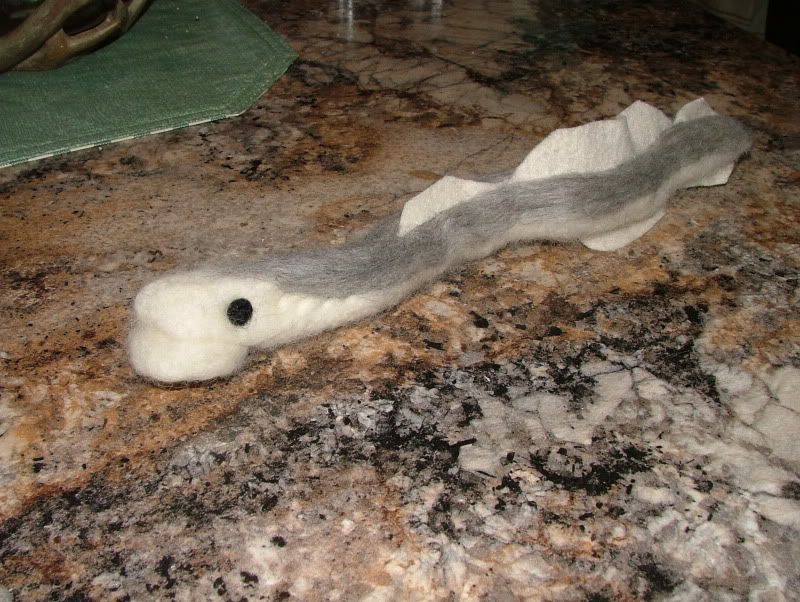
It seems that media attention of non-charismatic species is growing. I recently had an interview with a French news site, which can be found here. Also, my wife (I’m still getting used to saying that) has taught me how to needle felt. Remember how I complained that there’s no such thing as a plush Lamprey? There is now. I would like to make more plush EUTs, but I need suggestions about which ones to create. Please leave suggestions, and I promise you’ll see them by the next post.

Image by Ryan Photographic


The Rennell Island Sea Krait (Laticauda crockeri) is like most other Sea Kraits in many ways: it uses its wide paddle tail and venomous bite to hunt fish. On the other hand, it is smaller, not striped, and, oh yeah, doesn’t live in the sea. Instead, they’re found in the brackish Lake Tegano in the Solomon Islands.

I suppose I should back up somewhat. Sea Snakes are exactly what they sound like—snakes that are well-adapted to marine life. They have large, oar-like tails for propulsion, smooth scales for less drag, big long lungs for hours of underwater hunting, and potent venom for easy hunting. Because of these traits, most of them hardly ever make it on to dry ground. Sea Kraits, however, are the least aquatically adapted of the Sea Snakes, with rougher scales and smaller tail fins that allow them to manage better on land.

Due to the small size of the range of the Rennell Island Sea Krait—that is, half of a small island in the South Pacific—it is automatically considered Vulnerable by the IUCN. However, the minimalistic human use of the island has helped keep the area pristine. While there is tourism, it seems to stay within the realm of nature observation with little impact on the ecosystem.

Monday, September 13, 2010

Plague of Locusts

I’m sorry I missed the end of August, but I was kind of getting married, so I hope you’ll excuse the late post. Since I just moved to the Upper Peninsula of Michigan1, I decided I needed to write about a local Endangered Ugly Thing. Meet the Lake Huron Locust (Trimerotropis huroniana)

Image by Thomas Bentley, via BugGuide.net


This locust is a drab-looking grasshopper, and not one to stand out in a crowd. It’s about an inch long, slate grey, and looks like a large number of related insects. The biggest characteristic that sets them apart from other grasshoppers is their habitat. Instead of living in thick grasses or dense woodlands, they live on meagerly vegetated beaches. There, they blend in with the sand and eat the sparse grasses that grow there.

Like most grasshoppers, male Lake Huron Locusts use the familiar melodic (or grating, depending on your preference) chirping to attract a mate. They also add an aerial element to their ritual, flying up in the air, snapping their wings to make a crackling noise2. Eggs laid in the summer hatch the next spring, and mature in time to start the cycle again.

One of the largest threats to the Lake Huron Locust is the creation of summer homes on the dune habitats where these insects reside. This irks me, as the “summer” here lasts approximately from mid-July to mid-August. Protecting the dunes and the vegetation found there is the most effective method to keep these little locusts alive.

1This is properly pronounced “da U.P., eh?”
2Does it surprise you to know that entomologists have a name for this? It’s called “crepitating”.

Tuesday, July 27, 2010

Black and White and Red All Over

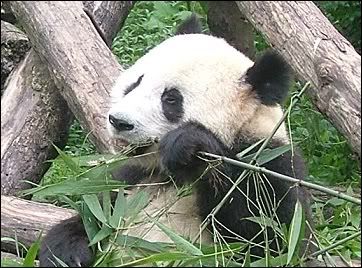
This marks the 100th post on this blog. To celebrate, I intend to do something a little different from what I’ve done in the past. For this month’s species, I’ll be writing about an animal widely considered to be one of the cutest around. It has become China’s golden child and the face of the World Wildlife fund. I am, of course, talking about the Giant Panda (Ailuropoda melanoleuca). While previously thought to be halfway between bears and raccoons, recent evidence puts them squarely in the bear family. Keep that in mind as you read this, as there is a depth to these animals that isn’t widely publicized.


The idea that Pandas eat only bamboo isn’t too far from the truth, as it makes up the large majority of their diet1. However, they are not above enjoying carrion if they happen to come across it. This is beautifully illustrated in this ARKive video, where a Panda saunters up to a rotting deer carcass, rips off a leg, and sits back to enjoy his meal. There are even reports of a wild Panda killing sheep, though it didn’t eat any of them.

Carnivory is one thing, but surely aggression isn’t a trait of these cute fuzzy-wuzzys, right? I’m sure that’s what went through mind of the drunk man who jumped into a zoo enclosure to give Gu Gu the Panda a hug, right before Gu Gu bit his legs. Or the teenager that scared Gu Gu into biting his legs. Or the man who jumped into Gu Gu’s enclosure to retrieve his 5-year old’s toy. Guess what happened to him. “Not so Cute” or “Not too Cuddly” seems to be the response of reporters on incidents like these. How surprised would we be if these had occurred with a Grizzly Bear? This is just an increasingly frustrated animal trying to defend its territory. The story is likely the same for the Panda in this video, attacking a man sitting outside its enclosure.

While it may seem like I’m trying to vilify the Panda, it's only to prove a point. I’ve got nothing against scavengers, or even dangerous animals. But the Giant Panda just dropped a few levels in the cuteness scale in the last two paragraphs, didn’t it? I’ve got all sorts of tidbits that could make any Charismatic Megafauna seem less charismatic2. Putting an animal on a pedestal just makes it that much easier to knock off, and turning an animal into a symbol makes you forget that it’s an animal. All creatures have behaviors that humans aren’t fond of, but we can’t expect them to act like giant teddy bears. While conservation efforts have helped the Giant Panda in the wild, over-exposure of the “cute” version of their life has left more and more people bored by its plight. The solution, as I see it, is to spread the exposure around to any other species that could use the help. Which is where I come in, I suppose. I hope I’ve managed to achieve that since I started this blog.

I really want to thank all of my readers who have stuck with me through these one hundred posts. I also have to thank my fiancée and my parents, who have helped with editing and ideas, but far more importantly have completely and utterly supported this fool idea of mine for four years. Thank you.

1 All bears are omnivorous, but the meat to veggie ratio depends mostly on the availability of the food.
2For example,
Gorillas and Lions will commonly kill the young of competing males. Chimpanzees and Dolphins commit murder of their own species. Black Rhinoceroses have the highest rates of death from fighting each other than any other animal. I could go on.