Wednesday, October 10, 2007

Snap Yo' Fingers

This month, I intend to keep with a theme: Local Water Habitats in Danger1. I could, if I felt so inclined, spend a good long time on aquatic larval insects. However, I would rather keep from stagnating on a specific taxon, so here’s an angry turtle.

Image from National Geographic


The Alligator Snapping Turtle (Macroclemys temmincki) is the largest turtle in North America, and the largest freshwater turtle in the world; it can reach weights of more than 100 pounds. They inhabit any freshwater area large enough to house them: rivers, ponds, swamps, and similar. Their range covers much of the Southeastern United States, and up the Mississippi River to northern Illinois. Alas, this majestic animal does not make it into Ohio.

They’re called Snapping Turtles for a reason. They will sit at the bottom of the pool blending completely with the rocks. Their tongue has a wiggling wormlike projection that acts as a lure for any unsuspecting fish or frogs. Any animal that looks too closely… WAPOW! The sharp beak instantly grabs on. I wish I could find better videos of this, but a search on YouTube brings forth a good number low quality videos of Alligator Snappers doing just that2.

The biggest threat to this animal is hunting, primarily for food. There’s a lot of meat on a 100-pound turtle, if you can keep all your fingers3. Since it takes about 12 years to reach sexual maturity, these slow-growing animals need some time to recover. This, along with the issues of pollution and runoff, are why it is listed in three states, and on the IUCN list. Many states now prohibit Snapping Turtle collection, though it is allowed in others with a permit. The EPA has wetland assessment methods in place to limit the impacts pollution will have on those fragile habitats, keeping the Alligator Snapper and its cohorts safer.

1There is a reason for this. My senior biology project concerns information that never gets from the scientists to the public, such as, say endangered species that people don’t hear about. I want to involve my summer experience of working with the Ohio EPA’s water control methods. Hence, Endangered Ugly Things: Midwest Water Edition!
2Many of them are pets. I don’t like that. A) They’re CITES protected, which, alas, doesn’t stop domestic trade. B) I’m against keeping any animal with the ability to bite your hand off in less than a second.
3Arguably, there’s more meat if you can’t keep all your fingers, but I’m not going to think about that.

Monday, October 01, 2007

She's a Rock.....House!

This is going to be another post where I’m going to try to whip up enough paragraphs with minimal information. I know enough about their order, but little about the species themselves. As adults, they look like small, oddly shaped moths.
Image from University of Michigan

On the other hand, as larvae, they are strangely shaped, grub-like, and quite ugly. On the Ohio Endangered Species list, there are three Caddisflies (Order Trichoptera, the species are Chimarra socia, Oecetis eddlestoni, and Brachycentrus numerosus). “Trichoptera” means “Hairy Wing,” not to be confused with their sister order, the Lepidoptera (“scaly wing”).

As larvae, Caddisflies inhabit streams and rivers all over the world, though I wouldn’t be surprised if the listed species had a much-reduced habitat range. Most of the life cycle is spent as a larva, usually at least a year. Many species attach bits of detritus to their bodies, such as in the picture, to act as a protective shell. The shape and material of the shell can even be used to classify the animals. To grow into big, strong adults, young Caddisflies will eat most anything they can catch. In fact, some even secrete a silky thread, like their caterpillar cousins. However, the Caddisflies use it to form a net and catch yummy detritus flowing by their home.

Most of that was off the top of my head, after spending the summer studying the small streams (technically known as Primary Headwaters) in the Cuyahoga Valley National Park. I know much less about them as adults. In fact, before doing some late night collecting for my Invertebrate Zoology course this fall, I couldn’t have told you what the adults even looked like. Of course, now I know they look like small, unexciting moths that hold their wings so they form a peak over their body1. Their mouthparts aren’t as exciting as butterflies’ or moths’, and about all they can do is suck up liquids. This doesn’t matter terribly much, because they have at most a month to have sex, lay eggs, and die.

Now, why are these three endangered, as opposed to the approximately 250 other species of Caddisflies found in Ohio? I’m not terribly sure. I’ve got guesses though. These might only be found in a few counties in Ohio2. They may also be endangered because the small stream habitats in which they are found are at risk from development, pollution, or the like.

That’s where Ohio is ahead of the game… to an extent. Because the Cuyahoga River burned in 1969, just in the midst of an environmental awakening3, state and federal Environmental Protection Agencies came into existence. Ohio developed some pretty good river assessment protocols. However, in 1999, they realized that small streams leading into the larger streams need to get cleaned as well. Therefore, they set up Primary Headwater Habitat conservation efforts that look at the quality of small streams, which are similar to the ones that our squirmy friends spend their childhood.

Oh, by the way, I noticed that I haven’t gotten a single comment in five weeks. If you feel like you have anything to say at all, good, bad or indifferent, please comment. Especially if I’ve gotten something wrong. I’d really like this blog to be as accurate as possible.

1I’m sure I’ve seen tons of them before that, I just couldn’t have told you it was a caddisfly.
2Phantom Midge, I don’t know how you found that out for Rheopelopia acra, but that was impressive.
3That wasn’t the first time it caught fire. It was just the one that got noticed.

Sunday, September 23, 2007

Hunchback of Colorado

It’s been a while since wrote about a fish, and I figured out I could search IUCN for all the Actinopterygii, that is, the ray-finned fish. Then found I could order the search by their category. While I found the pretty cool Shovelnose Sturgeon, there wasn’t enough information for me to write about1. The IUCN has recently highlighted the Humphead Parrotfish, which is ugly enough, but since they just highlighted it, I’ll let them talk about it.
Image by John Rinne via FishIndex
The Razorback Sucker (Xyrauchen texanus) is not too distantly related to the Blue Sucker that I wrote about a while ago. While it has a similar habit of eating organic detritus from the bottom of rivers, this one is lives in the Colorado River basin. It’s also larger, reaching lengths up to three feet, making it one of the biggest Suckers in North America. It has a big, sharp hump that gives it its name, which helps it navigate the fast moving rivers it calls home.

These Suckers are comparatively long lived, beginning to spawn at about 4 years old, and can live up to 40. However, despite their longevity, most of the young are dying early. This is mainly attributed to the large number of invasive predator fish that have been introduced into the Colorado River. Fragmented habitat and dams have also negatively affected their numbers. After all this, scientists estimate there are only about 500 adults left in the wild.

There are conservation efforts in place, many of which revolve around hatcheries in Utah and Colorado. The numbers are beginning to increase, and they’re certainly working on removing the invasive fish from the river.

1I’m getting pretty good at determining if I’ve got enough information fairly quickly anymore. A lot of that has to do with the number of photos Google has.

Sunday, September 16, 2007

It's a Bird! It's a Plane! It's a Gliding Mammal!

Image from Colugos.com
I don’t have any good quips for an introduction this week, but I’d like to let you know that this genus is much creepier in motion. Start this video at 5:31 to see it1.

The Philippine Colugo (Cynocephalus volans) is also known as the Philippine Flying Lemur. I won’t use that term again in this post for two major reasons: a) it doesn’t fly2, and b) it’s not a lemur. It is from the Philippines, so I can keep with that. They fit into the many, many gliding animals that are given the name “flying ___”3. There are only two species of Colugo, both in the genus Cynocephalus, which means “dog-headed,” which seems to be an accurate description. The Order, which is not too distantly related to the primates, is Dermoptera, which means “Skin Wing.” They’re not actually wings, but membranes that extend from the tips of their fingers to the ends of their toes.

Colugos spend their days in tree hollows. In the evenings, they dine on young leaves, which aren’t terribly nutritious (but more so than the older leaves), and run out on an individual tree fairly quickly. This is all right because, since they live in the Philippine jungles, fresh, new leaves are just a short glide (or not, they can glide for about 100 meters) away. Their hands and feet end in sharp claws for grasping onto trees, which is helpful if you never touch the ground in your life.

Young Colugos are born early and undeveloped, much like a marsupial. However, the mother lacks a pouch, so, instead, she folds up her tail and carries the young there until it can fend for itself. This means a mother can only have one, or at most, two, every few years.

Of course, a low birth rate means slow recovery from any threats that these animals face. The biggest threat, no surprise, is habitat loss. They don’t have a very large range, and the area is being developed fairly rapidly. Since they are wild herbivores, and like a good rubber tree leaf as much as anyone (probably more), plantation owners frequently regard them as pests, and deal with them accordingly. Habitat fragmentation is also causing a problem, as individual populations get cut off from one another, leading to less genetic diversity.

1If you’re interested in African Hunting Dogs, Indian Tigers, or the Amur Leopard, feel free to watch the rest of it.
2The difference between flying and gliding is simply the fact that fliers are able to increase velocity in midair, while gliders just fall really slowly.
3 Squirrels, snakes, “dragons”, squids, frogs, fish, and geckos, to name a few.

Tuesday, September 11, 2007

Calling On - Weta

I was going to write about the Hairy Marron, the fuzzy crayfish from Australia, but I couldn’t find enough information about it, least of all why it’s hairy. So, this week’s post is about the other arthropod I mentioned in the footnote of the Hunter Slug post.


Image by Gerald Cubitt via ARKive


Wetas are cricket-like insects native to New Zealand and frequent (possibly even preferred) prey of Tuataras. The Poor Knights Weta (Deinacrida fallai) belonging to the genus of Giant Wetas1, is amongst the largest insects in the world. They approach 8 inches in size when mature. As they are flightless, being light is not a concern, and thus, when laden with eggs, they can be heavier than sparrows.

The Poor Knights Islands are two small, uninhabited islands off the coast of New Zealand, apparently named for their resemblance to French Toast. Personally, I don’t see it. The islands are a nature reserve, and the 800 meters around the islands are protected as a marine reserve, and apparently a great diving spot2. The trees on these islands are where these Weta live, moving to the ground to lay eggs. They may also live on another nearby island, as a Giant Weta fecal pellet was found there. Please, don’t ask me how they determined that it was from Giant Weta.

Poor Knights Wetas are nocturnal and herbivorous, and their main defenses lie in being gigantic and spiky. An adult female can lay 200 to 300 eggs per clutch, which appears to be a one-time deal in a two-year lifespan. They’re listed as Vulnerable by the IUCN, even though they don’t seem to be declining. What they’re really worried about is the small size of their distribution, contained to small islands. They're also worried about the risk of a simple introduction of a non-native predator and its effects. The Wellington Zoo in New Zealand has a breeding program, both as a safeguard against extinction, and for public education.

1The genus name, according to Wikipedia, means “Terrible Grasshopper”.
2At least, according to the Tourism Department

Sunday, September 02, 2007

And the Vultures Circle

Well, it’s high time for another bird post, and I have just the animal for it. It was mentioned in the Waldrapp Ibis post as another bird seen at the Cleveland Zoo, and I even linked to a picture of it. This picture, in fact:

Image by Me
Image by me

The Cinereous Vulture (Aegypius monachus) is also known as the Monk Vulture or Eurasian Black Vulture. They’re found in mountainous areas all the way from Spain to the Himalayas. Due to their high lifestyle, they’ve developed a special hemoglobin molecule to help take in oxygen at altitudes where we would be sucking on air tanks. This vulture has even been spotted 23,000 feet up Mount Everest; that’s about 80 percent up to the summit. The tree line would have been about 8,600 feet down.

With an 8-foot wingspan, the Cinereous Vulture is the world’s largest “falconiforme,” the group that contains the true birds of prey. Finding this led to an interesting discovery: Old World vultures are unrelated to the New World vultures; all similarities between the two are a result of convergent evolution. While the Old World vultures evolved from hawk- and eagle-like birds, New World vultures—such as our beloved turkey vulture, or the largest flying bird, the Andean Condor—evolved into a similar niche from storks. This confusion on relationships even led to the common name I’ve been calling Aegypius monachus. It needed to be distinguishable from the American Black Vulture, now considered unrelated, so it was given a name meaning “ashy colored,” thus, “Cinereous.”

While the Cinereous Vulture is only listed as Near Threatened according to the IUCN, Europe1 classifies it as Vulnerable. The population decline is frequently attributed to poisoned meat set out to kill potential livestock predators, and a general lack of carcasses lying around due to quicker removal of dead cows, which were a historical food source.

Thankfully, European conservationalists have kicked into gear, so the Cinereous Vulture may never have to see the Threatened category on the IUCN list. Breeding programs have been set up in France, Spain, and heck, there’s even a breeding program at the Cleveland Zoo. Due to good management practices, their numbers are increasing rapidly in Greece. Actual direct hunting of the Cinereous Vulture has pretty much stopped because of outreach programs to the public.

1I didn’t even realize there was a list for all of Europe! Though, I can’t seem to find the list itself.

Monday, August 27, 2007

Crocodile Rock

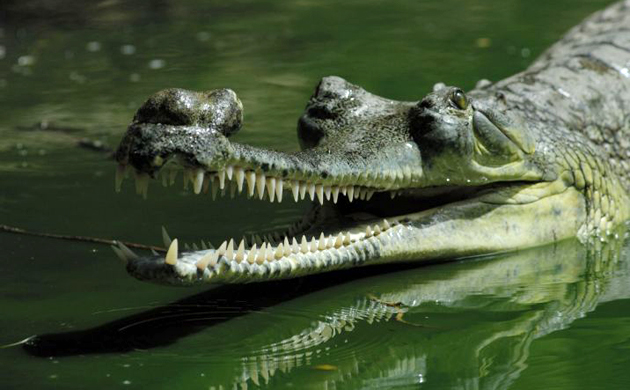
Well, I was searching around IUCN’s redlist for a reptile to write about when I came across the legless skink (Barkudia insularis) which lives on an Indian island. Then, I find out that it had been recently rediscovered after not being seen for 86 years. It’s category on the redlist, however, is “Data Deficient.” While I know that these things need to be seen1, they don’t make for very long posts, and I’m getting tired of writing about things with limited information. Therefore, I hit the redlist again, searching for this beauty.
Image from The Guardian

The Gharial, or Gavial2 (Gavialis gangeticus) is amongst the largest crocodilians in the world, rivaled only by the Saltwater Crocodiles of Northern Australia. Gharials can reach up to about 21 feet and weigh approximately one ton. They inhabit fast moving rivers in the Indian subcontinent, where the purpose of the long, thin snout becomes apparent. While many crocodilians are ambush predators (think of the Animal Planet footage of one leaping out of the water for a wildebeest), Gharials rely mainly on fish for their diet. A thick snout like an alligators would produce large amounts of drag, but a long, thin snout can snap sideways, grabbing unsuspecting catfish.

Not that they eat only catfish, but birds, crabs, and small mammals are eaten if they can be caught. This website mentions that the people buried by Hindu funeral tradition in the Ganges river frequently end up in Gharial’s stomachs. By my thinking, this is a good thing, reminding us that, as much as we try to deny it, we’re still part of the food chain.

Gharials have a bit of their own success story, but not quite to the point of the Lake Sturgeon or the Bald Eagle. At one point, in the 1970s, there were about 70 of them left, due to poaching3, and habitat destruction as the population of India increases. Now, after lots of captive breeding and introduction, there are about 2,500 of them in the wild. This still isn’t a big population, but it’s certainly a start.

1Which is why I mentioned it here, even though it’s not what the post is about.
2I’ve always called them Gharials, so I have no clue why I searched for “Gavial”.
3Their snout is long, with a bulb on the end. Of course people thought it was an aphrodisiac.