Wednesday, June 20, 2007

Secret Agent Bat

It’s been a bit since I’ve written about a mammal (actually, a month to the day) so I decided to raid the EDGE1 website, which deals with exceedingly endangered mammals, many of which are, unsurprisingly, small-rodent looking things, simply due to the large percentage of small-rodent looking mammals2 (those may come later). In this post, however, I’ll to tell you about a bat with the coolest adaptation ever: suction cups.

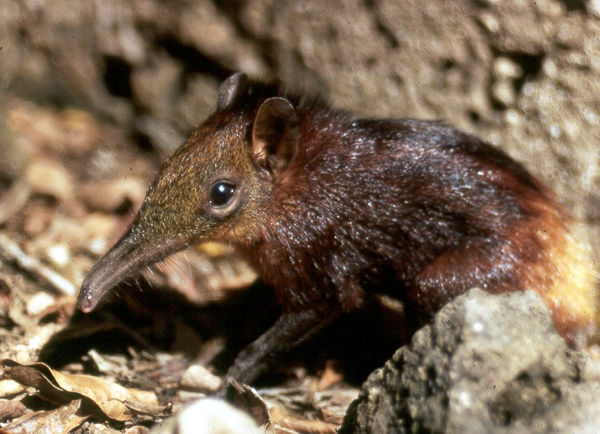
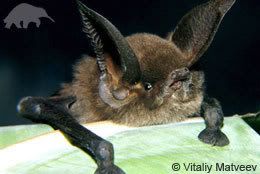
Image from EDGE
Image from EDGE

Yes, the Old World Sucker-Footed Bat (Myzopoda aurita) has, as its name suggests, suction cups on its wrists and ankles. Because of this adaptation, it can attach itself in cheesy-‘60s-spy-film style to the sides of broad leaves and smooth stems, hence the title of the post. Otherwise, it looks much like any other microchiropteran (echolocating bat, as opposed to the fruit bats), with ears bigger than its head and small, beady eyes. As my grandmother put it, it looks like a bulldog with fins.

There is little known about this bat’s specific habits. It is a moth-eater (mostly) and may require specific broad-leaved palms to roost upon. Researchers believe the glands in the suction cups might produce a glue-like substance (since we all know how long those plastic suction cups stick normally). While most bats are observed by mist netting, the Sucker-Footed Bat (such a cool name!) maneuvers well enough to avoid them, leading to even less certainty about this animal’s lifestyle.

They’re found only on the eastern edge of Madagascar, though evidence suggests it once (in the Pleistocene) inhabited most of eastern Africa. Loss of habitat has certainly negatively affected the bat’s populations, and sadly, there aren't many conservation efforts in place (although just telling you about it has helped the situation just a little bit). Scientists have recently found another species in the same genus, making it possibly a little less Evolutionarily Distinct.

Oh, by the way, the last suggestion I got was that post last month that I talked about. I’m kind of hard up for new ideas. Pleeeeaaase?

1That stands for Evolutionarily Distinct Globally Endangered, meaning that once these animals are extinct, nothing like them will exist in the world. Kinda chilling, isn’t it?
2Just because I’m describing them all as “small-rodent looking mammals” does not mean they’re all the same. Small-rodent looking mammals are exceedingly diverse.
Tuesday, June 12, 2007

Birdhouse in your Waldrapp

I had hoped that a trip to the Cleveland Zoo this last weekend with Miladyofthelake1 would prove fruitful, and, in fact, it did. Along with the Cinereous Vulture (near threatened—does that count?) and the Lappet-Faced Vulture (vulnerable), I found the Waldrapp Ibis (Geronticus eremita), which I think looks far more sinister than either of those adorably fuzzy carrion-eaters2.

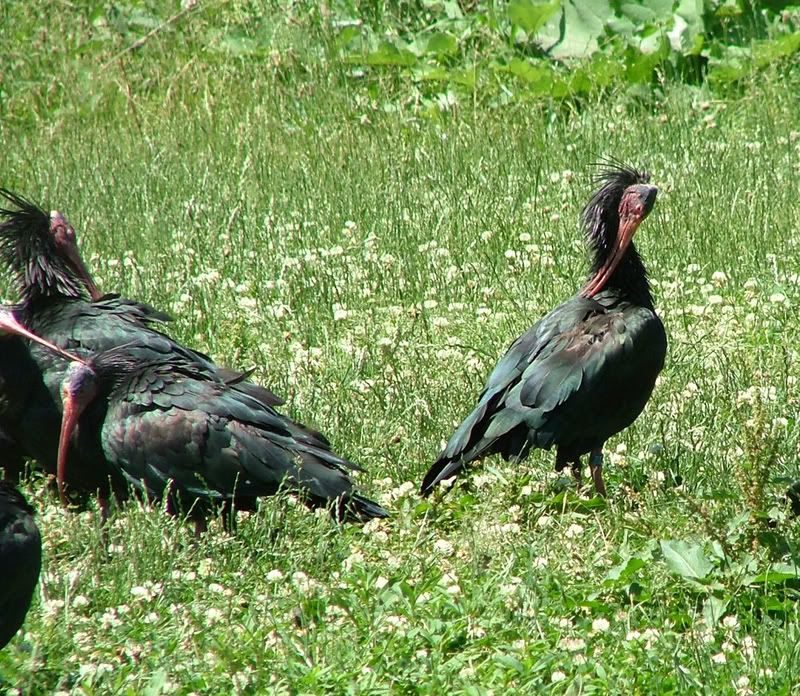
Image from Me
Image by me

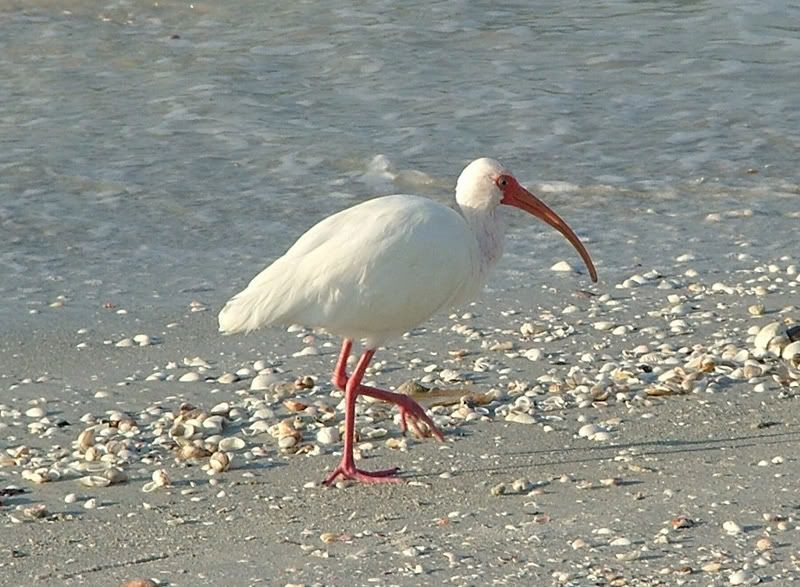
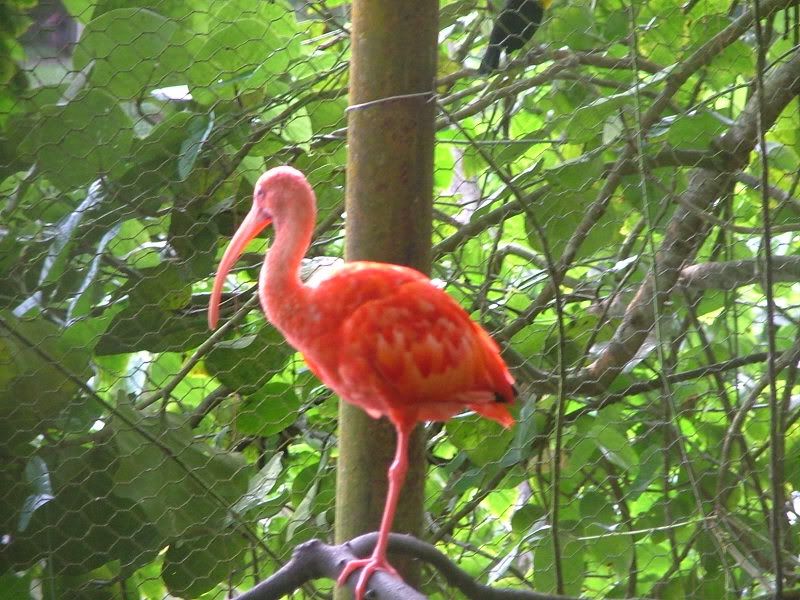
Yes, I said ibis, which most of you will associate with the American White Ibis or the Scarlet Ibis, which are much too bright and pretty. The Waldrapp Ibis (or Northern Bald Ibis, or Hermit Ibis) is oil-sheen black with a featherless head and a scraggly mane of black feathers that give it a buzzard look that no respectable shorebird should ever hope for. Not that the Waldrapp Ibis is really a shorebird, aside from being so phylogenetically. It lives in the grassy steppes of Morocco, Syria, and Turkey, as opposed to the marshes that its cousins inhabit. It still exhibits the same eating habits of other ibises by probing the mud (or dirt) for insects and lizards, and when the opportunity arises, small mammals. Completely shunning the aquatic lifestyle, they nest on cliff faces.

So why is it that these poor birds are critically endangered, and confined to three small areas, when it once roamed through all of Northern Africa, Central Europe, and the Middle East? It could be hunting, or nest site disturbances, or habitat loss. The insecticide DDT used in Turkey in the 1950s certainly didn’t help3, but they might be dying out due to natural causes. And these are suggestions from just one source. In other words, people do not know the exact reason why the Waldrapp Ibis is endangered.

Not that that’s stopping them from trying to help them out. Most zoos that house these ibises (and there are more of them in zoos than in the wild) are part of a Species Survival Plan, whose goal it is to breed animals in captivity to be released into the wild. Once there, the Waldrapp Ibis is protected by programs that are growing around them to see that they are undisturbed and happy.

1I have to thank her for editing most of the posts so graciously since, oh, about the lamprey post in late September. If you can read this without asking yourself, “What is he talking about?” thank her.
2I also found the Sturgeon Catfish, which is ugly enough to cause me to chastise myself for being disappointed that it’s not endangered. I have to keep reminding myself that I should not wish those sorts of things on an animal just so I can write about it.
3It has a tendency to wander up the food chain and kill whatever’s at top, cf. bald eagles in the United States.

Tuesday, June 05, 2007

Eye of the Tiger

I’ve been searching for more EUTs; rather, I’ve been searching for a new place to search for them. The Ohio list is all well and good, although a little small. I always worry that I won’t get enough information about the organism1. The IUCN Redlist has the opposite problem: it’s huge and I don’t know where to start looking. I’m starting to exhaust the U.S. list, as I cleared out the entire arachnid section in just three posts. This is why I keep begging my readers for suggestions. I don’t know how you guys find them, but when you do, it helps me out a ton.

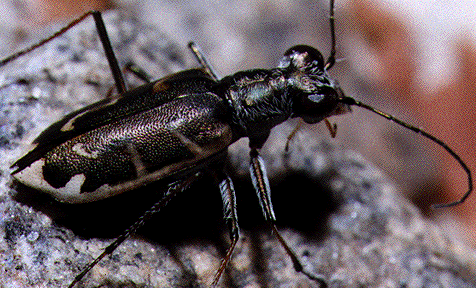
Image from University of Connecticut

The Puritan Tiger Beetle (Cicindela puritana) was found on the United States endangered species list, and I couldn’t find why it was so puritanical, though it may simply refer to its New England upbringing (just a guess). The “tiger beetle” part of the name is much easier to place, as it (and others of its family) is a ferocious predator, hunting smaller insects. By virtue of their good eyesight and bursts of speed, the beetles are frequently successful. They inhabit the beaches along the Connecticut River in Connecticut and Massachusetts2.

They, or at least the males, have an interesting mating strategy. While the actual copulation only lasts a few minutes, the males will mount the females for up to six hours at a time. This is to ensure that their sperm is the one that fertilizes the eggs3. I’m pretty sure I’ve heard of this strategy with other animals, but it’s certainly an interesting one. The only problem with that strategy is that it means that the beetle is occupied for about six hours. Beachgoers to the Connecticut River thus have a high likelihood of disrupting their… "relationships." The little larvae live for two years in holes in the sand, grabbing prey that wanders too close to the air hole. Other threats to this little predator include dams (of course), habitat loss, and people walking over the grubs’ burrows.

The Connecticut Department of Environmental Protection is working hard to make sure people know about the Puritan Tiger Beetle’s plight, putting up signs, sending out flyers, and generally trying to keep people from coleopteran coitus interruptus.

1I’m looking at you, Rheopelopia acra.
2Of course! The two states that I simply can’t spell!
3This voids some ideas as to why they’re called Puritan Tiger Beetles.

Saturday, May 26, 2007

Reel Big Salamander

In the footnote for the Sagala Caecilian1, I mentioned some big, ugly salamanders. Both are endangered, and closely related to the Hellbender2, in the family Cryptobranchidae, and the three species are together known as the Giant Salamanders. I’ll skip over the second largest salamander (the Japanese Giant Salamander, Andrias japonicus, you can look up information on your own), and start talking about the largest salamander in the world.

Image from Giant Salamander Protection International

The Chinese Giant Salamander (Andrias davidianus) is visually quite a lot like the Hellbender: flattened body and head with tiny, beady eyes, and folds of skin hanging from its body through which it breathes. The major visual difference, which will cause no one to mistake the two, is that the Hellbender is about a foot long, while the Chinese Salamander gets up to about, oh, six feet or so. This picture is the only one I could find that uses a person for scale. I don’t think anyone will disagree with me writing about this animal here.

They live in the cold mountain streams of China. Since they’ve got no gills or lungs, these streams must be well oxygenated. They are nocturnal, and hunt with a quick sideways snap of their mouth. What they hunt seems only to be limited by what they can catch. The Giant Salamanders mate in late August, where, according to ARKive, “hundreds of individuals congregate at nest sites.” Take a look at the videos they’ve got3. Now imagine hundreds of those things in a single place, mating.

IUCN has a nice long list of why these stream-leviathans are endangered, such as wood plantations, mining, clear-cutting, hunting, and pollution. There’s a BBC article about the poaching problems. Conservation methods are coming into place, as they are a protected species. There’s even a Giant Salamander Protection International website, and protected areas in these mountains are starting to appear. While other people want to make sure there are tigers for their grandchildren to see, I want to make sure my grandchildren get the chance to see a six-foot long salamander. Heck, I want to see it.

1That was eight months ago! I’m impressed by how long I’ve kept this up, even if no one else is.
2I just got a job studying headwater streams in a nearby national park. My boss had a poster about Hellbender conservation in her office, and I asked if that meant they were local to the area. Alas, they are not. I was really hoping, too.
3I’m sure this is required viewing for CGI animators of Discovery Channel shows that involve prehistoric amphibians.

Saturday, May 19, 2007

Golden Nosering

Two weeks ago, Phantom Midge1 threw a suggestion into the ring. I like the fact that when I complain about having been given no suggestions, there are always a few people who feel bad enough for me and find some. I’ll admit that this one isn’t horribly ugly, but once again, it’s the creepy, creepy nose.

Image by Galen Rathbun


This is the Golden-Rumped Sengi (Rhynchocyon chrysopygus). “Sengi” is the new, fashionable term for elephant shrews, because elephant shrews are more closely related to elephants than shrews. All of the following (and proceeding) information I just found while looking up stuff on the Sengi2. Currently, taxonomists are having a field day with a wide variety of African mammals. It turns out that elephants, manatees, hyraxes, sengis, golden moles, tenrecs and the aardvark all are related to an ancient African mammal. Everything within is now grouped into the superorder Afrotheria, which, if I’m not too wrong with my Latin, means African Beast.

The Golden-Rumped Sengi is about nine inches long (bigger than I thought an elephant shrew was; that’s about the size of a full-grown Norway rat), with surprise, surprise, a yellowish orange patch on its rear. Under this patch is a thick dermal shield, which is used to protect against the biting attacks of other Sengis. They mate for life, living in monogamous pairs, and they jointly protect their territory. Males will chase off intruding males, and females will chase off intruding females.

The sengis use their long, flexible snout3 to seek and destroy insects and other yummy invertebrates that inhabit the leaf litter in the Kenyan forests in which they live. Being a small, and apparently tasty, mammal they’ve got to watch out for hawks and snakes. They escape by running up to 15 miles per hour, which is dang fast for something that small. After spotting such danger and sprinting away, they slap their tail on the ground as a warning. The predator then knows that it’s been spotted, so an ambush is out of the question.

Living, as they do in Kenya, habitat loss and fragmentation is the major issue facing the Golden-Rumped Sengi. In fact, their range is limited to two patches on the Kenyan coast; luckily (or more likely, because) those places are protected. Illegal hunting for food does happen, but ARKive says, “current levels are thought to be sustainable.” The California Academy of Sciences even says that it is possible to breed them in captivity.


1She really should get a blog, so I can link to her instead of her sister, who I’ve linked to enough that it’s easier just to put her on the sidebar.
2This blog is as much for my edification as anyone else’s. Heck, in just the last three weeks, I’ve learned to correctly pronounce “uakari,” what the thing on the top of a cassowary’s head is called, and of the existence of a blind wolf spider.
3You should really check out the ARKive videos on this. So creepy.

Sunday, May 13, 2007

The Monkey with the Red Face

Natalie1 suggested2 that I write about the White Uakari. The only problem was the species, the Bald Uakari, was listed as “near threatened” on the IUCN redlist. I’d like it to be at least “vulnerable” before I write about it. But then I looked at the page for the White Uakari subspecies, and, lo and behold, it’s vulnerable.
Image by Luiz Claudio Marigo


Bald Uakari3 are a bunch of red-faced, cat-sized monkeys. I’ll get to the face later. The White Uakari (Cacajao calvus calvus) is the subspecies of which has a white coat. Other notable Uakaris are the red one, the Ucayli one, and Novae’s one, all of which are listed as vulnerable. I’m not quite sure how each subspecies can be vulnerable while the species is not, but IUCN said something about changing definitions of “vulnerable.”

Alright, back to the face. The deep Amazon of western Brazil, where the White Uakaris live, is a malaria hot-zone. Pale faces are a symptom of malaria. So, having a red face is the Uakari’s equivalent to a six-pack: I’m so exceedingly healthy, you just gotta mate with me. Redder faces get more mates, and the paler faces, well, get malaria.

The rest of the White Uakari is, well, white. It has a shortish (for a monkey), non-prehensile tail. They live in large troops, up to 100, though there are smaller subgroups within each troop. They are foragers, living mostly on fruits, with snacks of buds, leaves, and bugs. With the thickness of the Amazonian rainforest, they have little need to land on the ground, and spend most of their lives in the treetops.

Being a rainforest species, no one will be surprised when I tell you that their major concern is habitat loss. Human hunting also occurs, which certainly can’t help. Conservation, therefore, is still an issue. Though, as much as I harp on them, the WWF is doing their part to help. They alone are a major driving source behind rainforest protection.

1Who has linked to me for quite some time now, it’s only fair that she gets a link back.
2Phantom Midge, look out for a Sengi post soon.
3Which I just now learned is pronounced wuh-KAR-ee. I had been horribly mispronouncing it my entire life.

Sunday, May 06, 2007

Mama Cass

Despite my pleas for ideas, no one sent in any suggestions. My girlfriend, who wrote the Andean Condor post, wanted another one on birds, and mentioned an animal that is widely regarded as one of the most dangerous animals to keep in captivity. I like to refer to them as the “Angry Technicolor Ostrich.”
Image from Australian Wildlife Conservancy

The Sothern Cassowary (Casuarius casuarius)1 is listed as vulnerable on the Australian endangered species list. They belong to the group of birds called Ratites, which also include ostriches, emus, rheas, and kiwis. None of them have the keel present in flighted birds, but have developed into strong runners.

They are strong kickers too. All of the ratites defend themselves with their sharp claws on their strong legs. Cassowaries are especially infamous for this. I had heard that they are able to disembowel a person, but I’m having problems finding any reliable source that confirms this. Not that they would eat anyone; they’re technically frugivores, and are a useful species for spreading the seeds of rainforest plants.

The name “Cassowary” comes from the Papuan word for the bird, which means “Horned Head.” The horn to which this name refers is also known as a casque. The purpose of the casque is only guessed at, with hypotheses ranging from pushing through rainforest foliage to establishing dominance. I haven’t seen anybody talking about why they’re bright blue with huge wattles, though.

Cassowaries are solitary animals, though, when they do get together, the males are subordinate to the females, since they’re smaller. The females lay several clutches of eggs, and then they leave. The males incubate the eggs and take care of the young, which look like zebra/leopard/goslings, and are fairly annoyingly cute.

As rainforest animals, the major threat comes in the form of habitat destruction for agricultural and developmental purposes. This also leads to fragmented populations, which has genetic diversity implications. Traffic accidents are becoming more frequent, and nobody wants to run into a four-foot tall, 130-pound bird with a helmeted head. The Australian government has conservation efforts in place, including education efforts

1The Northern Cassowary (C. unappendiculatus) is also listed as vulnerable, but there isn’t much difference between the species, so I just picked one.