Sunday, January 28, 2007

Davey and Goliath

A while ago, I mentioned that frogs tend to be too cute to be mentioned here. I was mostly driven to this comment by the existence of the Golden Mantella, a tiny, big-eyed yellow frog, which happens to be critically endangered. My parents suggested that there might be, in fact, an ugly frog out there. I looked on the U.S. Endangered List and found something called a Goliath frog.

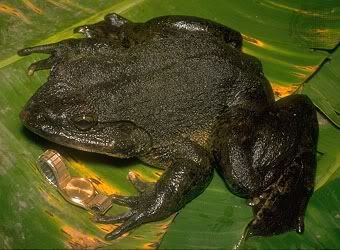
Goliath frog and watch--Image from Enyclopaedia Britannica
Image from Enyclopaedia Britannica

At 13 inches and 7 pounds, Conraua goliath lives up to its name. It is found in Equatorial Guinea and Cameroon. They tend to eat arthropods and fish, though they will eat anything smaller than their head that can be easily caught. ARKive has a picture of a Goliath frog eating... a Goliath frog. I didn’t find any indication of the frequency of cannibalism, though this article mentions it. It also talks about a 10-foot leap, but “it can only make three or four such bounds before giving in to exhaustion.” That is to say, they’ll be 30 feet away from you before they get tired.

The Goliath frogs, despite their large size, are difficult to find. The Cameroon Government allows the export of 300 individuals, though good hunters can find only a few dozen a year1. This does hint at the first cause of their endangerment: there’s a lot of meat on a 7 pound frog; they have been hunted for bush meat. They are exported for pet trade as well, but since they breed poorly in captivity, this collection does not help their numbers.

Scientists are trying to find more about their habits, and there was an extensive PIT-tagging project in 2004. However, legal aspects will have to come into play, since the Goliath frog is still unprotected.

1Though, for proper multiplication, it would be nice to have the number of good hunters around Cameroon.

Sunday, January 21, 2007

AYE Aye aye aye! (begin Crazy Train)

I’ve been mulling over this Endangered Ugly Thing since the inception of this blog. Is it cute or hideous1? Well, it was originally classified as a rodent, and the native Malagasy consider it a portent of death, so we welcome the world’s largest nocturnal lemur to Endangered Ugly Things.

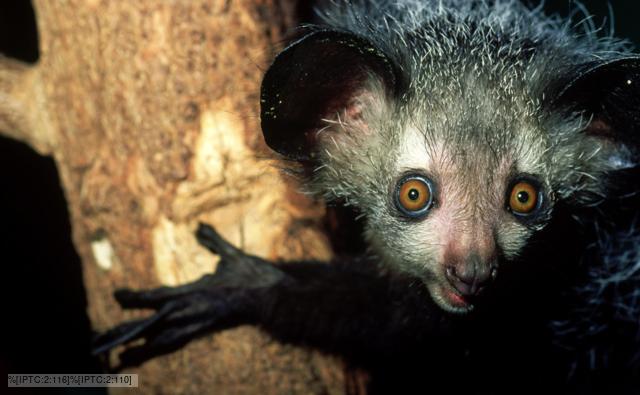
Image from BBC


The aye-aye (Daubentonia madagascariensis) has massive eyes and ears for better managing its nightlife. Like all lemurs2, they live in the dense jungles of Madagascar. Unlike the rest of the lemurs, their hands are long and spindly, with a skinny, elongated middle finger (I can’t find the average length, though). Aye-ayes tap the wood with this finger and listen for the correct echo with their huge ears, and gnaw a hole in the wood with their rat-like teeth before they begin rummaging for the grubs with their twiggy middle finger, filling much the same role as our woodpeckers. They will also eat fruit or vegetable material (or eggs), extracting the pulp using this finger3.

These raccoon-sized lemurs are usually solitary, moving along the treetops. Males’ home ranges are large (100-200 hectares) and encompass many females’ ranges. They tend to be curious and unafraid of people. Territories are marked by scents. When breeding season comes around, the females scream out to advertise their availability. The babies are weaned for about 7 months, and the females mate every three years.

Habitat destruction is the major threat to the aye-ayes, along with just about everything living in Madagascar. When agriculture invades their usual haunts, they will feed on the fruits, such as coconuts, becoming pests. Also, as mentioned in the beginning of the post, many Malagasy natives believe them to be omens of death, or other like portent, so they get killed on sight.

Many of the places aye-ayes live are protected, helping to save their habitat, and they are being introduced into other areas. There is a law against killing them, but it is not well enforced. Breeding programs exist at various zoos and the Duke University Lemur Center. But be warned, the little aye-ayes are even uglier.

1I get the feeling that the guys at Ugly Overload get this issue all the time.
2Which, appropriately enough, comes from the Latin “spirits of the night,” at least according to Wikipedia.
3ARKive has tons of wonderful pictures and videos, and it looks so much creepier when it’s moving.

Monday, January 15, 2007

Condor of Happiness

The following post was written by my girlfriend. She volunteered to write an ugly bird post, and I was more than glad to let her.
--Garfman

For the most part, birds are not considered to be terribly ugly. After all, they tend to be the object of many an extended metaphor involving ethereal instances such as flight and dazzling color elements. However, these correlations only extend to the surface of the animal. Humans mostly attracted to avian organisms with distinctions such as “songbird”, birds noted for their song or “parrots/parakeets,” which are noted for their plumage and ability to cross the border of “human speech.”

Never mind the sanitation officers of the avian world.

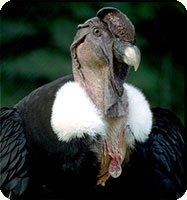
Image from National Zoo

Condors serve the biological niche required of them by being scavengers. The Andean Condor (Vultur gryphus1) is perhaps the most perfect example because they are known for being traditional scavengers. Their feet have blunt claws, unlike their cousin, the California condor (which has sharper claws and is known to hunt). In fact, the only time they hunt is in extreme cases, where they stalk, at a minimum, newborn or sickly creatures. On the menu for the average condor are assorted ungulates, sea bird eggs, and various rodents.

With a hideous head-crest and a fleshy comb on the males that rivals the common rooster, they can be considered rather “ugly.” However, these magnificent birds have the unique distinction of being one of the largest flying birds with an 11-foot wingspan and a body length of 43-51 inches. It is the only New World vulture/condor that is sexually dimorphic; the female is smaller at 17-24 pounds, sport garnet colored eyes, and lack a comb, while the male is 24-33 pounds with brown eyes. Both birds have rather “boring” plumage—black with white patches on the wings and neck.

They mate for life (huzzah) and lay a single egg per term directly on rock ledges or the cave. The incubation period lasts 54-58 days and the chick is raised for 1 ½ to 2 years. Due to the fact that they are sexually viable at six years, breeding and repopulation efforts face the issue of time.

Andean Condors inhabit South America (the Andes Mountains of South America from Venezuela to the islands of Tierra del Fuego in the Strait of Magellan), and due to hunting and poisoning, less than 3,000 exist in the wild. They used to frequent the northern portion, but there are as few as 75 birds in the area. Condors are not evasive and do not threaten farms—although it is due to misconceptions that these birds were killed to the point of being threatened. Conservation efforts do exist, however. Most zoos have breeding programs and raise condor chicks using a “puppet method” with the purpose of releasing them into the wild for repopulation. Personally, I would recommend viewing the webpage of the Cleveland Metroparks Zoo; they offer clear information and are very accessible to those of the younger age (side note: the younger one is aware, the more likely one will develop empathy for all living things).

1Being an English major, I had to include this bit of language eye candy: “The scientific name comes from the Latin words vultur and vello, meaning to pluck or tear and refers to its feeding habits and gryphus means a griffon and refers to the hooked bill. The common name refers to the bird’s range in the Andes Mountains.”

Sunday, January 07, 2007

Your Cheatin' Heart

The first EUT of the New Year I found… well, while randomly searching The List for ugly things. I recently discovered that Massachusetts has both an endangered leech and an endangered planarian, and I had hoped to write about those, but I could not find enough information on either (or both) for a decent post. It does mean that Massachusetts is ahead of the game when it comes to Endangered Uglies. This week’s EUT is a threatened gastropod that hails from West Virginia.

Image from Man and Mollusc

This is the Flat-Spired Three-Toothed Snail (Triodopsis platysayoides), also known as the Cheat three-toothed snail. No, not that The Cheat. This is the Cheat River1, which flows through West Virginia, and the three-tooth makes its home in Cheat Canyon, formed by this river. Actually, “three-tooth” is a misnomer. Many of its genus have three denticles in the opening to its shell, but the Cheat three-tooth2 only has one. Think of “three-tooth” as a grouping, instead of a description3. Its spire, where many snails have a point to their shell, is flat; that part of its name holds true.

The Cheat three-tooth lives on the rocks in damp, shaded areas within the Cheat canyon, such as cave mouths and near the river. I can’t seem to find any information about its food source, but most snails scrape vegetable off surfaces using their radula.

The three-tooth snail was added early to the Endangered Species List; five years after the Endangered Species Act came into play in 1973. Back then, it was listed as threatened due to rock scrambling and other visitor disturbances to Cheat Canyon, but those activities have been moved away from the snails’ habitat. Unregulated timber practices, such as logging trails that divert water flow and cause erosion, may be causes to the continued listing as threatened, as well as deer overbrowsing.

Alright, so I complain a lot about EUTs not getting any media attention, but the three-toothed snail has been used by preservation groups to limit logging within Cheat Canyon, even (briefly) showing up in the Charlton Gazette.

1There’s probably a very interesting story behind the name of the Cheat River. I can’t find it.
2Alright, so they’re not really teeth. In the snails mouths, no teeth either, but a horny tongue, called a radula, used to scrape food.
3Like Grey Squirrels. There are black Grey Squirrels, as well as grey Grey Squirrels.

Friday, December 29, 2006

Hawaii Fly-O

Have you heard the news? The polar bear got on the endangered species list? Well, at least that’s how I heard it, but looking at the Fish and Wildlife Service website, it turns out that they’re proposed to be listed as threatened1. On the other hand, this May, twelve animals were placed on the endangered species list, and no one noticed2. Well, I suppose some people did. The Hawaiian Drosophila Project, for one. If you’ve taken a biology class where they talk about “model species,” you’ll know the genus Drosophila. It’s the fruit fly, a few species of which are probably in your kitchen right now3.

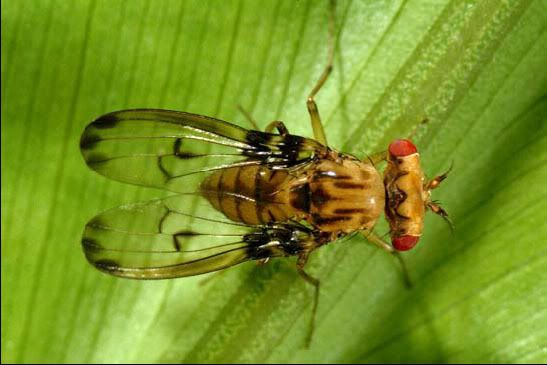
Drosophila heteroneura--Image from U.S. Fish and Wildlife Services

These, however, are collectively known as Hawaiian picture-wing flies, or pomace flies (pomace is remains from grape or olive oil). Drosophila aglaia, D. differens, D. hemipeza, D. heteroneura, D. montgomeryi, D. musaphilia, D. neoclavisetae, D. obatai, D. ochrobasis, D. substenoptera, and D. tarphytrichi are listed as endangered, and D. mulli is listed as threatened.

I kept seeing picture-wing flies described as, to quote the Recovery Outline,
…the “birds of paradise” of the insect world because of their relatively large size (4.32 to 6.35 millimeters [0.17 to 0.25 inches), colorful wing patterns, and the males’ elaborate courtship displays and territorial defense behaviors.
Seeing this, I had to figure out what those displays and behaviors were. Maybe I’m just not knowledgeable enough about birds of paradise. According to this article, the male flies will form a lek, or a mating ground to display to females. Each male will fight for his little piece of the lek, and then wait for the females to come. Once the females, show up, the males will perform species-specific mating dances to secure that female. Which is a lot like birds of paradise’s ritual, apparently.

Their eggs are laid on fairly specific plants, one of which is endangered as well. It and the other plants are being eaten by various invasive species, such as pigs, goats, cattle, and rats. Invasive grasses, along with management practices, have also removed the plants upon which the flies rely. The flies themselves are being preyed upon by other introduced species, such as wasps and various ants that have invaded Hawaii.

The question arises, what’s being done to save these flies? The major answer: they were added onto the endangered species list. They were added too recently to have many recovery programs in place. The endangered plant that two of the flies lay eggs on is protected, so that should help some. I just wish the Hawaiian Drosophila Project had a website, so I could see their input on this subject.

1Nothing against the polar bear at all. I’m glad to see they’re being considered, and citing global climate change as the reason is a step in the right direction.
2Drew suggested that I put together a list of ugly species that have been listed this past year. I thought that was a great idea, until I found out that there were 700 species listed as vulnerable, threatened or endangered by IUCN in the past year. Figuring out which ones were ugly would take some time.
3Drosophila melanogaster, for one, also used in scientific labs around the world.

Sunday, December 24, 2006

I'm a Bleedin' Volcano

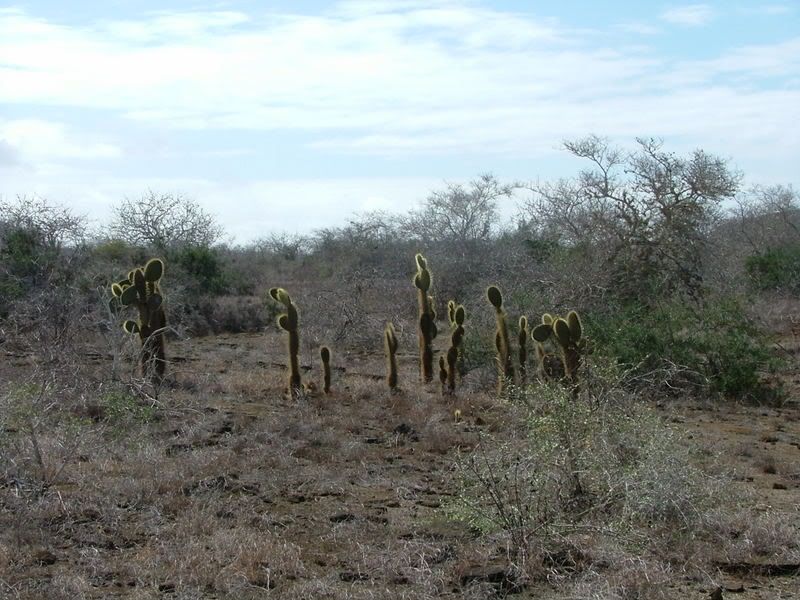
I did it to a lesser extent about two months ago, but we’re gonna try for another Endangered Ugly Ecosystem. This one is volcanic, reptilian, and arid. There’s only one problem: it’s immensely famous for being an ecological wonderland. Which it is. But it also looks much like this:
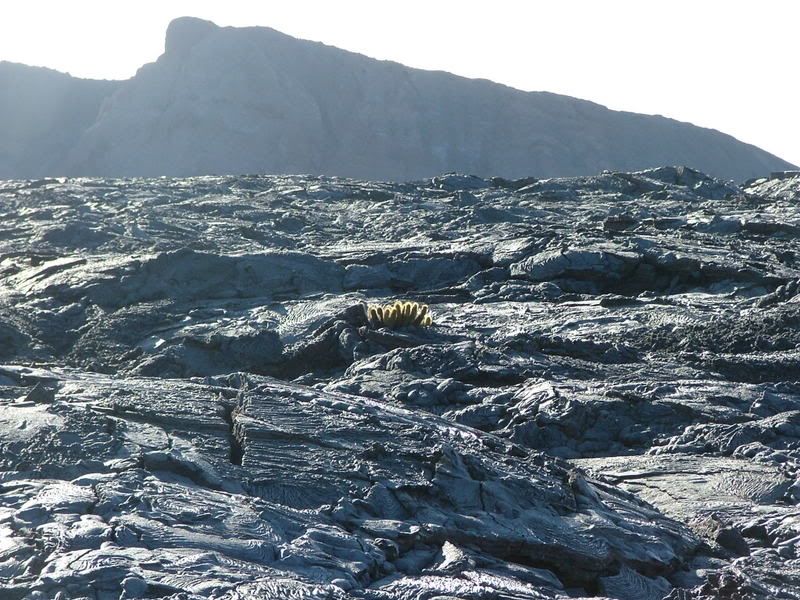

Sullivan Bay, Santiago Island--My photograph
Image by me

Welcome to the real Galápagos. Yes, the cactus in the picture is listed as vulnerable (lava cactus, Brachycereus nesioticus). The islands were formed (are forming, really) by volcanic activity, so there’s been no contact with the South American continent, some 600 miles away. This means everything that arrives there must be able to manage at least a 600 mile drift, usually on mats of vegetation blown over from wherever they came. This leads to an over-representation in reptiles, because they’re really good at managing a long time without any food or water. Birds get blown off course in the process of migrating, but they’re not ugly enough for inclusion. Mammals tend to have much too fast a metabolism to let them manage months without food, so the only (non-sea-faring; there are sea lions) mammals on the islands are the ever-present mice, which can survive practically anything. There are also bats, which probably got blown off course like the birds.

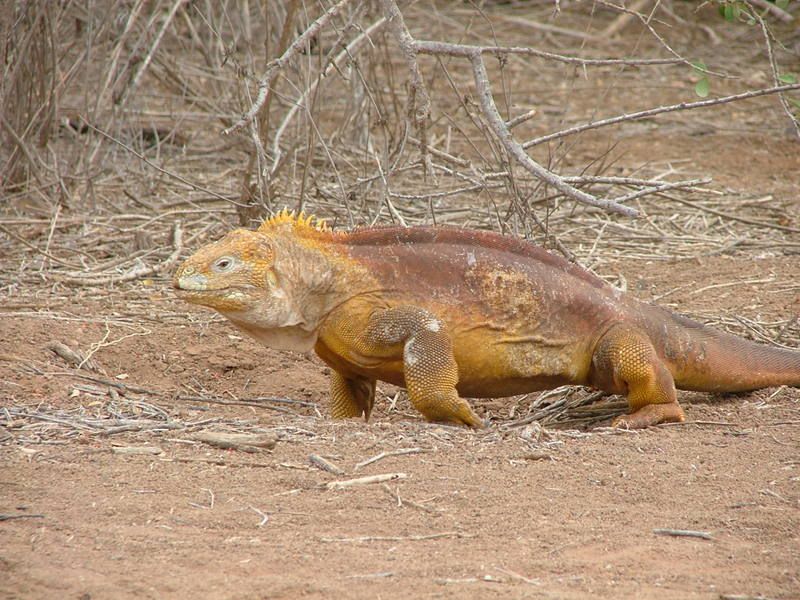
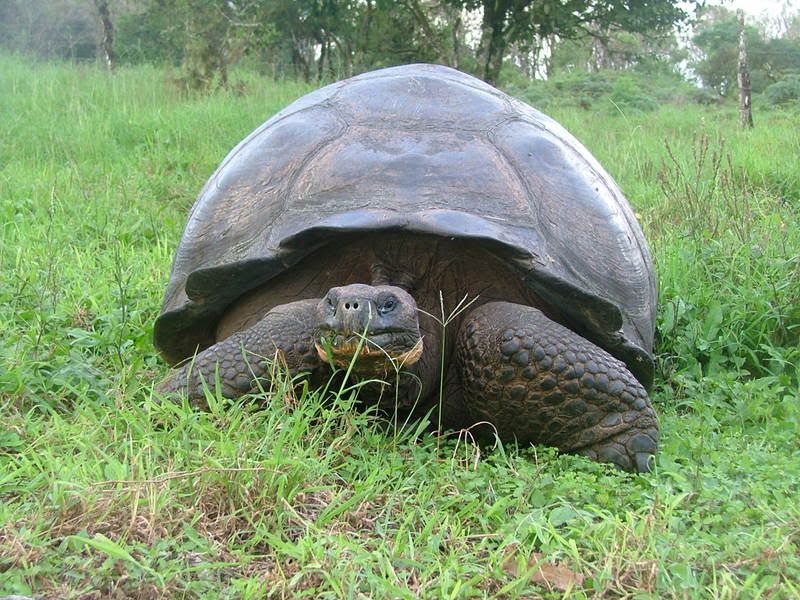
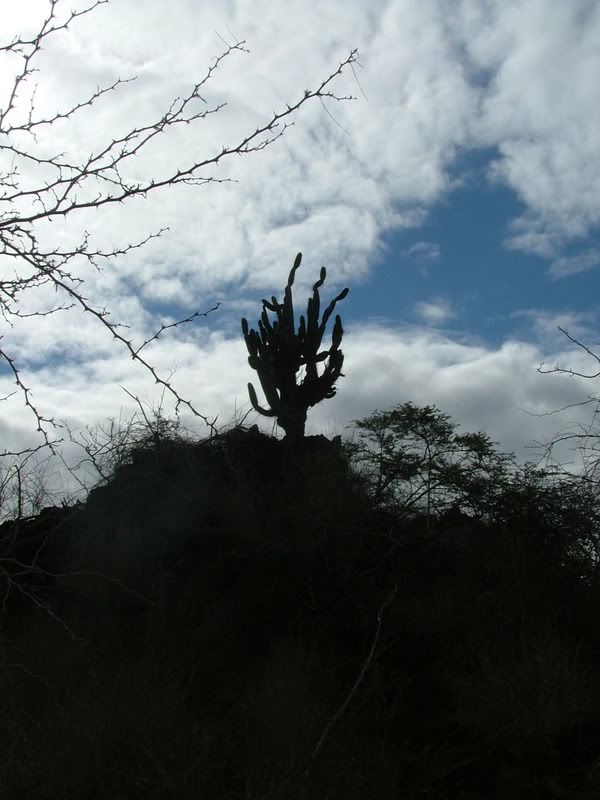
What EUTs call the Galápagos home? Well, the marine iguanas (Amblyrhynchus cristatus), and land iguanas (Conolophus subcristatus and C. pallidus) certainly fit the bill. The giant tortoises (Geochelone nigra, with many, many subspecies) may not be ugly enough, but it’s certainly plenty endangered. In my attempt to be more welcoming to all kingdoms1, there are also the cacti: the lava cactus mentioned earlier, an endemic species of prickly pear (Opuntia galapageia, also with a few subspecies), and the candelabra cactus (Jasminocereus thouarsii). There are plenty of other endangered things, but most of them are too pretty for me to talk about.

Why are they endangered? Goats, mostly. They escape farms or get released by sailors2 and then they run rampant, eating tons of vegetation, leaving none for the tortoises or land iguanas, and stepping on all the reptiles’ nests. Remember the issues the blue iguanas had with cats and rats and dogs? Well, cats and dogs and (non-endemic) rats have been introduced in the Galápagos, so the iguanas here have the exact same problem. And, since none of them are found anywhere else in the world, the animals there are starting at a disadvantage.

And to top it off, hundreds of people are flocking to the Galápagos each day, walking around, taking pictures, et cetera, et cetera. And what does this do for the islands? Funds the conservation, as one pays for entrance into the Galápagos National Park and into the Charles Darwin Research Station. The rules about what the groups are able to do, always with a trained guide, are strict enough that tourists do not adversely affect the wildlife3. What are the conservation efforts doing? There are successful breeding programs for the tortoises4 and the land iguanas at the Research Station. There is lots of work going into the goat eradication program, which at times involves people in helicopters with rifles. If any of my readers have had to deal with invasive species closer to home5, this will not seem like overkill, and it is certainly getting the job done.

Edit: I've just put up a new t-shirt design. Enjoy.

1I’m still looking for an endangered bacterium. No luck so far.
2Alright, sailors releasing them were mostly in the 1700s, but it’s taken them until recently to get rid of those.
3Stay on the trail. No touching animals. Do not take sand, shells, bones or any other item from the island. Wash your shoes between islands to prevent mixing sand. Seriously.
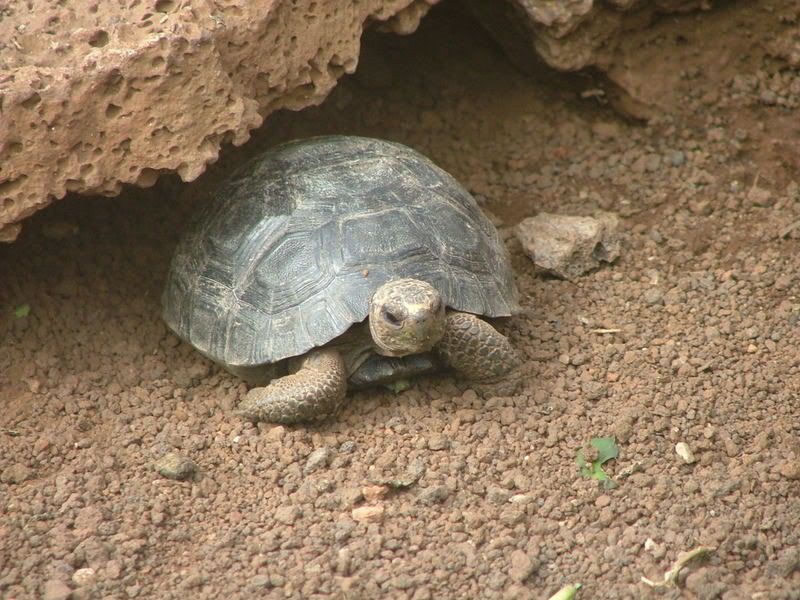
4Baby tortoises are much too cute to be discussed here. Oh well.
5For example, have wanted to take a gallon of gasoline and a match to multiflora rose.

Monday, November 27, 2006

Shake, Rattle and Roll

Well, Florabot suggested a specific EUT which fits the bill well. However, with going to the Columbus Zoo1 on Saturday and getting ready Sunday for a three-week long trip to the Galápagos Islands2, I’m a little late putting up a post about a wonderfully misunderstood animal. I don’t think it’s ugly, but I know most people can’t stand snakes.

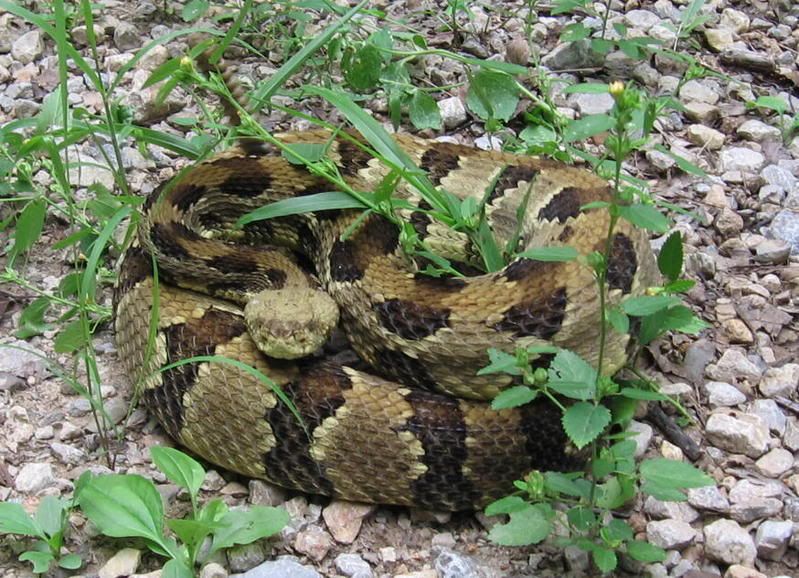
Image from Dad
Image by Dan Yaussy

The scientific name of the timber rattler (Crotalus horridus) is not as bad a moniker as I had originally thought. Crotalus refers to the rattle of the rattlesnake, and horridus, which seems to imply a terrifying animal, just refers to its raised stalking pose. Its bite is venomous, but apparently not as deadly to people as other rattlesnakes. According to a Minnesota herpetology site, the last lethal timber rattler bite in Minnesota was in the 1800’s.

Timber rattlesnakes are a middling size snake, somewhere between 3 and 4 feet long, and they have amazing camouflage for lying in wait among the leaf litter in the forests they call home. They ambush small mammals by positioning themselves conveniently in the paths the rodents run along. The females give birth (yes, birth. Not egg-laying) only every three years, and it takes her about five years to get to maturity. Even with their 20-year lifespan, that only leads to about six litters.

I’m sure no one will be surprised when I say that development, cars, and wanton killing are the leading threats to the timber rattlesnake. In fact, the wanton killing leads to an interesting example of selection at work. For the last 200 years, if a snake struck at a person, it got killed. If a snake even rattled at a person, it got killed. This leads, fairly quickly, to quiet, generally non-aggressive snakes. Which can be a problem, since they only rattle to let you know to not step on them. A friend and co-worker of my dad’s apparently walked along a line in a forest in southern Ohio multiple times, only to look down once and see a timber rattler, silently sitting right on the line.

On the site where the Ohio Department of Natural Resources asks people to help report sightings of timber rattlers, it is actively denied that the snakes are being released in Ohio. Why would a department of natural resources have to actively deny a conservation effort? The reason lies around a myth; a myth surrounding timber rattlesnake conservation that is far more exciting than any real conservation efforts would ever strive to be. According to this myth, ODNR uses black helicopters at night to drop rattlesnakes into potential habitats. That’s right, black helicopters. At night. This myth neglects to take several factors into account: A) Do you really think ODNR has the funding to buy several black helicopters? and B) If they really wanted to surreptitiously release rattlesnakes, wouldn’t three guys, a pillowcase full of snakes, and an ATV make more sense, both economically and logistically?

Oh well, myths will be myths.

1Tried to get a good timber rattler picture. Didn’t turn out as well as I had hoped.
2This is a warning to any die-hard readers (yes, both of you): I’m going to be on a small boat in the Pacific for three weeks. My parents and girlfriend might not get a phone call. Don’t expect a post.