Sunday, November 19, 2006

Where Have All the Flowers Gone?

It’s not easy being green. Each animal represented in this blog, despite its purported “ugliness,” has one distinct advantage over its endangered plant counterparts: it is an animal. This is arguably an advantage because animals tend to attract human attention and garner our sympathies in ways that plants generally do not. I think this probably stems from a natural tendency to anthropomorphize, and therefore identify with animals in ways that just don’t come as easily when considering plants. It’s rather difficult for us to imagine how a plant might “feel” or “think.”

But as Garfman has pointed out, this blog was created in the spirit of equal-opportunity representation. Finding a suitably “ugly” species for the first plant profile proved challenging for me, however. For one thing, plants are held to different standards of beauty than animals. For another, as a botanist, I felt reluctant to assign a derisive label to any species from my chosen kingdom of study. Even though I have been known to curse while clawing my way through dense, thorny undergrowth, grumble about garden weeds, and despise invasive plant infestations, the source my vexation is only contextual. I was hard-pressed to think of a plant I would call flat-out ugly, because my fascination tends to override my aesthetic sensibilities.

It was after much deliberation that I chose the plant featured as this week’s endangered ugly thing: Rafflesia arnoldii. This species (and in fact the whole genus) is highly unusual in many regards.

The genus Rafflesia is native to tropical rainforests of Southeast Asia, and all members of the genus are either threatened or endangered. At least two species are probably already extinct.

These plants are commonly known as “stinking corpse lilies.” In case the name wasn’t enough of a clue, they produce malodorous blossoms that smell like decomposing flesh or feces. The reason? Well, just as we’ve seen that beauty is in the eye of the beholder, the sort of bouquet that attracts one pollinator differs from the sort that attracts another. If you hadn’t guessed, R. arnoldii and the rest of the species in its genus are pollinated by carrion flies. To learn more about flowers that share this method of pollination, this site at Wayne’s Word is on of the most informative (and humorous) I have encountered.

The flower itself is also a sight to behold. R. arnoldii has the distinction of producing the world’s largest flower. (Amorphophallus titanum, the Titan Arum, loses this contest on a technicality, as its huge flowering structure is actually composed of many smaller flowers). R. arnoldii’s flower buds are the size of cabbage heads, and when these finally open, the blossom can be reach up to 3 feet in diameter and weigh up to 25 pounds. Looking like something reminiscent of a Mario Bros. videogame, its five sepals are leathery, usually red or orange in color, and spotted with light-colored “warts.”

Image from Southern Illinois University


Additionally, the genus Rafflesia is atypical because all of its members are endoparasitic; that is, they live entirely within another plant (in this case, plants of the genus Tetrastigma, which are related to grape vines) and lack chlorophyll necessary to produce their own food. They are without stems, roots, or leaves. In a sense, they are tapeworms of the plant world. The only time Rafflesia are visible, in fact, is when they are at their reproductive stage; otherwise they exist within the Tetrastigma host vine as threadlike strands of tissue.

So picture this: an enormous flower bursting out of a vine on the floor of a lush tropical rainforest, emitting a rotten stench which is attracting flies. Hardly compares to a sunny field of daisies or a garden of roses, does it? Therefore I feel no qualms in calling R. arnoldii an “ugly” plant. “Weirdly intriguing,” yes. Conventionally “pretty,” no. In any case, probably not something your sweetheart would be thrilled to receive on a special occasion.

According to a 1988 article published in the American Journal of Botany (full text can be found here if you have access to JSTOR), the primary threat is habitat destruction, a theme we’ve encountered over and over again. There is a twist, however, which has to do with the plants’ method of reproduction. Rafflesia plants are dioecious, a fancy term which biologists use to denote that male and female sexes occur in separate organisms. This means that the flowers of a Rafflesia plant either have male sex organs or female sex organs, but not both, as is the case with many plants. In order for fertilization (and thus successful reproduction) to occur, both male and female plants must be present and flowering at the same time. As this source lucidly explains, this situation does not always occur. Rafflesia flowers take a long time (9-10 months) to develop, and there is a high mortality rate. Once open, they last for only a brief window of time (3-5 days). With habitat fragmentation, the chance of a male and female flower being in bloom at the same time while in close proximity to each other is greatly diminished. The situation is further complicated by the fact that even when successful fertilization takes place, the resultant seeds must find their way to a host vine to propagate.

Little is known about Rafflesia because its very nature, in addition to its rarity, makes it difficult to study. As I see it, however, the source of hope for saving these plants is that because of their uniqueness they have managed to draw much interest from both the scientific and lay communities. Efforts have been made to protect them, but as long as the rainforest habitat they occupy continues to disappear, so will they.
Sunday, November 12, 2006

The Devil Went Down to Sussex

The name of this blog is Endangered Ugly Things. No specific mention of animals. So today, in the interest of fairness, I’m adding a fungus to the annals of EUT. Though, when I looked at the US Endangered Species List, there aren’t any fungi listed. The United Kingdom, however, has a ton(ne), or rather twenty-eight fungus species of concern. So, for all you mycologists crying out for your part in the EUT, here you go. Then go put some fungi on the US list; I’m sure there are some endangered ones out there.

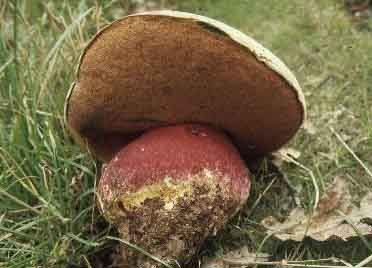
Image from UK Biodiversity Action Plan

The Devil’s Bolete, or Satan’s Mushroom (Boletus satanas1) is a poisonous fungus found in southern England, and has been extirpated (probably2) from Northern Ireland. It forms a symbiotic relationship (ectomycorrhizal, but I had to look up what that meant) with broad-leafed trees, such as birch, oak, and sweet chestnut. The fungus gains a carbon source, and the tree gains increased nutrient intake.

In terms of looks, it’s a short, stocky, with a light colo(u)red cap and reddish yellowish stem. The devilish part comes from its smell. The Northern Ireland site claims that “the taste is unpleasant…” There’s only one issue I’ve got with this statement. It’s poisonous, so “unpleasant” might be putting it lightly. In fact, the most recent record of Satan’s Mushroom in Ireland is due to a poisoning incident.

The major cause of endangerment is deforestation, limiting the number of broad-leafed symbiotes to go around for the Devil’s Bolete. Also, a 1987 hurricane, which resulted in even fewer trees, didn’t help. There doesn’t seem to be any specific program(me) in place to save this devilish fungus. On the bright side, they’ve got a list for fungus. C’mon US, there have to be some American fungi that need our help.

Next week, stay tuned for another non-animal post, because Florabot, my summer roommate who suggested the whole thing (EUT), will teach us about an Endangered Ugly Plant. If there are any botanists out there complaining about underrepresentaion of plants on this blog, consider this my affirmative action.

1Sound like a good heavy metal album name? These guys thought so.
2Fungi have this terrible habit of disappearing from view and existing solely as hyphae underground. That, and they aren’t exactly conspicuous. Which might be why there aren’t any on the US list.

Sunday, November 05, 2006

Like a Sturgeon

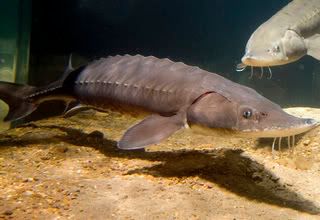
Last week, I showed my blog to my cousin, who just turned 20 (geez, we’re getting old). This was apparently a good move, since he sent me an e-mail earlier this week saying, “I think the lake sturgeon is endangered, but it’s kind of an older book.” A web search turns up threatened in New York, species of concern in Minnesota, and endangered in Ohio. And it’s plenty ugly, so good call there.

Image from Tennessee Aquarium

Think the 3-foot long lungfish with a 100-year lifespan isn’t enough? Howzabout the Lake Sturgeon (Acipenser fulvescens), right here in the Midwest, which, during its life of 150 years, can grow to 8 feet long. It has gigantic bony plates on its body, which grow smoother as it ages, because small spiky fish aren’t as digestible. The name “sturgeon” means “the stirrer” in various European languages (and, its scientific name means “reddish-yellow sturgeon” in Latin), which refers to its bottom-feeding habits. The “whiskers” (more technically barbules, which translates from Latin to… uh… whiskers) on their snout allow them to feel food items, such as crustaceans and small fish that are hiding under the substrate, which they suction up with their protruding mouth. Sound familiar?

As stated in the lungfish and tuatara posts, long life means one thing in the animal kingdom: slow to reproduce. Sturgeons take just as long to go through puberty as we do, reaching sexual maturity at 15 to 25 years of age, though they probably don’t have to worry about strange hair and cracking voices, what with being fish and all. Slow to reproduce means that this big fish is still getting over being used for meat, caviar, and isinglass (whatever that is). Pollution, damming, and the normal ol’ endangering factors still come into play.

Since this big bony fish has become protected in pretty much all of its range, the population has stabilized, even bumping it off the IUCN Redlist. It’s very much on its way to become one of those “Conservation Success Stories” like the bald eagle, but hopefully, when it’s pulled of the state endangered species lists, it gets some media attention too.

Sunday, October 29, 2006

Yellow Arachnids of Texas

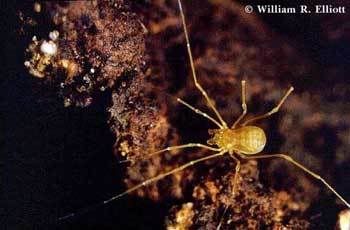
Take a look at the U.S. Endangered species list, arachnid section. Out of twelve arachnids, eleven of them fall into the form of “X Cave Y,” where X is the name of a cave, and Y is the type of arachnid. Ten of these are from two counties in Texas. Since these aren’t discussed in depth separately, we’ll talk about the whole bunch. They are, in no particular order, the Bee Creek Cave Harvestman (Texella reddelli), the Bone Cave Harvestman (Texella reyesi), Robber Baron Cave Harvestman (Texella cokendolpheri), the Braken Bat Cave Meshweaver (Cicurina venii), the Government Canyon Bat Cave Meshweaver (Cicurina vespera), the Madla's Cave Meshweaver (Cicurina madla), the Robber Baron Cave Meshweaver, (Cicurina baronia), the Tooth Cave Pseudoscorpion (Tartarocreagris texana), the Government Canyon Bat Cave Spider (Neoleptoneta microps), and the Tooth Cave Spider (Leptoneta myopica). For your viewing pleasure today, we have the Bone Cave Harvestman, simply because it has a cool name (and if any Metalheads reading this are at a loss for a band or album name, you’re welcome).

Image from City of Austin

Each of the arachnids is predatory, feeding on smaller cave-dwelling invertebrates. They are eyeless, and paler than its superterranian counterpart, often becoming orangish or yellowish. Otherwise, the spiders (meshweavers included) are similar to the everyday house spiders, and the same goes with the harvestmen, though I had to look them up to find that harvestman was another name for daddy longlegs. Pseudoscorpions, which I’m not sure how many people are familiar with them (I’m not), look much like, well, scorpions, just tailless, with small venom glands in their claws.

What is this cave habitat that contains all these endangered species, and why are there so many endangered arachnids in such a small area (relatively, we’re talking about Texas here)? The Texas karst is a limestone area that, due to the erosion of softer rocks, has formed extensive cave systems. Since they have formed (and continue to do so, they won’t stop for us) by water flow, anything dumped on the surface goes right through to all of those places where eyes are luxury items. While pollution is certainly a problem, the major issue is development encroachment, which has the possibility of destroying the area around caves or the caves themselves, or changing the temperature of the cave, which has been constant since, oh, the last ice age. Invasive plants can bring in red fire ants, which compete with the arachnids for food and sometimes prey on them.

There’s another reason for the density of endangered cave arachnids: the density of spelunking entomologists. Like it or not, much of the information about endangered species comes from a few people looking for specific species. Since they know exactly what they’re looking for, they can determine that these species are endangered, and go through the rigmarole of getting them listed. There are tons of endangered species running all over the place, but since no one’s described them, or looked closely enough at them, they go unnoticed.

Sunday, October 22, 2006

Oh, Caecilian, You're Breaking my Heart

Within amphibians, there are the frogs and toads (order Anura; it means tailless), which can be considered too cute to include on this blog and there are the salamanders and newts (order Caudata or Urodela, both meaning with a tail), which I’ve already posted about one1. There is a third order of amphibians, of which most people have not heardof. The scientific name for the order is either Gymnophiona (naked snake) or Apoda (footless), both of which are stunning endorsements for the inclusion of a caecilian on this blog.

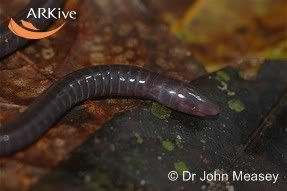
Image from ARKive
Image by John Measey

The Sagala Caecilian (Boulengerula niedeni) is a species that was first described in 2005. Its name comes from the hill it inhabits (Sagala Hill in southern Kenya). Since they’re such a newly discovered species, there’s a lot that still isn’t known about them, but scientists are pretty sure that their range is about 30 sq. km, which is smaller than Manhattan Island. Right there, with that small of a range, they become listed as Critically Endangered. Along with its already minimal range, large-scale farming disrupts streamside habitats, where they make their home, and introduces pollutants.

I’m having problems finding specifics about the Sagala caecilian, such as what it eats (probably small invertebrates) and specific reproductive history, though caecilians are the only order of amphibians that perform internal fertilization. In fact, the discerning feature of this amphibian, used to describe it as a new species, is its oddly shaped phallus.

On a different note, I have received my Official EUTshirt, and I am pleased with the quality. The concept of a cute lamprey stuck with me since I wrote about it. I asked friends and family if the idea of a line of cute Endangered Ugly Things t-shirts went against everything EUT stood for, and they said, “Maybe.” Well, they’re up and buyable anyway. Enjoy, and I’m up for any suggestions of other EUTs, since I’m having slight problems finding good ones.

1Possibly more to come, ‘cause if you thought the hellbender was big and ugly, there are some bigger, uglier ones out there.

Saturday, October 14, 2006

I Only Have Ears For You

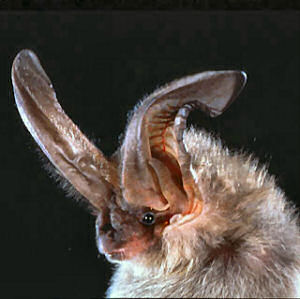
I promised myself I wouldn’t post a mammal unless it was certainly ugly. I have come to the realization that, y’know, I’m a pretty bad judge of ugly. Bats with noses like satellite dishes are just par for the course. So, here’s a bat with ears about half as long as its entire body and facial glands on either side of its nose.

Image from Bat Conservation International

Those glands on the Virginia Big-Eared Bat (Corynorhinus townsendii virginianus) probably emit pheromones. Nothing quite like natural perfume sacs right next to your nose (it’s amazingly difficult to definitely determine this sort of thing). Like many other bats, they are nocturnal insectivores, feeding mostly on moths. Unlike most bats, they’re late sleepers1, as they leave the cave about an hour after dark instead of an hour before. Since they fly fairly slowly, they’ve got their share of predators, including barn owls, and the less native feral housecat.

Big-eared bats mate in the fall and early winter. Since bats in temperate habitats tend to hibernate all winter, this might not seem like a good idea. But fear not, dear reader, for the female big-ear has a trick up her… sleeve. She is able to keep the sperm through the winter, ovulate in the spring, and have the baby (well, pup, actually) in early summer, when all the juiciest moths are out and getting in people’s campsites.

Not only are the big-ears late sleepers, they're also light sleepers in the winter. When the bats are hibernating, disturbances cause them to wake up, shift around, and lose valuable energy for managing their way through the winter2. Thus, spelunking and other caving activities are potentially dangerous to these bats. Intrusions during other times of the year can directly affect young, or drive the bats to look for a new home.

To keep these occurrences at a minimum, gates or fences have been placed around the colonies by concerned government employees. Studies on big-ears’ favorite roosting places are being conducted to see what else we can do to study them. And, on the political front, in 2005, the Virginia Big-Eared Bat was chosen to honorably represent the Commonwealth of Virginia as the Official State Bat.

1Like many college students.
2Also like many college students.

Sunday, October 08, 2006

Lady Madonna - The Beatles

As beetles go, the American Burying Beetle (Nicrophorus americanus) isn’t terribly ugly (this may be due to its nice black and reddish orange pattern on its back). It is a little big (about an inch). On the other hand, invertebrates need a bit more screen time on this blog, and when you’re competing with pandas and tigers, anything with more than twice as many legs as eyes fits into the ugly category.
Image from University of Nebraska State Museum
There’s another thing going for this nocturnal beetle’s inclusion here. People really don’t like carrion eaters, despite their impressive ability to smell a dead body from two miles away within an hour of death. Of course, their habit for eating dead things is helpful for returning nutrients to the soil, and they even have orange mites living on them, which keep the beetle and the carcasses free of many microbes and fly eggs (nothing like a clean corpse).

The impressive part about this beetle is its childcare policy. While most insects tend to drop their eggs and either leave or die, burying beetles are almost… vertebrate in their parental care. After one finds a suitable dead thing, a dove or chipmunk, for example, it will send out a huge amount of pheromones into the air. When a potential mate shows up, the two work together to move the carcass to an acceptable location, and, once there, live up to their name. Once the body is under a few inches of soil, they strip off the skin and some appendages, and generally form the body into a flesh ball, applying excretions that stop fungal growth. The pair then mate, lay 10 to 30 eggs in an adjacent tunnel, and wait for them to hatch. Once the larvae have hatched, the adults will help them out by regurgitation feeding, a la birds, or by moving the young to particularly choice pieces of carcass.

The American burying beetle has a cause for endangerment I haven’t talked about yet: habitat fragmentation, which reduces available prey items, and increases competing scavengers, like raccoons and crows. It also separates the populations, resulting in minimized gene flow. Pesticides and light pollution (remember, they’re nocturnal) don’t help, so now the beetle exists only in isolated pockets, a shadow of its former range.

One does not normally think of breeding programs and reintroduction of insects, but they exist for the burrowing beetle. More than 200 beetles have been reintroduced into Southern Ohio since 1998, and Massachusetts has had a head-start program to bolster their burying beetle population since 1994. Many other states are doing their part to help bring this little necrophage back from the brink.