Saturday, October 14, 2006

I Only Have Ears For You

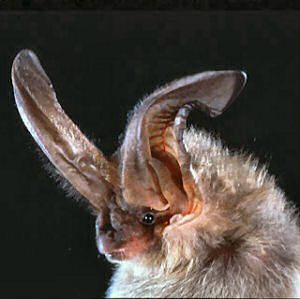
I promised myself I wouldn’t post a mammal unless it was certainly ugly. I have come to the realization that, y’know, I’m a pretty bad judge of ugly. Bats with noses like satellite dishes are just par for the course. So, here’s a bat with ears about half as long as its entire body and facial glands on either side of its nose.

Image from Bat Conservation International

Those glands on the Virginia Big-Eared Bat (Corynorhinus townsendii virginianus) probably emit pheromones. Nothing quite like natural perfume sacs right next to your nose (it’s amazingly difficult to definitely determine this sort of thing). Like many other bats, they are nocturnal insectivores, feeding mostly on moths. Unlike most bats, they’re late sleepers1, as they leave the cave about an hour after dark instead of an hour before. Since they fly fairly slowly, they’ve got their share of predators, including barn owls, and the less native feral housecat.

Big-eared bats mate in the fall and early winter. Since bats in temperate habitats tend to hibernate all winter, this might not seem like a good idea. But fear not, dear reader, for the female big-ear has a trick up her… sleeve. She is able to keep the sperm through the winter, ovulate in the spring, and have the baby (well, pup, actually) in early summer, when all the juiciest moths are out and getting in people’s campsites.

Not only are the big-ears late sleepers, they're also light sleepers in the winter. When the bats are hibernating, disturbances cause them to wake up, shift around, and lose valuable energy for managing their way through the winter2. Thus, spelunking and other caving activities are potentially dangerous to these bats. Intrusions during other times of the year can directly affect young, or drive the bats to look for a new home.

To keep these occurrences at a minimum, gates or fences have been placed around the colonies by concerned government employees. Studies on big-ears’ favorite roosting places are being conducted to see what else we can do to study them. And, on the political front, in 2005, the Virginia Big-Eared Bat was chosen to honorably represent the Commonwealth of Virginia as the Official State Bat.

1Like many college students.
2Also like many college students.

Sunday, October 08, 2006

Lady Madonna - The Beatles

As beetles go, the American Burying Beetle (Nicrophorus americanus) isn’t terribly ugly (this may be due to its nice black and reddish orange pattern on its back). It is a little big (about an inch). On the other hand, invertebrates need a bit more screen time on this blog, and when you’re competing with pandas and tigers, anything with more than twice as many legs as eyes fits into the ugly category.
Image from University of Nebraska State Museum
There’s another thing going for this nocturnal beetle’s inclusion here. People really don’t like carrion eaters, despite their impressive ability to smell a dead body from two miles away within an hour of death. Of course, their habit for eating dead things is helpful for returning nutrients to the soil, and they even have orange mites living on them, which keep the beetle and the carcasses free of many microbes and fly eggs (nothing like a clean corpse).

The impressive part about this beetle is its childcare policy. While most insects tend to drop their eggs and either leave or die, burying beetles are almost… vertebrate in their parental care. After one finds a suitable dead thing, a dove or chipmunk, for example, it will send out a huge amount of pheromones into the air. When a potential mate shows up, the two work together to move the carcass to an acceptable location, and, once there, live up to their name. Once the body is under a few inches of soil, they strip off the skin and some appendages, and generally form the body into a flesh ball, applying excretions that stop fungal growth. The pair then mate, lay 10 to 30 eggs in an adjacent tunnel, and wait for them to hatch. Once the larvae have hatched, the adults will help them out by regurgitation feeding, a la birds, or by moving the young to particularly choice pieces of carcass.

The American burying beetle has a cause for endangerment I haven’t talked about yet: habitat fragmentation, which reduces available prey items, and increases competing scavengers, like raccoons and crows. It also separates the populations, resulting in minimized gene flow. Pesticides and light pollution (remember, they’re nocturnal) don’t help, so now the beetle exists only in isolated pockets, a shadow of its former range.

One does not normally think of breeding programs and reintroduction of insects, but they exist for the burrowing beetle. More than 200 beetles have been reintroduced into Southern Ohio since 1998, and Massachusetts has had a head-start program to bolster their burying beetle population since 1994. Many other states are doing their part to help bring this little necrophage back from the brink.

Saturday, September 30, 2006

It Sucks to be Me

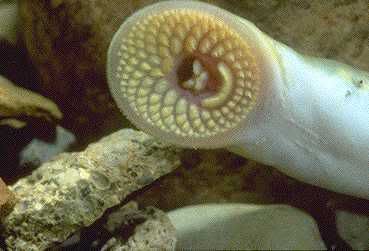
Blood-sucking. Slimy. Limbless. A face like an orbital sander mated with a shark. A species in concern in about 10 states. Sounds like we’ve got a candidate ripe for the honor of Endangered Ugly Thing, and EUT's new mascot. Meet the Ohio lamprey (Ichthyomyzon bdellium).

Image from Ohio DNR
Image from Ohio Department of Natural Resources

The Ohio lamprey is a 2 foot long, eel-looking fish, which is native to streams and rivers in the eastern Midwest (or western East) states. In their two years as adults they parasitize fish by sucking onto other fish with its gaping maw (also known as an oral disc; lamprey don’t have jaws), where it proceeds to suck the host’s blood1.

Before the parasitic adult stage, baby lamprey (now isn’t that an adorable mental image?) spend four years buried in the riffles of small streams with their head poking out, filter feeding on algae and plankton. After this time, they develop eyes and an oral disc, make their way to a larger river, and find a suitable host. I’m not sure if how frequently they switch hosts, and it’s possible that the scientists don’t know either. After their first year, the lamprey disengage themselves from their hosts, and make their way back to the river that spawned them. Here, they will build a nest, often with the cooperation of other spawning lamprey, lay their eggs in the gravel, and die.

Quick quiz! What have all the aquatic vertebrates I’ve written about had a problem with?
Time’s up! If you guessed “Dams,” you’re correct! With the lamprey, dams stop them from being able to move to their feeding grounds as adults. The entrance of more silt in the streams, usually from runoff, gives the juveniles problems with filter feeding.

There are people working on fixing these problems, through land conservation and habitat monitoring. Determining good solutions for lamprey preservation requires that we learn a lot more about them. Sampling is hard due to their habits of being either buried in a stream or a fish for five-sixths of their life. Getting people interested in them is the first step toward saving them, so I’m trying to do my part.

1Can anybody think of a parasitic vertebrate that isn’t a lamprey? I know of the male anglerfish, but that hardly counts.

Saturday, September 23, 2006

Gonna Be a Blue Collar Lizard

I personally don’t think the Grand Cayman blue iguana (Cyclura lewisi) is ugly, but reptiles are usually given a bit of a short straw in terms of caring about their conservation. What they lack in ugliness (which is a bad thing?) they certainly make up for in being so endangered, with a long-term goal to get up to 1000 individuals, including those in captivity. They represent the last Endangered Ugly Thing that I’ve actually dealt with.

Image by me
Endemic to a small Caribbean island that’s roughly 20 miles across, the blue iguana makes its living as the largest native land vertebrate on the incredibly sharp coral rocks that make up Grand Cayman. They somewhat fit the elephant’s niche as the large (they get up to maybe 5 feet long) herbivore, with no predators as adults, though the young are preyed upon by snakes native to the area.

They live up to their name well, though they are the bluest when they are either very angry or trying to impress a female. They differ from green iguanas, which are an invasive species in the Caymans, in a variety of ways, such as the shields on the green iguanas’ cheeks, or the thicker tail on the blue iguana.

The reason why blue iguanas are so endangered is, like the tuatara, after a few million years of isolation with minimal predators, human interactive has brought rats and cats, which go after the eggs and young, and dogs, which will attack the adults. This brought their population down far enough to earn them the distinction of the world’s most endangered iguana.

They are not without their champion, however, as the Blue Iguana Recovery Program has come into existence to help save the iguanas from the edge of extinction. Captive breeding programs at the Queen Elizabeth II Botanical Park have managed to hatch more than 80 baby iguanas the last few years. Female iguanas, when they are ready to lay their eggs, will dig a burrow. However, to the dismay of the conservationists who wish to incubate the eggs in a controlled environment, the female’s burrows are labyrinthine, with many dead ends, where only one will contain any eggs. After the eggs hatch, the young are kept at the botanical park until they are two years old, big enough to deter any rats and cats. These are released into a reserve on the sparsely populated eastern end of the island.

The news that I am very happy to impart upon you, the reader, is that these released iguanas spent the last weeks of this past June mating. This July, the females were busy laying eggs around the reserve. The past few weeks, the first of the hatchlings have begun to emerge from their burrows. These hatchlings represent the first generation of wild hatched iguanas in the reserve, untagged and free.

Saturday, September 16, 2006

I Wish They All Could be California Arthropods

This one falls into the category of ugly things that I came across while randomly looking through The List. I'm going to keep on the lookout for any others, but I'm running low on EUTs that I've heard of. If anyone has any suggestions, start sending 'em in.
Image by Aviva Rossi
Looking somewhat like a cross between a horseshoe crab and a shield bug, the vernal pool tadpole shrimp (Lepidurus packardi) gets the distinction of being the first invertebrate on Endangered Ugly Things. It will not be the last, as the diversity of invertebrates is staggering, and, with the exception of butterflies, they're pretty much all considered ugly.

Distantly related to triops and sea monkeys (actually brine shrimp), which you can buy at any decent science shop, the tadpole shrimp share their ability to breathe through their 35 or so phyllopoda (leaf-feet) which also act as paddles. They grow up to a whopping 2 inches in length, eat organic matter smaller than them, and get eaten by everything that normally eats benthic macroinvertebrates: other invertebrates, amphibians, fish, and some birds.

The vernal pool tadpole shrimp hangs its small, strangely shaped hat in ephemeral pools in the San Fransisco bay area that dry out every summer. It survives these dry spells by laying drought-resistant eggs, which will hatch once the pools fill up again.

There are no big surprises with why these are endangered. Habitat destruction is always a problem when your habitat is a big wet spot, and someone says, "Hey, this looks like the perfect place for a shopping mall." Suddenly, your big wet spot is under a ton and a half of concrete. Agricultural and urban runoff, overgrazing, and invasive plants are also having an effect on the tadpole shrimp. Hope exists for them in the form of programs to save wetlands, which are being put into effect all over the United States.

Saturday, September 09, 2006

Third Eye Blind(ish)

The Tuatara (Sphenodon punctatus) is a reptile that is also grouped into the "living fossil" category (see footnote on the lungfish). They belong to order Rhynchocephalia, which has existed worldwide about 220 million years ago, and the tuataras themselves look about the same as they did 140 million years ago. They aren't exactly worldwide anymore, as they are confined to New Zealand, and being an island species is never good news in terms of population.
Image from Wellington Zoo


While superficially resembling lizards, there are various characteristics separating the two groups, such as lack of external ears, another set of teeth, and a developed pineal eye1. This "third eye" may help in temperature regulation, circadian regulation, Vitamin D absorption, or something completely different.

Tuataras are nocturnal and able to function at much lower temperatures than most reptiles. They have long lifespans, taking 20 years to reach maturity and living up to 100 years. Like many predators, they subscribe to the idea, "Is it animal matter, smaller than my head, and easy to catch? Then it's food." Hunting by ambush, they will eat insects, lizards, eggs, and seabird chicks.

The endangerment of the tuatara starts out fairly textbook. After millions of years isolated on islands, humans interfere and begin habitat destruction, removing them from the New Zealand mainland. Europeans bring rats, which eat the eggs and the young. However, there is a newer problem facing the tuatara. Like many reptiles, incubation temperature determines the sex of the offspring. Too warm (above 71.6 degrees Fahrenheit for the tuatara) and the nest is all males, too cold (under 69.8 degrees) and the nest is all females. What happens when global warming comes into play? One female can only parent one litter at a time (and four years apart), so this hurts the population much more than if fewer males were being hatched.

There is hope for our spiny little friends. Breeding and release programs are working on bringing the tuatara back to the New Zealand mainland, with the help of rat-proof fencing. Various studies are being conducted to determine the extent of global warming's effect.

1Though not near as developed as this guy's, who I came across while searching for images.

Saturday, September 02, 2006

Like a Salamander Outta Hell

There has to be a story behind the eastern hellbender's name. It sounds like Dante on a drug trip, a motorcycle gang, or a punk metal band1 (the Ozark Hellbenders would perform cover songs heavily involving banjos). If anyone has the actual etymology behind the name, I'd be glad to hear it.

Image from Ohio Department of Natural Resources
Despite having an ugly sounding name, the eastern hellbender, Cryptobranchus alleganiensis, is, in fact, not pretty. As an adult, they can achieve lengths of 11 to 20 inches. Folds of skin hang from their sides, through which they breathe. The hellbenders have lungs, but those are used only for buoyancy. Their heads are flat, with tiny, beady eyes. Their habitat exists under rocks and debris in clear, fast-moving streams.

These giant salamanders hunt crayfish, small fish, and large insects, searching mainly using lateral lines and then sucking in prey, a method not shared by any other adult salamander. Also seperating them from other salamanders is the fact that the hellbender practices external fertilization, where the female will drop the eggs and then allow the male to fertilize them. After this, the male will guard the eggs for two to three months until they hatch.

Hellbenders are endangered in Ohio, Maryland, Illinois, and Indiana, threatened in Alabama, and a species of concern in New York. Pollution is a major problem facing eastern hellbenders, and for that matter, many amphibians. This is due to their ability to breathe through their skin. Any chemical with a higher concentration in the water than their body is drawn in, be it oxygen, nitrogen, or agricultural runoff. Damming rivers cause silt to clog the hellbender's nesting site (remember the lungfish?). The bad rap that the hellbender gets also doesn't help, as there are many legends of the salamanders sliming fishers' nets or poisoning river water. Photos of herpetologists, gloveless, holding it, might help dispel these myths. So if you happen to be creeking in the eastern Midwest (or western East), and see a gigantic salamander, consider yourself lucky to be in the presence of the largest salamander around.

1They are a band! That's what I get for looking too far on the internet for hellbender research. Though, they look more indie than punk metal.